Culinary Explorer
A cooking platform built around craft, culture, and the stories behind what we eat.
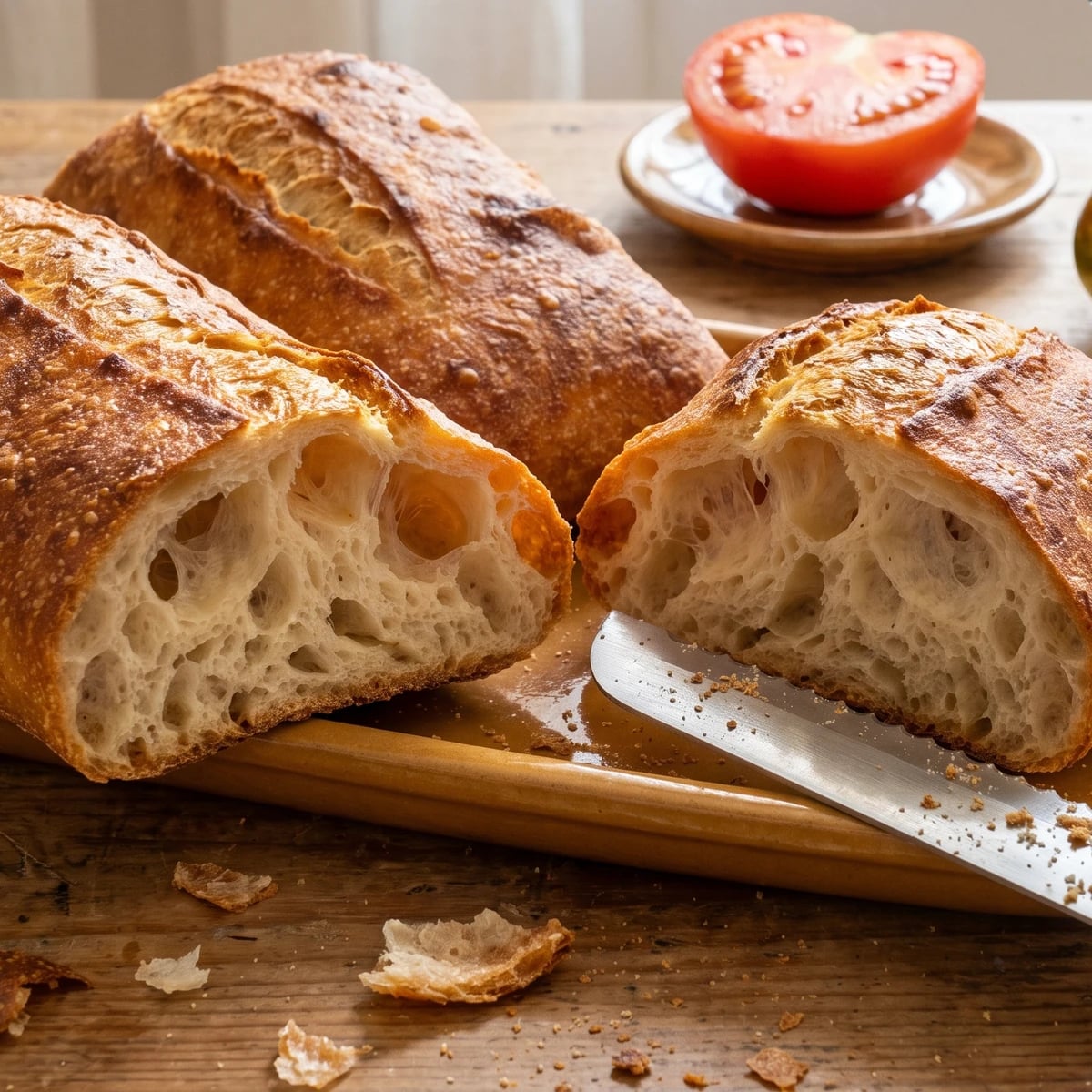
Pan de Cristal Catalan (Pa de Vidre)
Created by Chef Isabel
Catalonia's pan de cristal is all thin amber crust and a web of large holes. The dough carries as much water as flour, and gentle folds make it strong enough for pa amb tomàquet.
Pan de cristal, pa de vidre in Catalan, belongs to Catalonia and especially Barcelona: a lean rectangular loaf with a paper-thin amber crust and an airy crumb whose walls look almost translucent. Its proper place at the table is split and toasted for pa amb tomàquet, bread rubbed with ripe tomato and dressed with olive oil and salt. What makes this loaf itself is the water. The dough carries the same weight of water as flour.
At that hydration, the mixture begins closer to a batter than any sensible-looking bread dough. Don't rescue it with extra flour. Four sets of coil folds organize the gluten into a strong net, then gentle handling preserves the bubbles that net has caught. Build the strength first and leave the air alone afterward. That's the method that decides the loaf.
Use harina de fuerza, strong white bread flour with 13% to 14% protein. Far from Catalonia, the strongest supermarket bread flour is the right substitute. If yours has only 11.5% to 12% protein, use 460g water rather than 500g; the crumb will be a little closer and less translucent, but the loaf won't collapse. My Margin says only this: don't shape what took hours to inflate. Pésalo, no lo adivines, weigh it, don't guess. Siempre sale, si lo sigues.
Ingredients
strong white bread flour
Quantity
500g
13% to 14% protein
strong white bread flour
Quantity
30g
for dusting; not all may be needed
water
Quantity
500g
cool, 20 to 22°C; divided into 450g and 50g
| Ingredient | Quantity |
|---|---|
| strong white bread flour13% to 14% protein | 500g |
| strong white bread flourfor dusting; not all may be needed | 30g |
| watercool, 20 to 22°C; divided into 450g and 50g | 500g |
Where cooking meets culture.
Culinary guides, cultural storytelling, and the editorial depth that makes cooking meaningful.
Discover Culinary Explorer