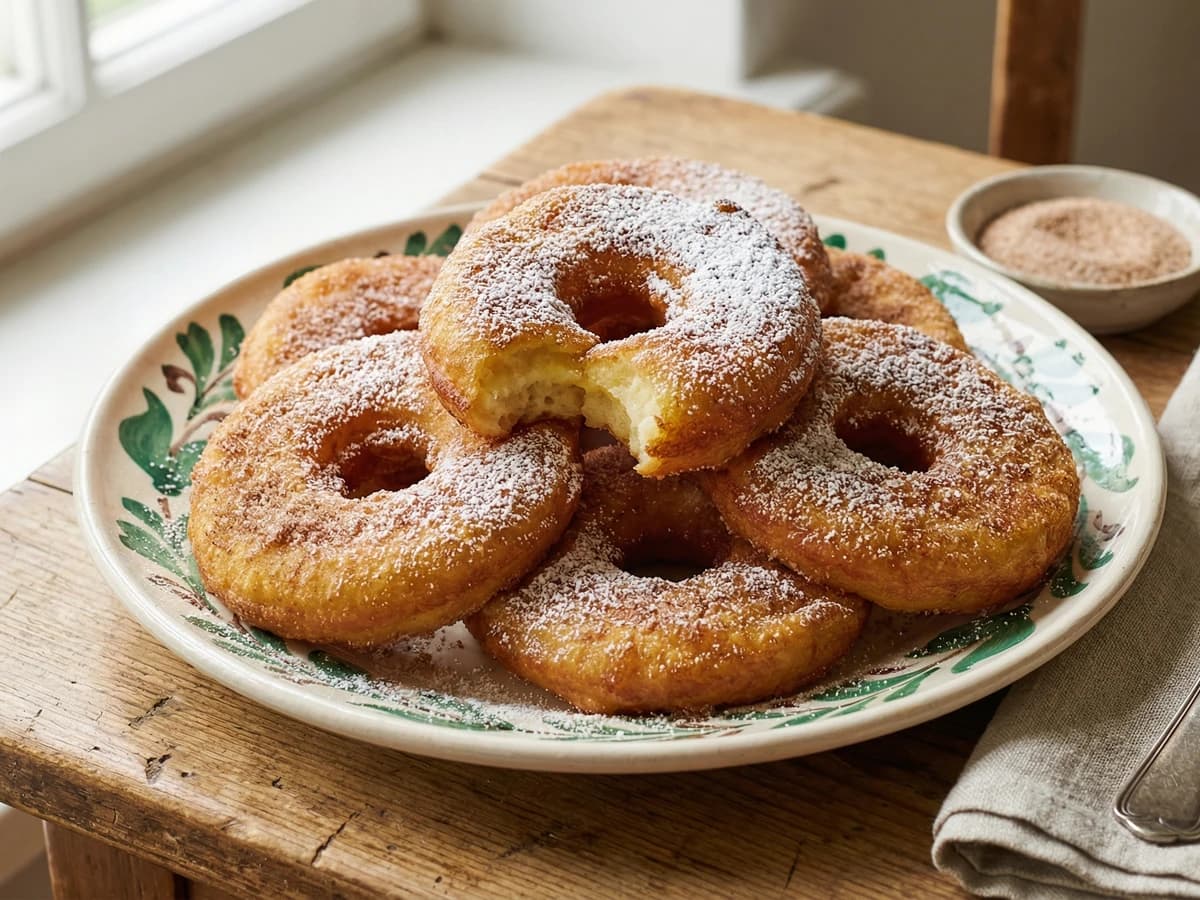
Hand-stretched strudel dough rolled around a warm walnut filling with cinnamon, lemon zest, and rum-soaked raisins. The smell of an Austrian Christmas kitchen in every slice.
Pastries & Cookies
Austrian
Christmas
Holiday
1 hr
Active Time
35 min cook•1 hr 35 min total
Yield8 servings
Every December in my grandmother Eva's kitchen in Kent, the walnut strudel came out before the Advent candles were lit. Gretel would grind the walnuts by hand in a small rotary mill clamped to the counter, and the whole house smelled like Christmas before a single ornament went up. The filling was warm milk poured over ground walnuts, cinnamon, lemon zest, and raisins that had been soaking in dark rum since the night before. It was the simplest thing. It was always the first to disappear.
Nussstrudel is the strudel Austrians bake when the days get short and the kitchens stay warm. Where Apfelstrudel belongs to every season, Nussstrudel belongs to winter. The walnuts give it a richness and depth that sits perfectly with a cup of strong coffee on a cold afternoon, a heaviness in the best possible sense, the kind that makes you slow down and sit a little longer. The dough is the same hand-stretched strudel dough you'd use for Apfelstrudel or Topfenstrudel: flour, water, oil, a splash of vinegar, rested and pulled thin across a floured cloth until you can see through it. The filling goes on thick and fragrant, gets rolled up inside those translucent layers, and bakes until the pastry shatters at the first cut.
I put this on my restaurant's Christmas menu in Salzburg every year without exception. Guests who've never tried it sometimes expect something like baklava, because they see walnuts and think of Middle Eastern pastry. It's not that. The filling is softer, milkier, scented with cinnamon and rum rather than honey and rosewater. It is its own thing entirely, shaped by centuries of Austrian baking, and it fills the whole house with a warmth that has nothing to do with the oven temperature.
Nut-filled strudels and rolled pastries appear across the former Habsburg lands, from the Hungarian beigli to the Bohemian ořechový závin, each culture shaping its own version from shared roots. In Austria, Nussstrudel became firmly tied to Advent and Christmas baking, when walnuts from the autumn harvest were cracked, ground, and folded into holiday Mehlspeisen. The use of hand-stretched dough rather than the yeasted rolled doughs favored in Hungary marks the Austrian tradition as distinct, and this particular combination of walnuts, cinnamon, and rum-soaked raisins has appeared in Austrian Konditorei recipe collections since at least the mid-19th century.
The technique, the tradition, and the story behind every dish.
•Large clean tablecloth or cotton sheet for stretching
•Rolling pin
•Baking sheet lined with parchment paper
•Pastry brush
•Food processor or rotary nut grinder
•Serrated knife for slicing
Instructions
1
Make the strudel dough
Mound the flour on a clean work surface and make a well in the center. Add the egg, warm water, oil, vinegar, and salt. Work everything together with your hands, then knead for a good ten minutes until the dough is smooth, elastic, and slightly tacky to the touch. It should spring back when you press it with your finger. The vinegar and oil are doing important work here: they relax the gluten strands, which is what lets you stretch the dough paper-thin later without it tearing. Shape the dough into a ball, brush the surface lightly with oil, cover it with a warm bowl turned upside down, and let it rest for thirty minutes. Don't skip the rest. If the gluten hasn't relaxed, the dough will fight you at every turn.
Use griffiges Mehl if you can find it. Austrian coarse flour has less gluten than American all-purpose, which makes the dough more forgiving when you stretch it. If you're using regular plain flour, add an extra splash of oil to compensate.
2
Prepare the walnut filling
While the dough rests, warm the milk and sugar together in a small saucepan over medium heat, stirring until the sugar dissolves completely. Don't boil it. You just want the sugar to melt. Pour the warm sweetened milk over the ground walnuts in a large bowl and stir well. The mixture will drink up the milk and turn into a thick, spreadable paste. Add the Vanillezucker, cinnamon, lemon zest, and the rum-soaked raisins along with any rum they haven't absorbed. Mix everything together. The filling should be moist but hold its shape on a spoon. If it's too stiff, add a splash more milk. If it's runny, stir in a few more ground walnuts until it firms up.
Grind your own walnuts in short pulses in a food processor. You want a coarse, sandy texture, not walnut butter. Stop well before the oils release and the mixture starts clumping together. A few larger pieces are fine. They give the filling character.
3
Stretch the dough
Lay a clean cloth over your kitchen table and dust it generously with flour. Roll the rested dough out with a rolling pin into a rough rectangle, as thin as you can manage before the pin stops being useful. Then comes the part that scares people. Slide your hands under the dough, palms down, backs of your hands and knuckles facing up, and start pulling gently from the center outward. Walk around the table. Stretch a little at a time. The dough should get thin enough that you can see the pattern of the cloth through it. Gretel always said you should be able to read a newspaper through strudel dough, and she wasn't exaggerating. Small tears near the edges don't matter. Trim any thick border off with scissors. That thicker rim won't stretch the same way as the rest and it'll make the finished strudel chewy where it should shatter.
Take off rings and watches before you start stretching. One snag from a ring and you'll tear a hole straight through the center. Work slowly and let gravity help you. The dough's own weight does most of the stretching if you give it time.
4
Fill and roll the strudel
Preheat your oven to 180°C (350°F). Brush the entire surface of the stretched dough with melted butter, all the way to the edges. Sprinkle the breadcrumbs in a wide strip along the long edge closest to you, leaving about five centimeters clear on each side. The breadcrumbs absorb moisture from the walnut filling during baking so the dough underneath stays crisp instead of going soggy. Spread the walnut filling evenly over the breadcrumbs in that same strip. Fold the side borders in over the filling to seal the ends. Then use the cloth to help you roll: lift the edge of the cloth nearest you and let the dough roll forward over itself, away from you. The cloth does the work. If you try to roll it with your fingers you'll press too hard and tear right through. Don't roll too tightly. The filling needs room to expand in the oven, and a strudel wound too tight will split along the seam. Let it settle seam-side down.
5
Bake the strudel
Carefully transfer the strudel to a parchment-lined baking sheet, bending it into a gentle curve if it's longer than the tray. Brush the top generously with melted butter. Bake at 180°C for 30 to 35 minutes, until the pastry turns deep golden brown and the layers look dry and flaky. Brush with butter once more halfway through. You'll know it's ready when the whole kitchen smells like cinnamon and toasted walnuts and warm butter. That smell is half the reason people bake this at Christmas.
If the top browns too quickly before the sides catch up, lay a sheet of baking parchment loosely over the strudel for the last ten minutes. You want even color, not a pale belly with a burnt back.
6
Dust and serve
Let the strudel cool on the tray for ten minutes before cutting. If you slice it straight from the oven the filling will ooze out and you'll lose the clean spiral you worked for. Dust generously with powdered sugar, then cut into thick slices with a sharp serrated knife, using a gentle sawing motion so the pastry layers crack cleanly instead of crushing. Serve warm alongside strong coffee. Nussstrudel keeps well for two days at room temperature wrapped loosely in a clean cloth, and some Austrians will tell you it's even better the next morning with breakfast. They're not entirely wrong. Mahlzeit!
Chef Tips
•Soak your raisins in rum overnight if you can. An hour is the minimum, but the longer they sit, the plumper and more fragrant they get. Gretel always said raisins that haven't been properly soaked are just dried grapes pretending to belong in a strudel.
•Buy whole walnuts and crack them yourself if you have the patience. Pre-ground walnuts from a bag have often been sitting on a shelf long enough to go stale and bitter. Fresh walnuts have an almost sweet, milky flavor that transforms the filling completely.
•Don't panic about the dough stretching. It's more forgiving than it looks. If you get a small tear, just overlap the torn edges and move on. Once the strudel is rolled and baked, nobody will ever know.
•This strudel keeps beautifully at room temperature for two days, wrapped loosely in a clean cloth. The pastry softens just slightly, but the walnut filling actually improves as the cinnamon and rum settle in overnight.
Advance Preparation
•Soak the raisins in rum at least one hour ahead, or the night before for the best flavor.
•The strudel dough can rest for up to two hours under its warm bowl. Longer rest only makes it easier to stretch.
•The walnut filling can be made a full day ahead and refrigerated. Bring it back to room temperature before spreading, or it will be too stiff to work with on the thin dough.
•Baked Nussstrudel freezes well for up to one month. Thaw at room temperature, then warm briefly in a 150°C oven for ten minutes to crisp the pastry before serving.
Frequently Asked Questions
Nutrition Information
1 serving (about 130g)
Calories
605 calories
Total Fat
40 g
Saturated Fat
9 g
Trans Fat
0 g
Unsaturated Fat
29 g
Cholesterol
50 mg
Sodium
65 mg
Total Carbohydrates
55 g
Dietary Fiber
4 g
Sugars
23 g
Protein
11 g
Where cooking meets culture.
Culinary guides, cultural storytelling, and the editorial depth that makes cooking meaningful.