
Chef Dean
Danish Jødekager
Shatteringly crisp Danish butter cookies crowned with a cinnamon-sugar crust and toasted almond bits, baked to a deep golden edge that speaks of caramelized butter and centuries of Scandinavian tradition.
A cooking platform built around craft, culture, and the stories behind what we eat.
Created by
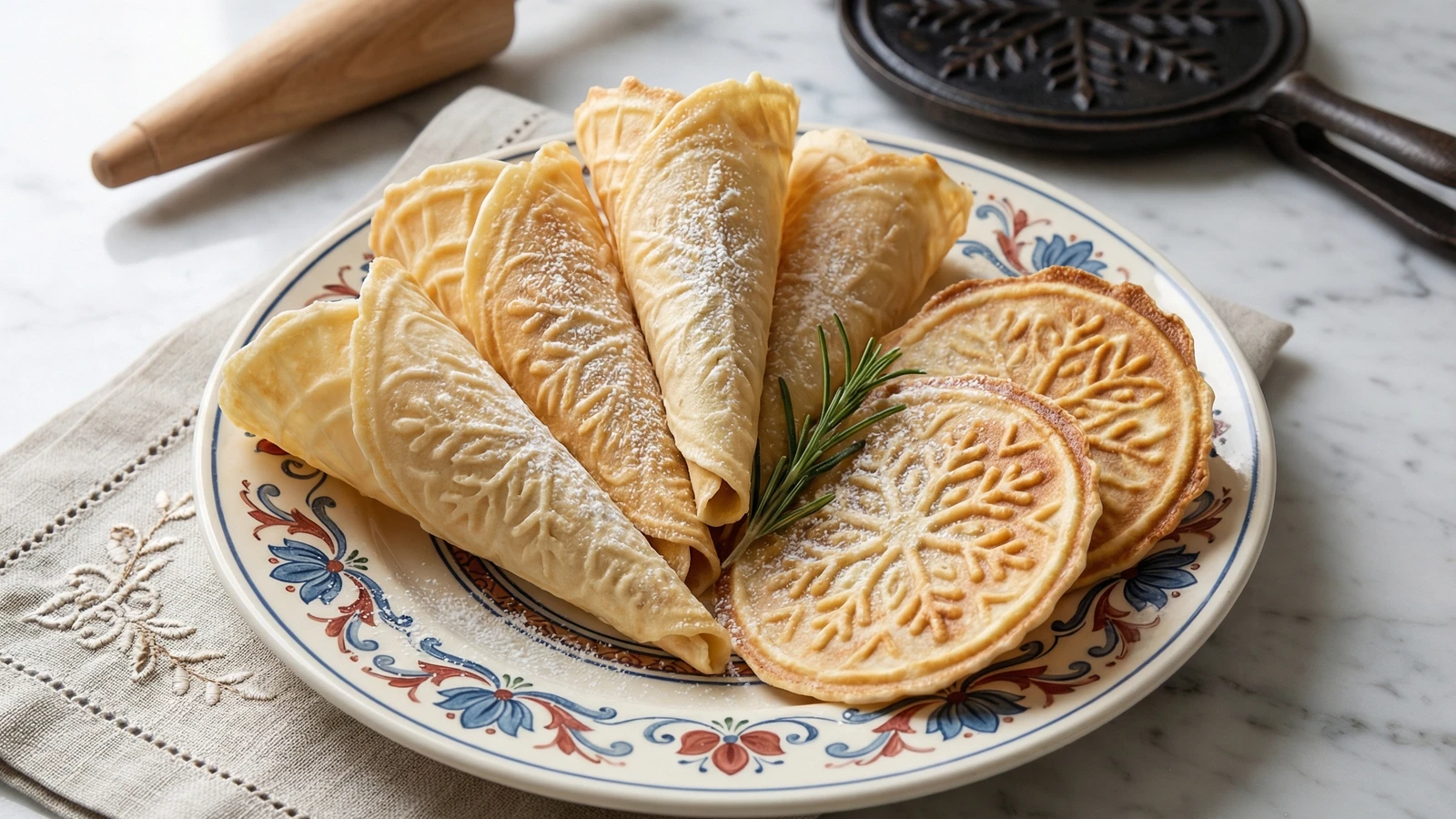
Paper-thin Scandinavian waffle cookies embossed with intricate patterns and rolled into delicate cones while still warm from the iron. The whisper of cardamom transports you to a Norwegian farmhouse kitchen where generations of women have made these same cookies every December.
Every December in Norwegian households, the krumkake iron comes down from the top shelf. It is a ritual as reliable as the first snowfall. These paper-thin cookies, pressed between decorative plates and rolled into cones while still pliable, represent centuries of Scandinavian baking tradition. The word itself tells you everything: krumkake means "curved cake," and the curve is the whole point.
Norwegian immigrants brought their krumkake irons to the Upper Midwest in the late 1800s. You'll find these cookies at church potlucks in Minnesota, at bakeries in Wisconsin, at family gatherings throughout the Dakotas. They became American without ever losing their Norwegian soul. My students from those communities speak of krumkake the way Southerners speak of biscuits: with reverence and strong opinions about whose grandmother made them best.
The technique is simple once you understand it. Thin batter, hot iron, quick roll. The challenge is timing. You have perhaps fifteen seconds after the cookie leaves the iron to shape it before the sugars set. Work too slowly and the cookie cracks. Work too quickly and you burn your fingertips. This is why Norwegian grandmothers have such tough hands.
Don't let that intimidate you. Your first few will be imperfect. They'll still taste wonderful. By your tenth cookie, you'll find your rhythm. By your twentieth, you'll understand why families pass their krumkake irons down through generations like heirlooms. Because that's exactly what they are.
Quantity
3
Quantity
1 cup (200g)
Quantity
1/2 cup (115g)
melted and cooled
Quantity
1/2 cup (120ml)
Quantity
1 teaspoon
Quantity
1 teaspoon
Quantity
1/4 teaspoon
Quantity
1 1/2 cups (190g)
Quantity
for greasing
| Ingredient | Quantity |
|---|---|
| large eggs, room temperature | 3 |
| granulated sugar | 1 cup (200g) |
| unsalted buttermelted and cooled | 1/2 cup (115g) |
| heavy cream | 1/2 cup (120ml) |
| pure vanilla extract | 1 teaspoon |
| ground cardamom | 1 teaspoon |
| fine sea salt | 1/4 teaspoon |
| all-purpose flour | 1 1/2 cups (190g) |
| neutral oil or butter | for greasing |
In a large bowl, whisk the eggs and sugar together until the mixture turns pale yellow and falls from the whisk in thick ribbons. This takes about three minutes of vigorous whisking by hand, less with an electric mixer. The sugar should be completely dissolved. Rub a bit between your fingers. If you feel grains, keep whisking.
Pour in the melted butter slowly while whisking constantly. The mixture should stay smooth and glossy. Add the heavy cream, vanilla extract, cardamom, and salt. Whisk until everything is thoroughly combined. Take a moment to smell the batter. That warm cardamom fragrance is the signature of authentic krumkake.
Sift the flour over the wet ingredients in three additions, folding gently with a rubber spatula after each. The batter should be perfectly smooth with the consistency of thin pancake batter. It will spread easily but hold together. If it seems too thick, add cream one tablespoon at a time until it flows freely.
Cover the bowl with plastic wrap and let the batter rest at room temperature for 30 minutes. This allows the flour to fully hydrate and any air bubbles to settle. The cookies will be more tender and the batter will spread more evenly in the iron.
Place your krumkake iron over medium heat (or plug in your electric iron according to manufacturer instructions). Heat for at least five minutes. Test by flicking a drop of water onto the surface. It should sizzle and evaporate immediately. Lightly grease both plates with a small amount of butter or neutral oil using a heat-proof pastry brush or folded paper towel.
Drop one level tablespoon of batter onto the center of the lower plate. Close the iron firmly and cook for 30 to 45 seconds per side, flipping once for stovetop models. Listen for the sizzling to quiet. The cookie is ready when it turns a pale golden color with slightly darker edges. Your first cookie is a test. Adjust your batter amount and timing based on this result.
Working quickly, use a thin spatula or butter knife to lift the hot cookie from the iron. Immediately wrap it around a cone-shaped roller (or the handle of a wooden spoon for a cylindrical shape), pressing gently to seal the seam. Hold for five to ten seconds until the cookie sets. Slide off and place seam-side down on a cooling rack. You have roughly fifteen seconds before the cookie becomes too brittle to shape.
Continue with the remaining batter, greasing the iron lightly every three or four cookies to prevent sticking. Find your rhythm: batter goes on, iron closes, you roll the previous cookie while the next one cooks. Stack finished cookies on their sides in a single layer as they cool. They are extremely fragile until fully set.
Allow the krumkake to cool completely on wire racks before storing, at least 30 minutes. They should be crisp throughout and shatter cleanly when you bite through. Any residual warmth trapped in storage will make them soft and chewy rather than delicate and crisp.
1 cookie (about 28g)
Culinary guides, cultural storytelling, and the editorial depth that makes cooking meaningful.
Discover Culinary ExplorerChef Dean
Shatteringly crisp Danish butter cookies crowned with a cinnamon-sugar crust and toasted almond bits, baked to a deep golden edge that speaks of caramelized butter and centuries of Scandinavian tradition.

Chef Dean
Impossibly thin and shattering-crisp, these Finnish Christmas gingerbreads carry the warmth of cardamom, the surprise of black pepper, and centuries of Nordic tradition in every delicate bite.

Chef Dean
Shatteringly crisp, warmly spiced Swedish ginger cookies rolled thin as parchment and baked to a deep amber. The cardamom makes them unforgettable. The snap makes them addictive.

Chef Juliette
A pale short-paste shell holds silken, lightly sweet carrot purée beneath neat glazed half-discs, their butter syrup catching the light: a classical tart poised between vegetable course and sweet.