
Chef Dimitra
Arkatena Omodous (Αρκατένα Ομόδους)
Omodos arkatena are Cypriot chickpea-leavened rusks, pale inside and sesame-studded, baked once as little rings and again until they crack clean under the tooth and keep beautifully.
A cooking platform built around craft, culture, and the stories behind what we eat.
Created by
In raisin country around Corinth and Achaia, stafidopsomo means small olive-oil buns scented with orange and cinnamon, made soft by soaking the currants before they ever meet the dough.
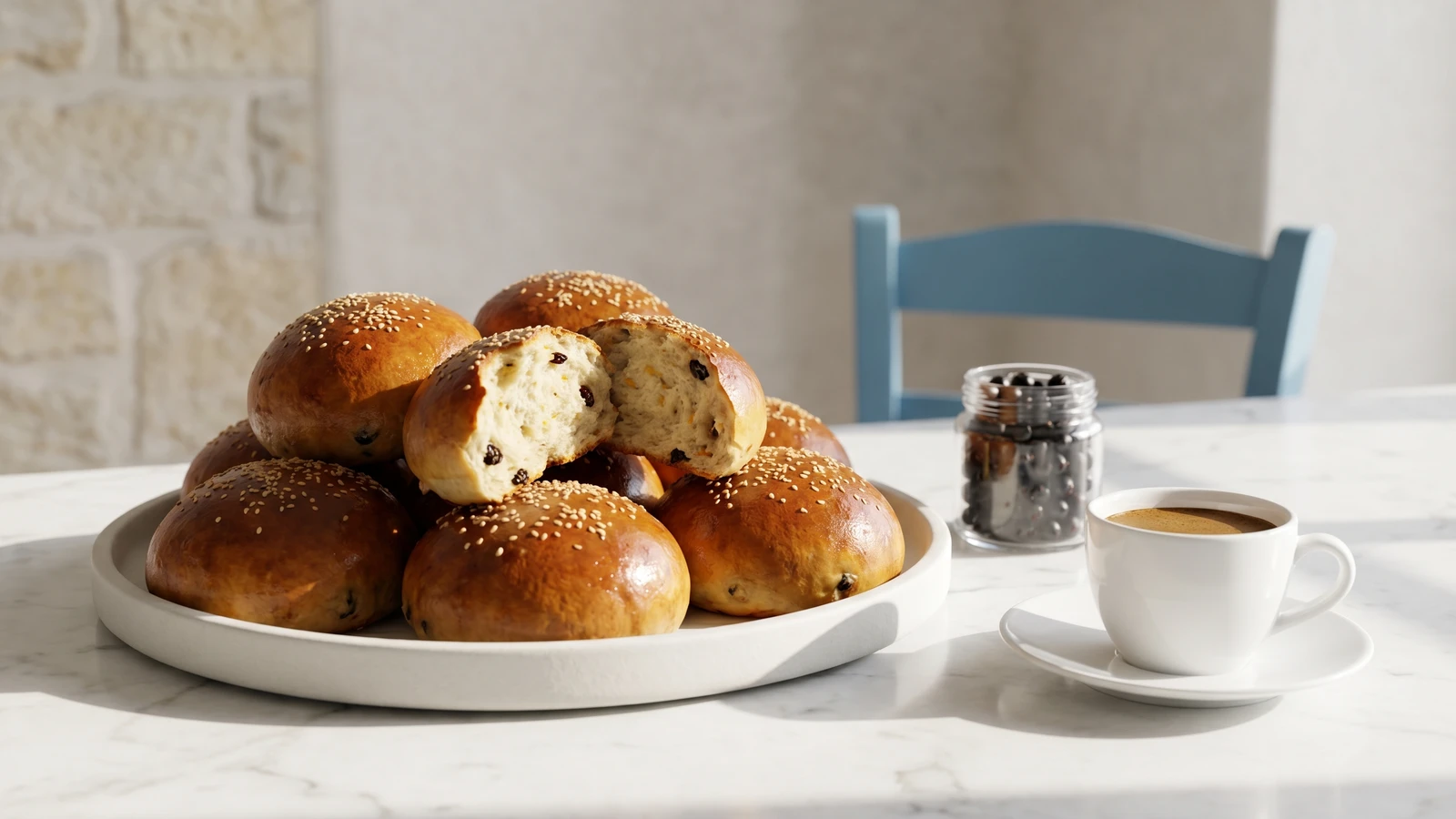
Stafidopsomo of the northern Peloponnese is the little raisin bread of Corinth and Achaia, where the black currant is not decoration but the point. The buns are nistisima, fasting-friendly, made with olive oil instead of butter and scented plainly with orange peel and cinnamon. They belong beside Greek coffee, in a school bag, or wrapped in paper for the road.
The method that decides them is the soaking. Pour hot water over the currants, let them plump, then use part of that dark soaking water in the dough. Dry fruit steals moisture while the buns bake. Soaked fruit gives some of it back, and the crumb stays tender instead of turning tight around little hard raisins.
I keep this version close to the bakery buns from raisin country: no milk, no eggs, no show. Good olive oil, and patience. Shape them small, tuck the exposed currants under the surface so they don't scorch, and let the buns cool before you tear one open. A recipe written down is a recipe saved, especially when it is as ordinary and loved as this one.
Stafidopsomo in the northern Peloponnese belongs to the raisin belt of Corinthia and Achaia, where the tiny black Korinthiaki stafida fed households and export ledgers for generations. By the late nineteenth century, dried Corinthian currants were Greece's main export crop, and the currant crisis of the 1890s shook the Peloponnesian economy. The bun's dairy-free olive-oil dough also fits the Orthodox fasting calendar, when dried fruit made plain bread feel like a treat.
Quantity
220g
Quantity
250ml
for soaking, with 190ml reserved for the dough
Quantity
500g
plus a little for dusting
Quantity
7g
Quantity
70g
Quantity
8g
Quantity
5g
Quantity
1/4 teaspoon
Quantity
from 1 orange
finely grated
Quantity
80ml
Quantity
80ml
for the dough
Quantity
10ml
for brushing the baked buns
Quantity
15g
| Ingredient | Quantity |
|---|---|
| black Corinthian currants (Korinthiaki stafida) or small dark raisins | 220g |
| just-boiled waterfor soaking, with 190ml reserved for the dough | 250ml |
| strong white bread flourplus a little for dusting | 500g |
| instant dry yeast | 7g |
| granulated sugar | 70g |
| fine sea salt | 8g |
| ground cinnamon | 5g |
| ground cloves (optional) | 1/4 teaspoon |
| unwaxed orange zestfinely grated | from 1 orange |
| fresh orange juice | 80ml |
| extra virgin Koroneiki olive oilfor the dough | 80ml |
| extra virgin Koroneiki olive oil (optional)for brushing the baked buns | 10ml |
| sesame seeds (optional) | 15g |
Put the currants in a bowl and pour over the just-boiled water. Leave them for 20 minutes, then drain over a measuring jug and reserve 190ml of the dark soaking liquid. If you are short, top it up with warm water. Spread the currants on a towel and blot them dry. This is the step that decides the bun: dry fruit steals moisture in the oven, while soaked fruit stays plump and keeps the crumb tender.
Let the reserved soaking liquid cool until it is warm, not hot. In a large bowl, stir together the flour, yeast, sugar, salt, cinnamon, clove if using, and orange zest. Add the 190ml soaking liquid, orange juice, and 80ml olive oil. Mix until no dry flour remains, then knead 8 to 10 minutes by hand, or 5 to 6 minutes with a dough hook, until the dough is smooth, elastic, and only lightly tacky.
Press the dough into a rough rectangle, scatter over the drained currants, and fold the dough over itself until the fruit is held inside. Knead only enough to distribute the currants. If many break through the surface, tuck them back in with your fingertips; exposed currants burn before the bread is done.
Set the dough in a lightly oiled bowl, cover it, and leave it in a warm place for 75 to 90 minutes, until doubled and soft-looking. In a cool kitchen it may need up to 2 hours. Greek bread has no watch, only a room.
Line a 33x40cm rimmed baking sheet with parchment. Turn the dough onto a lightly floured surface and divide it into 12 pieces, about 95g each. Shape each piece into a tight round or short oval, pulling the surface smooth and sealing the bottom. Set them on the sheet with about 4cm between them.
Cover the buns and let them rise 45 to 60 minutes, until puffy. During the last 20 minutes, heat the oven to 190C conventional or 180C fan. Brush the tops lightly with water and sprinkle with sesame seeds if using. A fingertip pressed gently into the dough should leave a dent that springs back slowly.
Bake on the middle rack for 20 to 22 minutes, until the buns are deep honey-brown and the bottoms sound hollow when tapped. As soon as they come out, brush with the 10ml olive oil if you want a softer bakery-style crust.
Move the buns to a rack and let them cool at least 20 minutes before tearing one open. The crumb finishes setting as it cools. Eat them the day they are baked, or keep them covered for 2 days. They freeze well, wrapped tightly, for up to 2 months.
1 serving (about 85g)
Culinary guides, cultural storytelling, and the editorial depth that makes cooking meaningful.
Discover Culinary ExplorerChef Dimitra
Omodos arkatena are Cypriot chickpea-leavened rusks, pale inside and sesame-studded, baked once as little rings and again until they crack clean under the tooth and keep beautifully.

Chef Dimitra
Attica's Clean Monday lagana is lean, sesame-heavy, and deeply dimpled, made to be torn beside taramosalata before the bread goes stale by morning.

Chef Dimitra
Crete's eftazymo rises from a ground-chickpea ferment kept warm and still, then bakes into a fragrant sesame loaf with sweet-sour crumb and a faint whisper of mastic.

Chef Dimitra
Cypriot flaounes are Easter cheese breads with a sesame crust, fragrant dough, and a firm halloumi-anari filling that must rest before it bakes.