Culinary Explorer

A cooking platform built around craft, culture, and the stories behind what we eat.
Discover Culinary Explorer
Nogada de Santa Monica

Nogada de Santa Monica

Created by

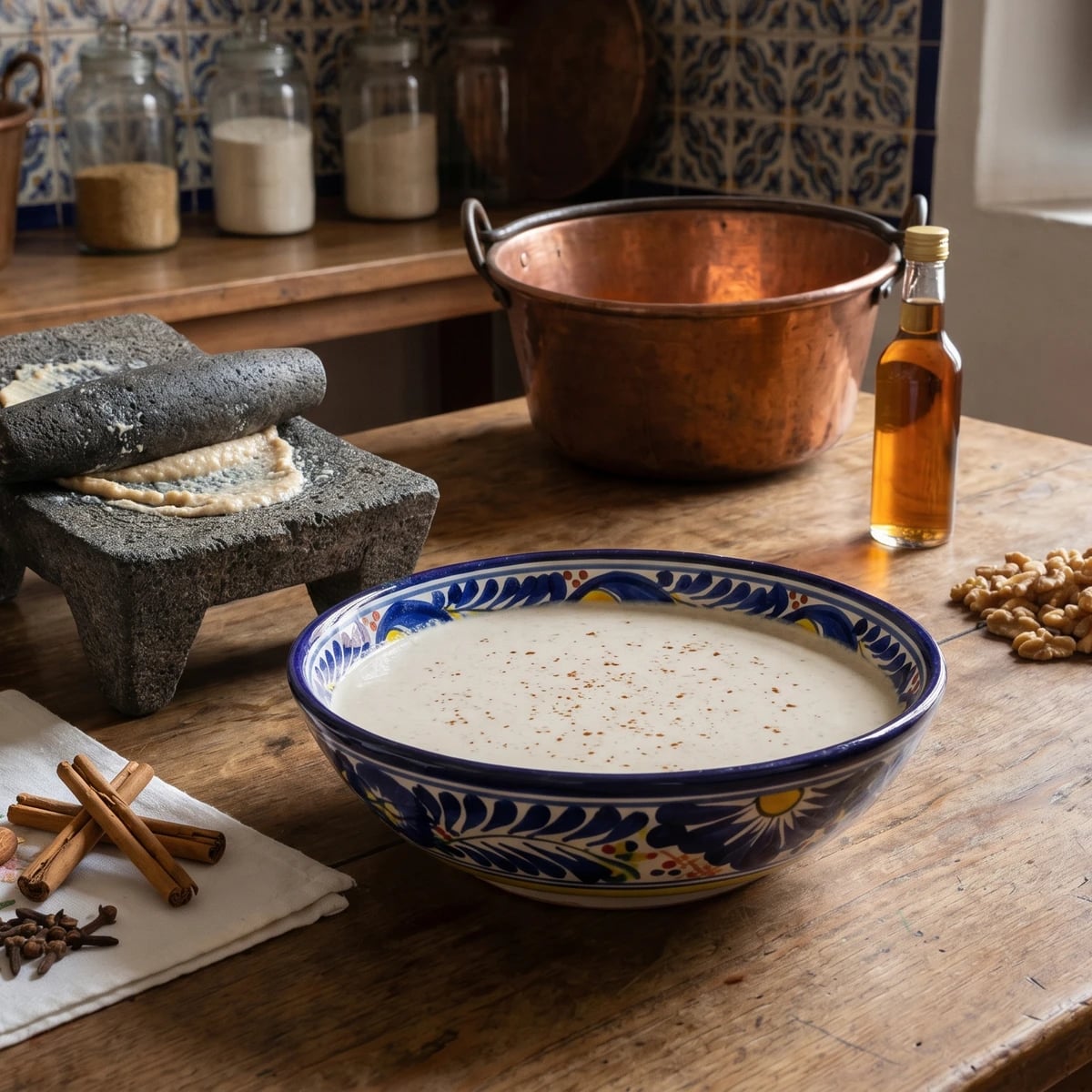
Puebla's convent walnut sauce, pale and rich from fresh nuez de Castilla, goat cheese, milk, sherry, and canela, made in August when the walnuts still peel clean.

Sauces & Condiments
Mexican
Special Occasion
Holiday
Celebration
1 hr 30 min
Active Time
0 min cook9 hr 30 min total
YieldAbout 4 cups, enough for 10 to 12 chiles en nogada

Puebla, specifically the convent kitchens of the city, owns this sauce. Nogada de Santa Monica is the walnut cream tied to the Augustinian nuns of the Convento de Santa Monica, the pale cloak that dresses chiles en nogada when August gives Puebla fresh nuez de Castilla and pomegranate at the same time.

The walnut is the authority here. Not pecan, not dried supermarket walnut, not cashew pretending to be useful. Fresh nuez de Castilla has a thin skin that must be peeled by hand, one piece at a time, until your fingers understand why convent cooking was labor organized into devotion. The goat cheese gives the sauce its clean sharpness. The milk softens it. The jerez and canela mark the conventual register, Old World ingredients absorbed into a Mexican architecture.

I have stood in Puebla markets in August watching women choose walnuts the way other people choose jewelry. They know which ones will peel, which ones are too old, which ones will make the sauce bitter. Preguntale a las senoras del mercado. If the walnuts are not good right now, do not make nogada right now. Cook what the season gives you.

This sauce is cold, but it is not easy. It asks for time, patience, and clean judgment. La cocina no es decoracion, es trabajo. Recetas probadas y garantizadas, but only when the market is telling the truth.

Nogada de Santa Monica is associated with Puebla's Augustinian Convento de Santa Monica and the 19th-century rise of chiles en nogada as a civic dish linked to Mexican independence celebrations. The common story says Puebla nuns prepared the dish in 1821 for Agustin de Iturbide after the signing of the Treaty of Cordoba, but written documentation is later and the legend has been polished by patriotic retelling. What is historically clear is the conventual technique: native chile poblano and seasonal pomegranate joined with Old World walnut, dairy, sherry, and canela in the baroque cooking of Puebla.

The technique, the tradition, and the story behind every dish.

Discover Culinary Explorer

Ingredients

fresh nuez de Castilla

Quantity

2 cups

shelled, skins removed by hand

whole milk

Quantity

3 cups, divided, plus more if needed

for soaking and blending

fresh goat cheese

Quantity

4 ounces

crumbled

queso fresco

Quantity

4 ounces

crumbled

Mexican crema

Quantity

1/2 cup

dry sherry

Quantity

1/4 cup

sugar

Quantity

2 tablespoons, or to taste

ground canela

Quantity

1/4 teaspoon

fine sea salt

Quantity

1/8 teaspoon

blanched almonds (optional)

Quantity

1 tablespoon

for body if the walnuts are thin

Equipment Needed

  • Small paring knife for peeling walnuts
  • Volcanic stone metate with tejolote
  • High-powered blender
  • Fine-mesh sieve
  • Talavera serving bowl or small Puebla ceramic salsera

Instructions

  1. 1

    Peel the walnuts

    Work with fresh nuez de Castilla, not dried walnuts from a bag. Break the nuts into large pieces and pull away the thin brown skin with the tip of a small knife. This is the work. The skin is bitter and it stains the sauce gray. A proper nogada should be pale, almost ivory. No me vengas con atajos.

    If the skins cling hard, cover the walnuts with very hot milk for 10 minutes, then drain and peel while they are still warm. Do not boil them.
  2. 2

    Soak in milk

    Place the peeled walnuts in a bowl and cover with 2 cups of whole milk. Refrigerate at least 8 hours, or overnight. The milk softens the nut and pulls out the edge of bitterness left from the skin. This is why the sauce tastes round instead of harsh.

  3. 3

    Drain and grind

    Drain the walnuts and discard the soaking milk. Grind the walnuts on a metate if you have one, working them with the tejolote until they become a damp paste. El metate es la regla. A blender can finish the job, but the first grind teaches you the texture this sauce wants.

  4. 4

    Blend the nogada

    Transfer the walnut paste to a blender with 1 cup fresh whole milk, the goat cheese, queso fresco, crema, sherry, sugar, canela, and salt. Blend until completely smooth. The sauce should fall from a spoon in a thick ribbon, not pour like milk and not sit like frosting. Add milk one tablespoon at a time only if the blender refuses to move.

  5. 5

    Taste and adjust

    Taste cold, because this sauce is served cool or at room temperature. It should be creamy, gently sweet, lightly sharp from the goat cheese, and perfumed with sherry and canela. If the walnuts are weak, add the optional tablespoon of blanched almonds and blend again. That is a correction, not an upgrade.

  6. 6

    Rest before serving

    Cover and refrigerate for 1 hour before serving. Stir well and let it sit at room temperature for 20 minutes before it goes to the table. This is a sauce, not the whole plate. It belongs over chiles poblanos filled with picadillo, with pomegranate and parsley added on that dish, not mixed into the nogada.

Chef Tips

  • Make this in August or early September, when Puebla's fresh nuez de Castilla is in season. Dried walnuts make a darker, harsher sauce. A substitution is a compromise, not an upgrade.
  • The sauce should stay pale. Brown walnut skin, too much canela, or cheap sherry will muddy it. Convent cooking looks restrained, but the discipline is severe.
  • This is the sauce only. The chile poblano, picadillo, pomegranate, and parsley belong to the plate of chiles en nogada, not inside this preparation.
  • If you cannot find fresh goat cheese, use a mild, unsalted chevre. If it tastes barnyard-strong, it will take over the sauce. The walnut is supposed to speak first.

Advance Preparation

  • The walnuts can be peeled and soaked in milk overnight, covered and refrigerated.
  • The finished nogada can be made up to 24 hours ahead. Keep it refrigerated, then stir and bring it toward room temperature before serving.
  • Do not freeze nogada. The dairy separates and the walnut texture turns grainy.

Frequently Asked Questions

Nutrition Information

1 serving (about 85g)

Calories
230 calories
Total Fat
20 g
Saturated Fat
6 g
Trans Fat
0 g
Unsaturated Fat
14 g
Cholesterol
20 mg
Sodium
165 mg
Total Carbohydrates
7 g
Dietary Fiber
1 g
Sugars
5 g
Protein
8 g

Note: Chef personas and recipes are created with AI assistance. Cook with care: follow safe food-handling practices, check doneness with a thermometer when needed, and adapt for allergies and your kitchen.

Where cooking meets culture.

Culinary guides, cultural storytelling, and the editorial depth that makes cooking meaningful.

Discover Culinary Explorer

More from Moles, Pipianes & Escabeches Conventuales

Browse the full collection