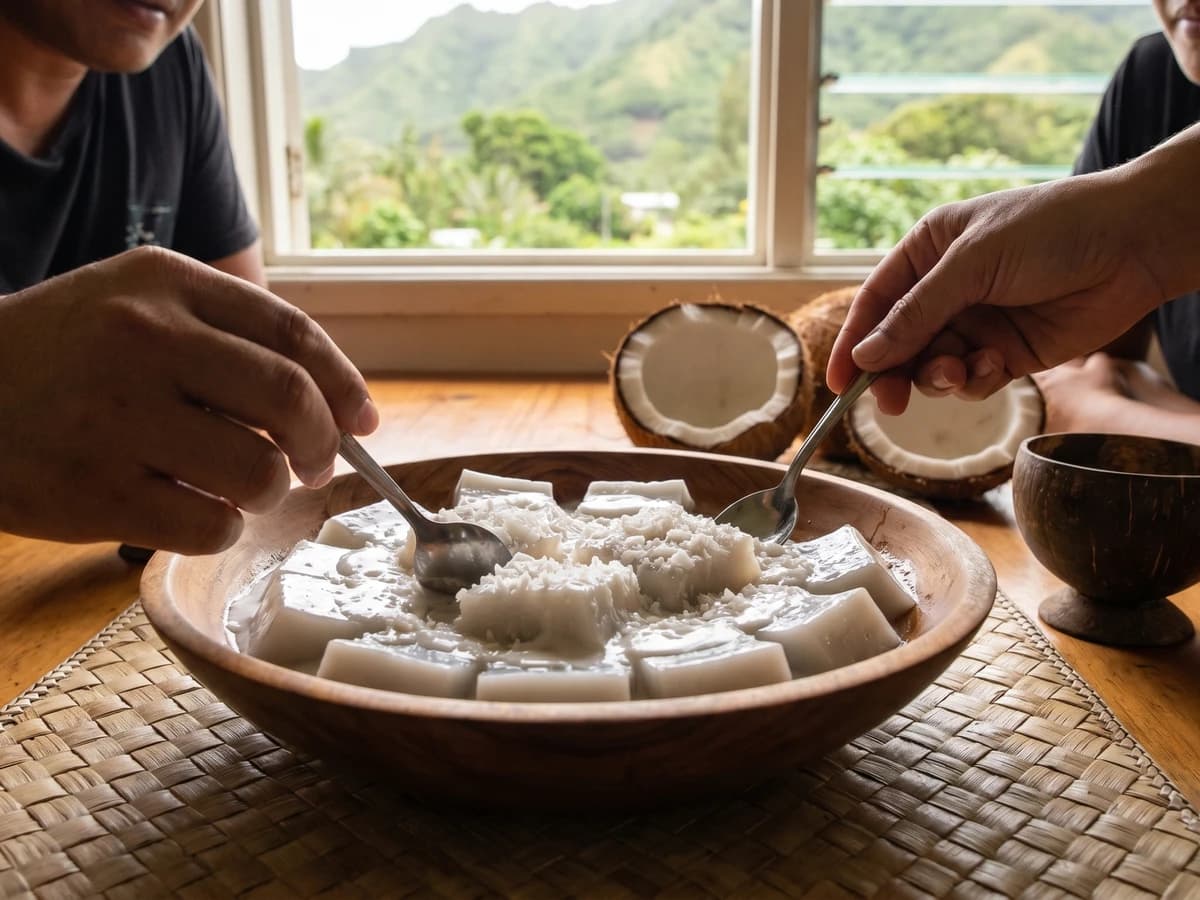
A cold Cook Islands custard built on niu, the coconut canoe plant, baked slow with egg until the center trembles, then chilled for a spoonable, rich dessert.
Desserts
Polynesian, Cook Islands
Comfort Food
Make Ahead
Special Occasion
15 min
Active Time
50 min cook•5 hr 5 min total
Yield6 to 8 servings
The canoe carried niu, coconut, with the same care it carried kalo and ʻuru, because coconut is water, fat, vessel, shade, and sweetness all in one body. In the Cook Islands, from Rarotonga out to the Pa Enua, the outer islands, that tree stands close to the house and close to the table. This custard belongs to that Cook Islands hand: coconut cream, egg, sugar, low heat, then the patience to let it set cold.
This isn't the same as Hawaiian haupia, where coconut milk sets firm with starch, and it isn't Tahitian poʻe, where fruit and starch bake under coconut. The Cooks have poke too, the banana or pumpkin pudding with arrowroot and coconut cream, not the Hawaiian raw-fish poke. Same ocean, same niu, different bowl. This one is softer, richer, spoonable, the lagoon-islands answer to a baked custard.
Make it in the dish you actually have. Fresh coconut cream is beautiful if you can squeeze it, and a good can will feed the family on a weeknight. The only thing you don't rush is the set. Pull it when the middle still trembles, chill it until it relaxes, then eat it cold. Deep food is not fancy. It just asks you to listen.
Polynesian voyagers carried niu, coconut, into the Cook Islands with the other canoe plants, and it became part of daily food from the high southern islands to the northern atolls. The egg-and-sugar custard form belongs to a later layer: the London Missionary Society reached Aitutaki in 1821 and Rarotonga in 1823, and the mission and trading years brought new baking habits, sugar, vanilla, and dairy into island kitchens. So this dessert is Cook Islands food in the living sense, old coconut cream holding a newer custard form, sitting beside deeper canoe-crop foods like rukau, ʻuru, and Cook Islands poke.
The technique, the tradition, and the story behind every dish.
preferably fresh, or full-fat canned coconut cream
coconut milk
Quantity
1 cup
fresh second pressing or canned
large eggs
Quantity
5
sugar
Quantity
1/2 cup
fine sea salt
Quantity
1/4 teaspoon
vanilla extract
Quantity
1 teaspoon
freshly grated nutmeg (optional)
Quantity
1/4 teaspoon
toasted grated coconut (optional)
Quantity
2 tablespoons
hot water
Quantity
as needed
for the water bath
Ingredient
Quantity
thick coconut cream from mature niu (coconut)preferably fresh, or full-fat canned coconut cream
2 cups
coconut milkfresh second pressing or canned
1 cup
large eggs
5
sugar
1/2 cup
fine sea salt
1/4 teaspoon
vanilla extract
1 teaspoon
freshly grated nutmeg (optional)
1/4 teaspoon
toasted grated coconut (optional)
2 tablespoons
hot waterfor the water bath
as needed
Equipment Needed
•8-inch oven-safe glass or enamel baking dish, or six 6-ounce oven-safe cups
•Deep roasting pan for the water bath
•Fine-mesh strainer
•Kettle or small pot for hot water
Instructions
1
Set the oven
Heat the oven to 300F. Set an 8-inch oven-safe glass or enamel baking dish, or six 6-ounce cups, inside a deep roasting pan. Lay a folded kitchen towel under the dish if it slides around. That little bit of steadiness keeps the custard gentle while the heat moves around it.
2
Smooth the niu
Stir the coconut cream and coconut milk together until smooth. If the cream has separated in the can, warm it just enough to loosen the fat, then let it come back to warm, not hot. Fresh cream smells clean and sweet, like the inside of the coconut shell. If it smells sour, no use it here.
Fresh coconut cream is the better bowl when you can get it. A good full-fat can is still welcome. Eat what you have, just choose the cleanest one you can.
3
Whisk the eggs
In a wide bowl, whisk the eggs, sugar, salt, and vanilla until the sugar starts to dissolve and the mixture looks even. Don't whip it foamy. Foam bakes into little bubbles, and this custard wants to be calm and satin-smooth.
4
Strain and pour
Whisk the coconut mixture into the eggs in a slow stream. Strain the custard into the baking dish so any egg threads stay behind. Dust the top with nutmeg if you're using it. The surface should look pale ivory and glossy, with no lumps hiding in it.
5
Bake it gentle
Pour hot water into the roasting pan until it comes halfway up the sides of the custard dish. Bake 45 to 55 minutes for one dish, or 30 to 35 minutes for small cups, until the edges are set and the center trembles like a small wave when you nudge the pan. If you use a thermometer, look for 170F to 175F in the center. Pull it before it looks dead-still, because it keeps setting as it cools.
A cracked custard usually means the heat was too high or it stayed in too long. No shame. Next time pull it when the middle still has that soft wobble.
6
Cool and chill
Lift the custard out of the water bath and cool it on the counter until it is no longer warm, about 1 hour. Cover and chill at least 4 hours, or overnight, until it sets cold and spoonable. Don't leave egg custard sitting out more than 2 hours.
7
Serve it cold
Spoon the custard into coconut shells, small wooden bowls, or plain everyday dishes. Scatter toasted coconut over the top if you like. Serve it cold, soft, and rich, enough for the table to pass around.
Chef Tips
•Use full-fat coconut cream, not coconut beverage. Thin boxed drinking coconut makes a weak custard and no amount of eggs will give it the same body.
•If you squeeze fresh coconut cream, use it the same day when you can. It separates as it sits, so stir it back together before measuring.
•This is Cook Islands dessert, not a generic island sweet. Put it beside Cook Islands poke, rukau, or ika mata at a family table and let each dish keep its own name.
•For a dairy-free custard, stay with coconut milk for the full liquid. If your family likes a softer, more European-style set, swap the 1 cup coconut milk for whole milk.
Advance Preparation
•Make the custard 1 day ahead and chill it overnight; the texture settles and cuts cleaner from the spoon.
•Toast the grated coconut up to 3 days ahead and keep it sealed at room temperature.
•Fresh coconut cream is best squeezed the day of baking, but it can be chilled overnight if needed. Stir before using.
Frequently Asked Questions
Nutrition Information
1 serving (about 145g)
Calories
350 calories
Total Fat
28 g
Saturated Fat
24 g
Trans Fat
0 g
Unsaturated Fat
3 g
Cholesterol
115 mg
Sodium
120 mg
Total Carbohydrates
20 g
Dietary Fiber
1 g
Sugars
17 g
Protein
6 g
Where cooking meets culture.
Culinary guides, cultural storytelling, and the editorial depth that makes cooking meaningful.