
Chef Fai
Southern Cucumber Relish (Ajad)
The one Thai condiment where vinegar replaces lime as the sour pillar, and the system still holds. Palm sugar for sweet, nam pla for salt, prik for heat. Ajad is the four pillars in a jar.
A cooking platform built around craft, culture, and the stories behind what we eat.
Created by
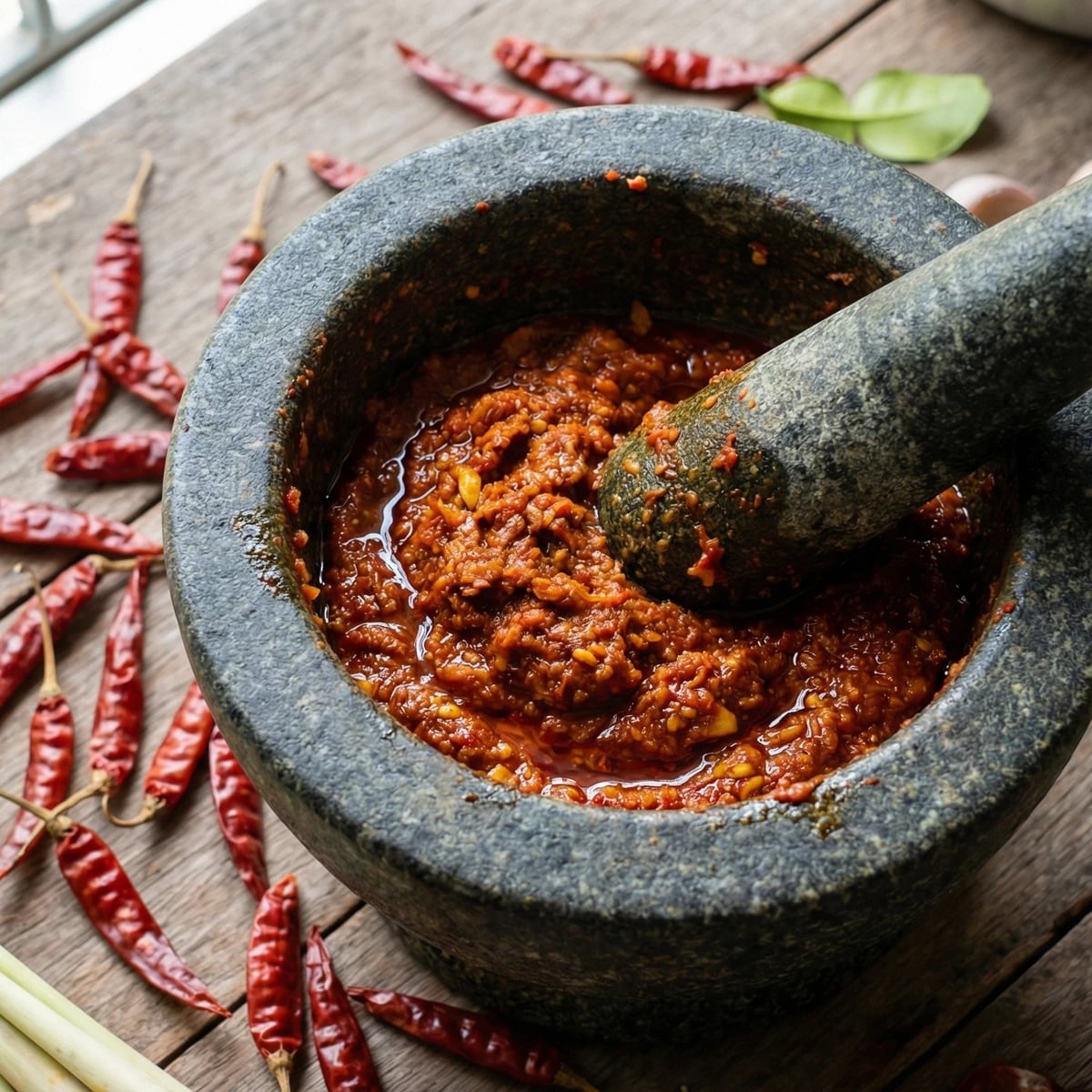
Same nine ingredients as green curry, but dried red chilies replace fresh green. Deeper heat, longer shelf life, wider application. This is the workhorse kreung tam of Central Thai cooking, and it starts in the krok.
The kreung tam is everything. If you understand one thing about Thai food, understand this: every traditional Thai dish begins with a pounded paste. Not a blended paste. Not a store-bought paste. A paste built ingredient by ingredient in a granite mortar, each addition transforming the one before it. Red curry paste is the kreung tam you need to master first because it's the one that works hardest.
Ajarn McDang identifies nine essential ingredients that form the base of Thai cooking. All nine are in this paste: dried chilies, garlic, shallots, lemongrass, galangal, cilantro root, kaffir lime zest, peppercorns, shrimp paste. Nine ingredients. One mortar. That's the system. Green curry paste uses fresh green chilies. Red curry paste swaps them for dried red chilies (prik chi fa haeng). That single change gives you a deeper, smokier heat, a paste that's less volatile, more stable, with a shelf life that makes it the practical backbone of a Thai kitchen.
Here's what happens in the mortar that can't happen in a blender. When you pound peppercorns, they crack and release their volatile oils. When you pound lemongrass on top of those cracked peppercorns, the fibers break and absorb those oils. When you add galangal, its resinous compounds merge with the lemongrass. Layer by layer, the paste builds. A blender spins everything at once, cutting with steel, generating heat that destroys volatile compounds. The mortar transforms at room temperature, through pressure and friction. The science is real. Ajarn taught me this on day one: "I don't teach you how to cook through recipes. I want you to learn the principles and understand."
I teach this paste first in every Fai Thai workshop. Not green curry. Not massaman. Red. Because once you've made nam prik gaeng phet from scratch and tasted the difference between yours and the can on the shelf, you don't go back. You understand why the mortar matters. You understand what kreung tam actually means. And every Thai curry, every stir-fry paste, every nam prik you make after that point will be built on this foundation.
Red curry paste is the foundational kreung tam of Central Thai cuisine, predating the introduction of dried chili peppers to Thailand via Portuguese traders in the 16th century (before which Thai cooks relied on peppercorns and galangal for heat). The distinction between gaeng phet (red, dried chili) and gaeng khiew wan (green, fresh chili) reflects the Central Thai system of categorizing curries by chili type rather than spice level. Nam prik gaeng phet is considered the most versatile paste in the Thai kitchen, forming the base of gaeng phet, gaeng pa, panang (with minor additions), and numerous stir-fried and braised dishes across the Central Plains.
Quantity
1 teaspoon
Quantity
1 teaspoon
dry-toasted
Quantity
1 teaspoon
dry-toasted
Quantity
1 teaspoon
Quantity
12
soaked 15 minutes in warm water, seeded
Quantity
5
soaked with the spur chilies
Quantity
1 tablespoon
roughly chopped
Quantity
1 tablespoon
thinly sliced
Quantity
2 stalks
bottom 3 inches only, thinly sliced
Quantity
1 tablespoon
finely sliced
Quantity
6 cloves
roughly chopped
Quantity
4 small
roughly chopped
Quantity
1 tablespoon
| Ingredient | Quantity |
|---|---|
| white peppercorns (prik thai) | 1 teaspoon |
| coriander seeds (met pak chi)dry-toasted | 1 teaspoon |
| cumin seeds (yira)dry-toasted | 1 teaspoon |
| fine sea salt | 1 teaspoon |
| dried red spur chilies (prik chi fa haeng)soaked 15 minutes in warm water, seeded | 12 |
| dried bird's eye chilies (prik khi nu haeng) (optional)soaked with the spur chilies | 5 |
| cilantro roots (rak pak chi)roughly chopped | 1 tablespoon |
| galangal (kha)thinly sliced | 1 tablespoon |
| lemongrass (takhrai)bottom 3 inches only, thinly sliced | 2 stalks |
| kaffir lime zest (phiu makrut)finely sliced | 1 tablespoon |
| garlicroughly chopped | 6 cloves |
| shallots (hom daeng)roughly chopped | 4 small |
| shrimp paste (kapi) | 1 tablespoon |
Toast the coriander and cumin seeds in a dry pan over medium heat. Shake the pan. Thirty seconds, maybe forty-five. The moment you smell them, they're done. Don't walk away. Burnt spices are bitter spices, and there's no fixing that. Let them cool completely. Combine them with the white peppercorns and salt in the granite mortar. Pound to a fine powder. This takes real effort. The peppercorns will bounce and resist. Keep going until there are no whole pieces left. This is your aromatic base, and it goes in first because it's the hardest and driest. Hardest first. That's the rule of the krok.
Drain the soaked chilies and squeeze out excess water. You want them pliable, not dripping. Add them to the mortar on top of the ground spices. Pound with steady, firm strikes. The chilies need to break down completely into the spice powder, creating a rough red mass. This is where the paste gets its color and its heat. Prik chi fa (spur chilies) give you color and moderate warmth. The bird's eye chilies give you fire. Adjust the ratio to your tolerance, but don't skip the prik chi fa. The color is the identity of the paste.
Now the fibrous ingredients, in this order: cilantro root first, then galangal, then lemongrass. Add each one separately. Pound each into the paste before adding the next. Cilantro root is earthy and stubborn. It needs real force. Galangal is woody and resinous. Slice it thin or you'll be pounding for an hour. Lemongrass is fibrous but gives up faster. You're listening for the sound to change: it starts as a sharp crack (fibers breaking) and shifts to a wet thud (paste forming). When the thud is consistent, the ingredient is incorporated. This is the heart of the kreung tam.
Add the kaffir lime zest. Pound it in. This is the ingredient that makes Thai curry paste smell like Thai curry paste. The zest contains citral and citronellal, aromatic oils that are intensely fragrant. A blender heats up and vaporizes half of those oils. The mortar keeps them in the paste. This is why krok ก่อน isn't nostalgia. It's chemistry.
Now the soft, wet ingredients: garlic first, then shallots. These are high in water content, so they go in late. If you added them early, the moisture would prevent the dry spices and fibrous aromatics from breaking down properly. The garlic will dissolve into the paste almost immediately. The shallots take a bit longer. Pound until the paste is uniform and you can't see distinct pieces of shallot. The texture should be getting smooth now, almost like a thick, rough sauce. The color should be a deep, vibrant red-orange.
Last ingredient: kapi (shrimp paste). This goes in at the very end because it's already a paste. It's soft. It needs no breaking down. What it needs is to be distributed evenly through everything you've built. Pound and fold it through, ten to fifteen strokes. The aroma will shift immediately. Kapi brings umami, salinity, and a fermented depth that ties the whole kreung tam together. It's the connective tissue. Without it, the paste tastes like a pile of aromatics. With it, it tastes like a curry.
Your paste is done when it's smooth, cohesive, and intensely aromatic. Scrape it into a bowl. Take a tiny taste. It should be salty (from the kapi and salt), immediately fragrant (lemongrass, lime zest), and warm (chilies, peppercorns) with an earthy backbone (cilantro root, galangal, garlic, shallots). If it tastes flat, you didn't pound long enough. The flavors haven't merged. Get it back in the mortar and keep going. The paste tells you when it's ready.
1 serving (about 20g)
Culinary guides, cultural storytelling, and the editorial depth that makes cooking meaningful.
Discover Culinary Explorer
Chef Fai
The one Thai condiment where vinegar replaces lime as the sour pillar, and the system still holds. Palm sugar for sweet, nam pla for salt, prik for heat. Ajad is the four pillars in a jar.

Chef Fai
Every grilled dish in Isan answers to this dip. Roasted dried chilies, nam pla, manao, khao khua, and shallots: the four pillars in a condiment that's structural, not optional.

Chef Fai
Roasted dried chilies and galangal pounded to a rough paste, folded with shredded pork skin and palm sugar until it becomes something sweet, smoky, and chewy that belongs on every khantoke tray in Chiang Mai.

Chef Fai
The kreung tam that proves the system adapts. Ginger instead of galangal, cumin and star anise alongside lemongrass. Lanna's mortar holds the whole Burma-to-Chiang Mai trade route in a single paste.