
Chef Lupita
Aguascalientes Beef Tongue Pozole (Pozole de Lengua)
Aguascalientes' Bajio pozole de lengua, built with cacahuazintle hominy, tender beef tongue, chile ancho and guajillo, with xoconostle brightness and table garnishes.
A cooking platform built around craft, culture, and the stories behind what we eat.
Created by
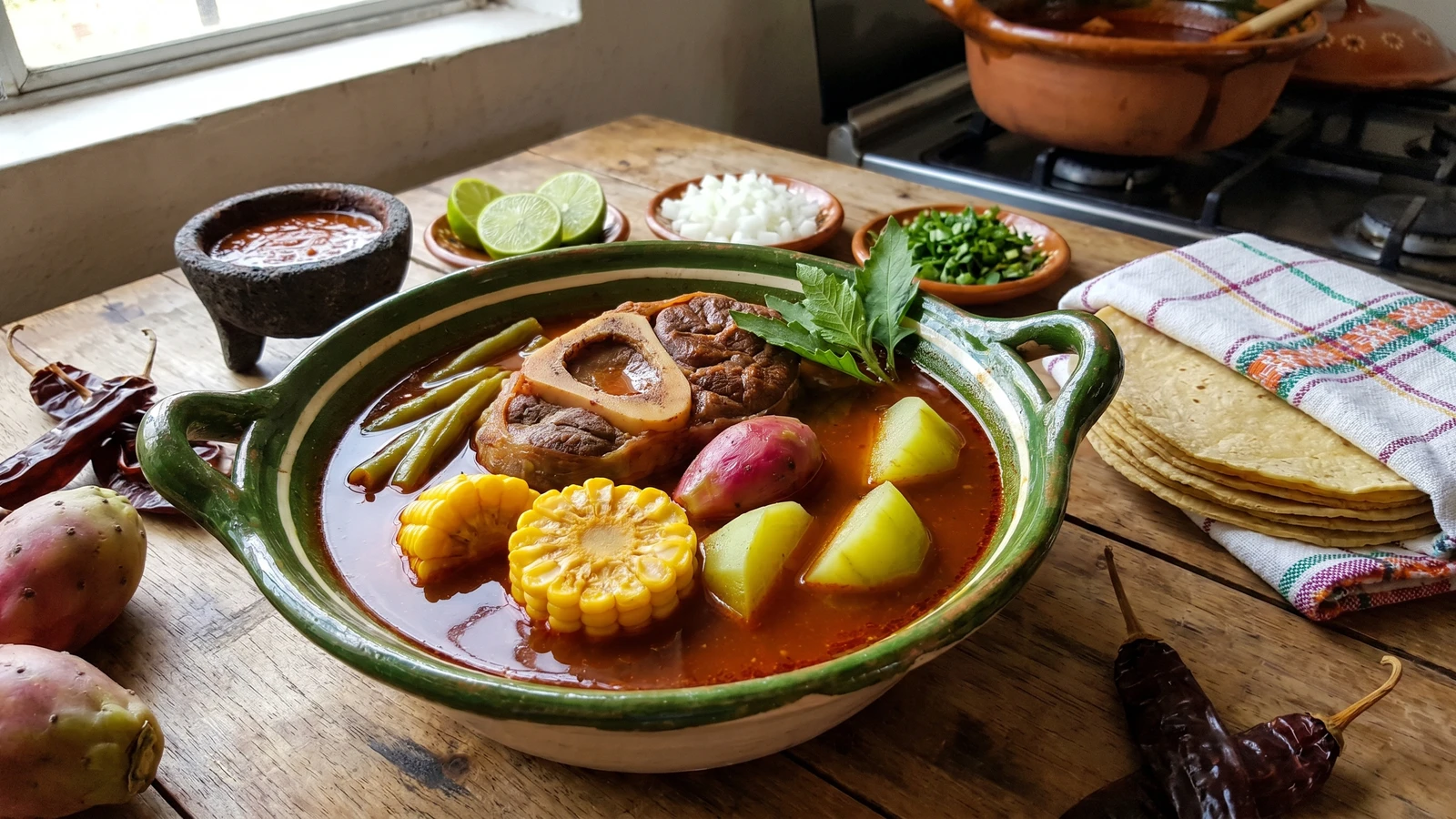
Ciudad de Mexico and Puebla's deep-bodied beef stew, built on toasted guajillo and pasilla, slow-simmered shank, summer vegetables, and the sour bite of xoconostle. Thinner than mole, deeper than caldo, exactly itself.
Mole de olla belongs to the central highlands. Ciudad de Mexico, Puebla, Tlaxcala, the altiplano where the markets sell xoconostle by the kilo and every cocinera has her own balance of guajillo and pasilla. This is not a mole the way poblano or oaxaqueno is a mole. The word here means something older: molli, sauce, concoction. A pot built around a chile puree thinned with beef broth and weighted down with whatever the milpa is giving up that week.
The xoconostle is what makes it. People outside the central highlands have never heard of it and it has no real substitute. Xoconostle is the sour wild prickly pear, harvested green, with a flesh that runs from pale jade to deep magenta and a flavor that is somewhere between tamarind and unripe gooseberry. It does not need lime. It is the lime. It builds the acid into the broth itself, balancing the chile and the fat in a way no citrus squeezed over the top ever could. If your mercado does not carry it, the dish is not in season for you. Cook something else.
My mother did not grow up with mole de olla, she was from Jalisco, but she learned it from a vecina in Colonia Roma named Dona Refugio who was from Tehuacan and made it every Wednesday in the summer when the corn and chayote and ejotes were all good at the same time. The pot would simmer all morning and the apartment would smell like guajillo and beef bone, and Dona Refugio would tell my mother that this is what poor people eat when they are not poor. One animal, the garden, a handful of chiles, and a few xoconostles. A feast assembled out of patience. Saber cocinar es saber vivir.
This is a summer dish, when the corn is fresh and the calabacitas are small and tender and the xoconostle is at the markets. Do not make it in February with frozen corn. Cada estado, su propia cocina, and this stew respects its season.
Mole de olla descends from the pre-Columbian practice of cooking meats and milpa vegetables in chile-thickened broths, a technique documented by Bernardino de Sahagun in the 16th century among the Nahua peoples of the central altiplano. The xoconostle (Opuntia joconostle), distinct from the sweet tuna of the prickly pear, has been cultivated since pre-Hispanic times in the semi-arid regions of Hidalgo, San Luis Potosi, Zacatecas, and the Bajio, and remained a pantry staple in central Mexican cooking long after Spanish citrus became available. The dish as known today, with beef shank replacing pre-conquest turkey or venison, took form in the 19th century in the working-class fondas of Puebla and Mexico City, where it became the midweek lunch of laborers, market vendors, and the families they fed.
Quantity
3 pounds
cut into 2-inch cross-cuts
Quantity
1 pound
Quantity
1 medium
halved
Quantity
1
halved crosswise
Quantity
3
Quantity
2
Quantity
1 tablespoon, plus more to taste
Quantity
6
stemmed and seeded
Quantity
3
stemmed and seeded
Quantity
2
stemmed and seeded
Quantity
3
Quantity
1/4 teaspoon
Quantity
2
Quantity
2 tablespoons
Quantity
2 ears
husked and cut into 1 1/2-inch rounds
Quantity
2 medium
peeled and cut into thick wedges
Quantity
1/2 pound
trimmed and cut in half
Quantity
2 medium
cut into thick half-moons
Quantity
4
peeled, halved, and seeded
Quantity
1 large sprig
Quantity
for serving
Quantity
for serving
Quantity
for serving
Quantity
for serving
warmed
| Ingredient | Quantity |
|---|---|
| bone-in beef shank with marrowcut into 2-inch cross-cuts | 3 pounds |
| beef short ribs or chambarete | 1 pound |
| white onionhalved | 1 medium |
| head of garlichalved crosswise | 1 |
| garlic cloves (for the chile puree) | 3 |
| bay leaves | 2 |
| kosher salt | 1 tablespoon, plus more to taste |
| dried chile guajillostemmed and seeded | 6 |
| dried chile pasillastemmed and seeded | 3 |
| dried chile anchostemmed and seeded | 2 |
| Roma tomatoes | 3 |
| whole cumin seed | 1/4 teaspoon |
| whole cloves | 2 |
| manteca de cerdo (pork lard) | 2 tablespoons |
| fresh elotehusked and cut into 1 1/2-inch rounds | 2 ears |
| chayotespeeled and cut into thick wedges | 2 medium |
| ejotes (green beans)trimmed and cut in half | 1/2 pound |
| calabacitas (Mexican zucchini)cut into thick half-moons | 2 medium |
| xoconostlespeeled, halved, and seeded | 4 |
| fresh epazote | 1 large sprig |
| lime wedges (optional) | for serving |
| diced raw white onion (optional) | for serving |
| chopped cilantro (optional) | for serving |
| hand-pressed corn tortillas (optional)warmed | for serving |
Place the shank and short ribs in a heavy 8-quart olla or stockpot. Cover with cold water by three inches. Add the halved onion, halved head of garlic, bay leaves, and salt. Bring to a slow simmer over medium heat. Skim the gray foam off the top for the first twenty minutes. The marrow bone gives this broth its body. Do not skip it and do not substitute boneless beef. That is not mole de olla, that is soup.
Lower the heat until you see one lazy bubble breaking the surface every couple of seconds. Cover partially and cook for one hour and forty-five minutes, until the shank is fork-tender and the meat is starting to pull away from the bone. The collagen needs time to break down. No me vengas con atajos.
While the meat simmers, heat a dry comal or heavy skillet over medium. Toast the guajillo, pasilla, and ancho separately, about 20 to 30 seconds per side. They should puff and turn fragrant, never blacken. Pull them as they go. On the same comal, toast the cumin and cloves for thirty seconds until you smell them. That toasting is the recipe. A raw chile puree tastes flat and metallic.
Place the toasted chiles in a heatproof bowl and cover with hot tap water, not boiling. Boiling water cooks the skin and makes the puree bitter. Let them soften for 20 minutes. While they soak, char the tomatoes directly on the comal until the skins are blackened in patches and the flesh has softened. Transfer the drained chiles, tomatoes, three cloves of raw garlic, the toasted cumin and cloves, and a cup of the beef broth to the blender. Blend until completely smooth.
Melt the manteca in a small skillet over medium heat. Strain the chile puree through a fine-mesh sieve directly into the hot lard, pressing on the solids to extract every drop. It will sputter. Cook for six to eight minutes, stirring constantly, until the puree darkens by a shade and the fat separates at the edges. La manteca es el sabor. This is the step that turns the chile from raw to deep, and the step most home recipes leave out.
Pour the fried chile base into the pot of meat and broth. Stir to combine. Fish out the spent garlic head, onion halves, and bay leaves and discard. Add the elote rounds first. The corn takes the longest of the vegetables and needs about twenty minutes. Simmer gently.
After the corn has simmered for ten minutes, add the chayote wedges, ejotes, and the halved seeded xoconostles. The xoconostle is the soul of this stew. It is a sour wild prickly pear from the central highlands, and it does what lime cannot: it cuts through the chile and the fat with a green, bracing acidity that builds into the broth itself rather than sitting on top. If you cannot find xoconostle at a Mexican mercado, do not substitute. Make a different stew.
After another ten minutes, add the calabacitas and the sprig of epazote. Calabacitas cook fast and turn to mush if you put them in too early. The epazote is non-negotiable. Not cilantro, not parsley. Epazote. It is the herb that ties this stew to Puebla and to the central altiplano. Simmer for eight to ten more minutes, until the calabacitas are tender but still hold their shape and the broth has thickened slightly from everything cooking together. Taste for salt now. The vegetables drink it up.
Ladle into deep cazuelas de barro, giving each bowl a piece of shank with the bone, a few rounds of corn, chayote, ejotes, calabacitas, and a half of xoconostle. The marrow bone in your bowl is a gift. Push it out with the handle of a spoon and spread it on a warm tortilla. Set lime, raw onion, cilantro, and warm tortillas on the table. Each person finishes their own bowl. Así se hace y punto.
1 serving (about 700g)
Culinary guides, cultural storytelling, and the editorial depth that makes cooking meaningful.
Discover Culinary ExplorerChef Lupita
Aguascalientes' Bajio pozole de lengua, built with cacahuazintle hominy, tender beef tongue, chile ancho and guajillo, with xoconostle brightness and table garnishes.

Chef Lupita
Veracruz's Gulf coast rice from Alvarado, built with seafood stock, tomato, chile chipotle, epazote, shrimp, fish, jaiba, and pulpo, served loose and brothy in a clay cazuela.

Chef Lupita
Costa Chica's wet salt-beef stew, built from chile costeño, guajillo, tomato, manteca, yuca, plantain, and masa dumplings, the ranching pot of Cuajinicuilapa and Pinotepa.

Chef Lupita
Michoacán's P'urhépecha atápakua is a masa-thickened sauce and stew at once, built with pork, chile guajillo, and hierbabuena added only at the end.