
Chef Lupita
Aguascalientes Beef Tongue Pozole (Pozole de Lengua)
Aguascalientes' Bajio pozole de lengua, built with cacahuazintle hominy, tender beef tongue, chile ancho and guajillo, with xoconostle brightness and table garnishes.
A cooking platform built around craft, culture, and the stories behind what we eat.
Created by
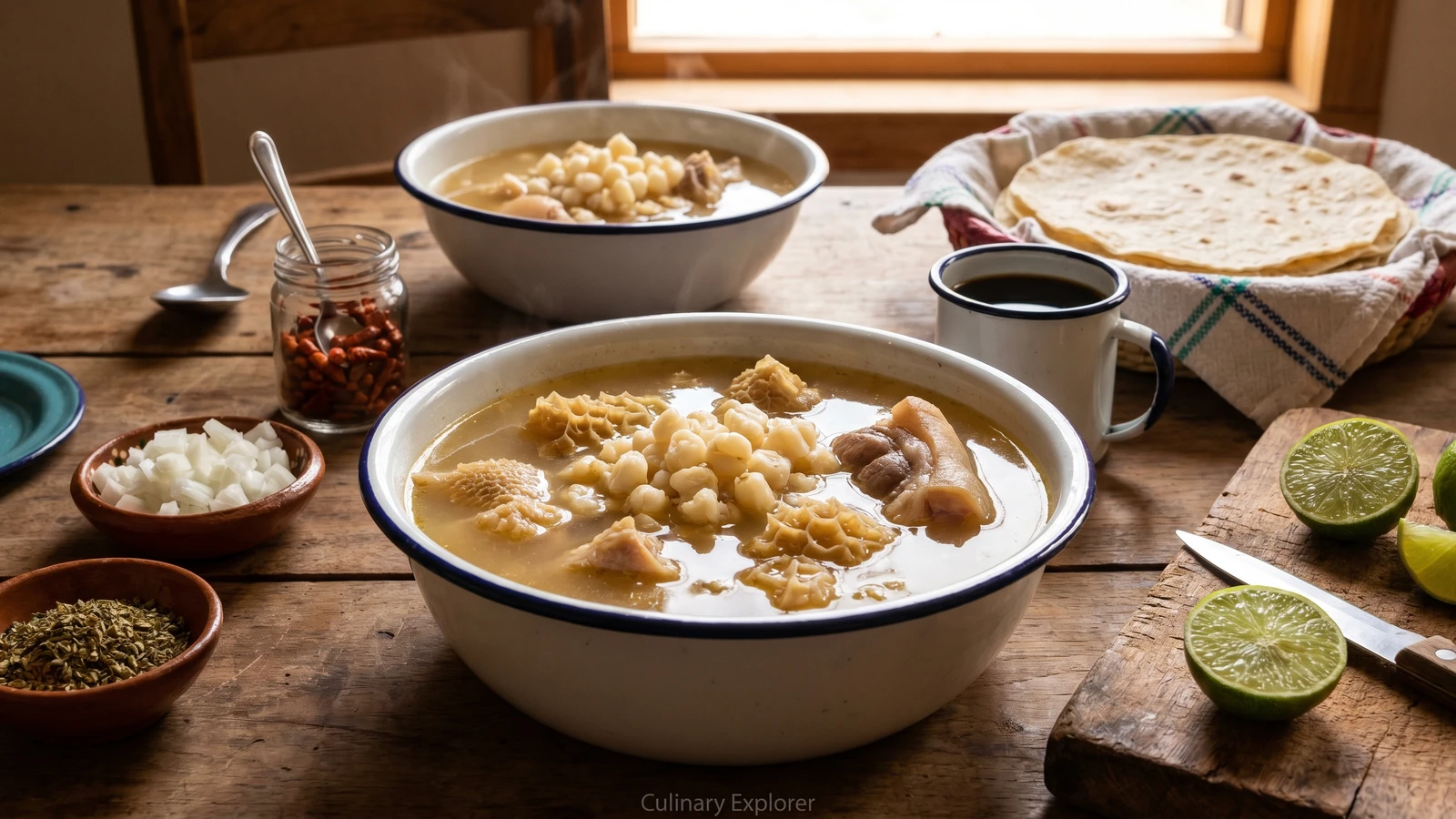
Sonora's white menudo. Tripe and pata simmered for hours in a clear hominy broth with garlic and oregano, finished with crushed chiltepin at the table. The Sunday morning ritual of every household in Hermosillo, Caborca, and Ciudad Obregon.
Menudo is a Sunday morning dish in Sonora. Not a weekday dish, not a restaurant dish, a Sunday dish. The pot goes on Saturday afternoon and simmers slow into the night, and by the time the family wakes up on Sunday the broth is clear, the tripe is tender, and someone is already warming the flour tortillas sobaqueras on the comal.
This is the white menudo, menudo blanco, and the absence of chile in the pot is the point. Other states color their menudo red with chile guajillo and ancho. In Sonora, the broth stays clear, pale gold from the pata and the long simmer, and the heat goes on at the table. A small jar of dried chiltepin sits in the middle, those tiny wild chiles from the Sierra Madre that grow on bushes between the mesquite. You crush one or two between your fingers, drop them into your bowl, squeeze a lime, scatter raw onion and oregano, and eat. That ritual is part of the dish.
The pata is not optional. Beef foot gives menudo its body, the silky texture that coats your spoon and tells you the broth has been worked properly. Without the pata, you have a thin soup with tripe in it. With the pata, you have menudo. Some cooks here will tell you menudo blanco is the cure for a Saturday night that ran long, and the Sonoran name for it, levantamuertos, raises the dead, is not entirely a joke. Saber cocinar es saber vivir.
This is noroeste cooking, so you serve it with flour tortillas sobaqueras, those huge thin discs the size of a steering wheel that Sonoran cooks press by hand and cook on a comal until they are translucent in spots. Corn tortillas with menudo blanco is a southern habit. In Sonora, it is wheat. Cada estado, su propia cocina.
Menudo's origins trace to colonial-era Mexico, when the introduction of European cattle gave cooks access to offal and lower cuts that the wealthy refused, and the long, slow preparation of tripe became a hallmark of working-class kitchens across the country. The clear, chile-free menudo blanco of Sonora and the broader noroeste reflects regional preferences shaped by ranching culture and limited historical access to the cultivated chiles of central and southern Mexico, with the wild chiltepin, harvested from the Sierra Madre Occidental and recognized as the only chile native to what is now the United States-Mexico border region, providing the heat instead. The chiltepin itself has been gathered and traded by the Yoreme, Yaqui, and Tohono O'odham peoples for centuries, and the Sonoran practice of placing it on the table rather than cooking it into the pot preserves an older, indigenous logic of letting each diner season to their own tolerance.
Quantity
3 pounds
cleaned
Quantity
1
split by the butcher into 3 or 4 pieces
Quantity
2 large
one halved, one finely diced for serving
Quantity
3
one halved crosswise, two cloves separated and minced
Quantity
3
Quantity
2 tablespoons, plus more to taste
Quantity
1 tablespoon
Quantity
2 cans (29 ounces each)
drained and rinsed
Quantity
2 tablespoons
Quantity
for the table
Quantity
for serving
Quantity
for serving
Quantity
for serving
Quantity
for serving
warmed
| Ingredient | Quantity |
|---|---|
| beef honeycomb tripe (panza)cleaned | 3 pounds |
| pata de res (beef foot)split by the butcher into 3 or 4 pieces | 1 |
| white onionsone halved, one finely diced for serving | 2 large |
| heads of garlicone halved crosswise, two cloves separated and minced | 3 |
| bay leaves | 3 |
| kosher salt | 2 tablespoons, plus more to taste |
| whole black peppercorns | 1 tablespoon |
| Mexican-style hominy (maiz pozolero)drained and rinsed | 2 cans (29 ounces each) |
| dried Mexican oregano (oregano sonorense if you can find it) | 2 tablespoons |
| dried chiltepin (optional) | for the table |
| lime wedges (optional) | for serving |
| diced white onion (optional) | for serving |
| dried Mexican oregano (for table) (optional) | for serving |
| flour tortillas sobaqueras (optional)warmed | for serving |
Even tripe sold as cleaned needs another wash. Rinse the panza under cold running water, rubbing it with coarse salt and a squeeze of lime. Trim away any dark or fatty patches. Cut it into 1 to 2-inch squares. The tripe should smell faintly of the animal, not strongly. If it smells off, send it back. In Hermosillo, the senoras at the carniceria will not sell you menudo tripe that has not been washed three times. Hold yourself to the same standard.
Place the cleaned tripe and the pieces of pata in a large stockpot, at least 10 quarts. Cover with cold water by three inches. Add the halved onion, the halved head of garlic, bay leaves, peppercorns, and salt. Bring to a gentle simmer over medium heat. Cold water draws the flavor out slowly. A rolling boil clouds the broth and this menudo is supposed to be clear.
For the first thirty minutes, skim the gray foam that rises to the top. Be patient. This is the work that gives you a clean broth instead of a muddy one. Once the foam stops rising, lower the heat until you see lazy bubbles every few seconds. Cover partially and cook for four to five hours. The tripe should be tender enough to bite through cleanly but still hold a little chew. The pata releases collagen that thickens the broth and gives menudo blanco its silky body. La cocina no es decoracion, es trabajo.
After about four hours, lift the pata pieces out with tongs. Let them cool until you can handle them. Peel the soft meat and skin away from the bones, discard the bones, and chop the meat coarsely. Return it to the pot. The bones have given everything they have. The meat is now part of the menudo.
Stir in the drained hominy and the minced garlic. Simmer 30 more minutes, partially covered. Taste for salt now. The hominy absorbs flavor as it sits, so the broth needs to be assertive. The pot should look pale gold, almost ivory, with kernels of hominy and pieces of tripe floating in a clear, glossy broth. There is no chile in the pot. The chiltepin goes on at the table.
Crumble dried oregano between your palms over the pot to wake it up. Ladle the menudo into deep enameled tin bowls or thick clay cazuelas. Set the chiltepin in a small jar in the middle of the table along with diced white onion, lime wedges, more oregano, and a basket of warm flour tortillas sobaqueras. Each diner builds their bowl. The chiltepin is crushed between the fingers directly into the broth. One or two for most people. Three if you grew up in Sonora. Asi se hace y punto.
1 serving (about 500g)
Culinary guides, cultural storytelling, and the editorial depth that makes cooking meaningful.
Discover Culinary ExplorerChef Lupita
Aguascalientes' Bajio pozole de lengua, built with cacahuazintle hominy, tender beef tongue, chile ancho and guajillo, with xoconostle brightness and table garnishes.

Chef Lupita
Veracruz's Gulf coast rice from Alvarado, built with seafood stock, tomato, chile chipotle, epazote, shrimp, fish, jaiba, and pulpo, served loose and brothy in a clay cazuela.

Chef Lupita
Costa Chica's wet salt-beef stew, built from chile costeño, guajillo, tomato, manteca, yuca, plantain, and masa dumplings, the ranching pot of Cuajinicuilapa and Pinotepa.

Chef Lupita
Michoacán's P'urhépecha atápakua is a masa-thickened sauce and stew at once, built with pork, chile guajillo, and hierbabuena added only at the end.