
Chef Lupita
Almendrados Conventuales Poblanos
Puebla's convent almond cookies, made from blanched almonds, sugar syrup, egg yolks, canela, and patient hands, the kind of sweet that belongs beside coffee in talavera, not in a plastic bakery box.
A cooking platform built around craft, culture, and the stories behind what we eat.
Created by
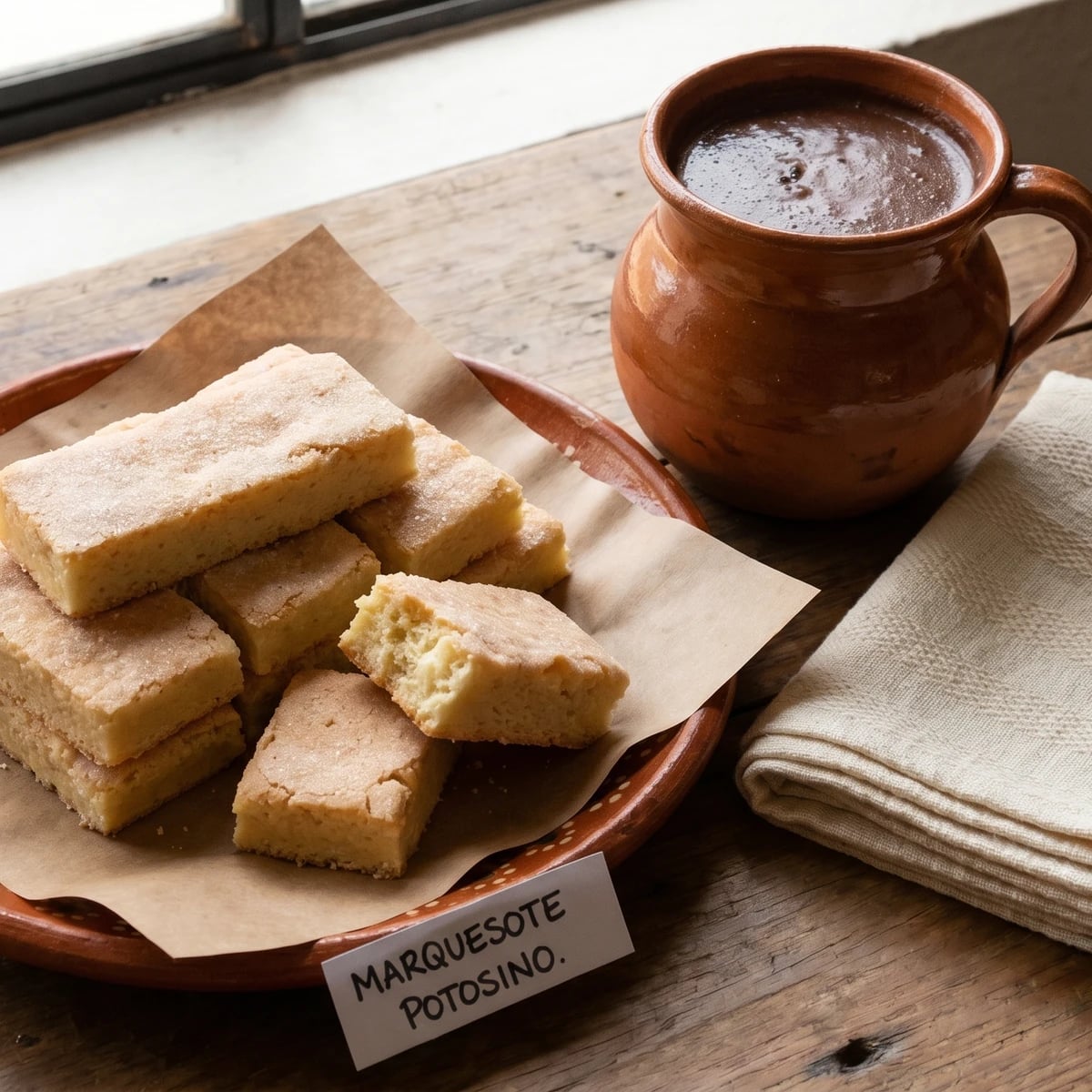
San Luis Potosi's mercado marquesote is a dry, fragile sponge bread made from whipped eggs, wheat flour, and sugar, baked until pale gold and meant to soften in chocolate caliente.
San Luis Potosi, especially the central markets around the capital, keeps this marquesote in the world of the puesto, the paper bag, and the cup of chocolate caliente. This is not cake with frosting. It is a dry sponge bread, closer to a fragile galleta than to birthday cake, made to crack under your fingers and soften when it meets hot chocolate.
The ingredient that defines it is not vanilla or butter. It is air. Egg whites beaten until they stand firm, yolks folded in gently, wheat flour sifted in without knocking the life out of the batter. No water. No milk. No syrup. The old market women know that the structure comes from the eggs, and if you are rough with the folding, the marquesote will sit heavy like a bad biscuit. No me vengas con atajos.
I first wrote this version down in San Luis Potosi after watching a vendor cut long pale slabs into thick bars and stack them in brown paper. She told me, 'Si se rompe poquito, esta bueno.' If it breaks a little, it is good. That is the point. The bread should be dry, light, and honest, waiting for chocolate from a clay jarro. Cada estado, su propia cocina.
Marquesote belongs to the family of egg-based breads that spread through colonial Mexico after wheat flour and convent baking techniques entered regional kitchens in the 16th and 17th centuries. In San Luis Potosi, the market version became a practical dry bread because it traveled well, kept longer than enriched pan dulce, and paired naturally with chocolate caliente sold in plazas and home kitchens. Similar marquesotes exist in Oaxaca, Chiapas, and parts of Central America, but the potosino style is recognized for its spare formula: egg, wheat flour, sugar, and almost nothing else.
Quantity
8
separated, at room temperature
Quantity
1 cup
Quantity
1 1/4 cups
sifted twice
Quantity
1/4 teaspoon
Quantity
1 teaspoon
Quantity
1 tablespoon
for dusting the pan
Quantity
as needed
for greasing the pan
| Ingredient | Quantity |
|---|---|
| large eggsseparated, at room temperature | 8 |
| granulated sugar | 1 cup |
| all-purpose wheat floursifted twice | 1 1/4 cups |
| fine sea salt | 1/4 teaspoon |
| Mexican vanilla extract | 1 teaspoon |
| granulated sugarfor dusting the pan | 1 tablespoon |
| manteca de cerdo or unsalted butterfor greasing the pan | as needed |
Heat the oven to 350F. Grease a 9 by 13-inch metal pan lightly with manteca de cerdo or butter, then dust it with the tablespoon of sugar. Tap out the excess. The sugar gives the outside a dry, fine crust, the kind you find on mercado marquesote wrapped in paper.
Sift the wheat flour with the salt twice. Do it now, before the eggs are whipped. Once the foam is ready, it waits for nobody. Lumpy flour forces you to stir too much later, and too much stirring knocks out the air.
Place the egg whites in a very clean bowl. Beat on medium-high until foamy, then add the sugar a spoonful at a time. Keep beating until the whites are glossy and hold firm peaks. This is the structure of the marquesote. There is no baking powder here to rescue careless work.
Beat the egg yolks lightly with the Mexican vanilla. Add them to the whites in a thin stream while mixing on low just until the color turns pale yellow and even. Stop there. You are not making a dense batter. You are protecting the air you already built.
Sprinkle one third of the sifted flour over the egg mixture. Fold with a wide spatula from the bottom of the bowl up and over the top. Repeat with the remaining flour in two additions. Move slowly but decisively. When the last streak of flour disappears, stop. Así se hace y punto.
Pour the batter into the prepared pan and smooth the top without pressing it down. Bake for 30 to 35 minutes, until the top is pale gold, the surface feels dry, and a toothpick comes out clean. The edges should pull slightly from the pan. Do not look for a moist cake crumb. Marquesote is meant to dry out.
Let the marquesote cool in the pan for 15 minutes, then turn it out onto a rack. Cool completely before cutting into thick rectangles. If you cut it warm, it tears. If a few edges crack after cooling, good. That fragile break is part of the bread.
Serve the bars plain with chocolate caliente in clay jarros. Dunk, let the bread drink for a second, then eat. No glaze, no whipped cream, no decoration. La cocina no es decoracion, es trabajo.
1 serving (about 60g)
Culinary guides, cultural storytelling, and the editorial depth that makes cooking meaningful.
Discover Culinary Explorer
Chef Lupita
Puebla's convent almond cookies, made from blanched almonds, sugar syrup, egg yolks, canela, and patient hands, the kind of sweet that belongs beside coffee in talavera, not in a plastic bakery box.

Chef Lupita
Ciudad de Mexico's panaderia banderillas are long sticks of hojaldre pressed with sugar, baked until amber, and finished with a hard glaze for coffee at the kitchen table.

Chef Lupita
Mérida's pale egg-yolk-and-vanilla kisses, tiny cookies built on eight yolks and a perfume of orange blossom, sandwiched with guava paste and dusted heavy with powdered sugar.

Chef Lupita
Hidalgo's bisquet de nata carries Pachuca's mining history into the breakfast table: a Cornish-style bread softened by Mexican nata, split warm and eaten with café de olla.