
Chef Makoa
Chinese Almond Cookies (Hawaiʻi Local Red-Dot Cookies)
Buttery, sandy Chinese almond cookies from Hawaiʻi's Local table, marked with the lucky red dot, the kind you found in a bakery case, a manapua man's box, or a holiday tin.
A cooking platform built around craft, culture, and the stories behind what we eat.
Created by
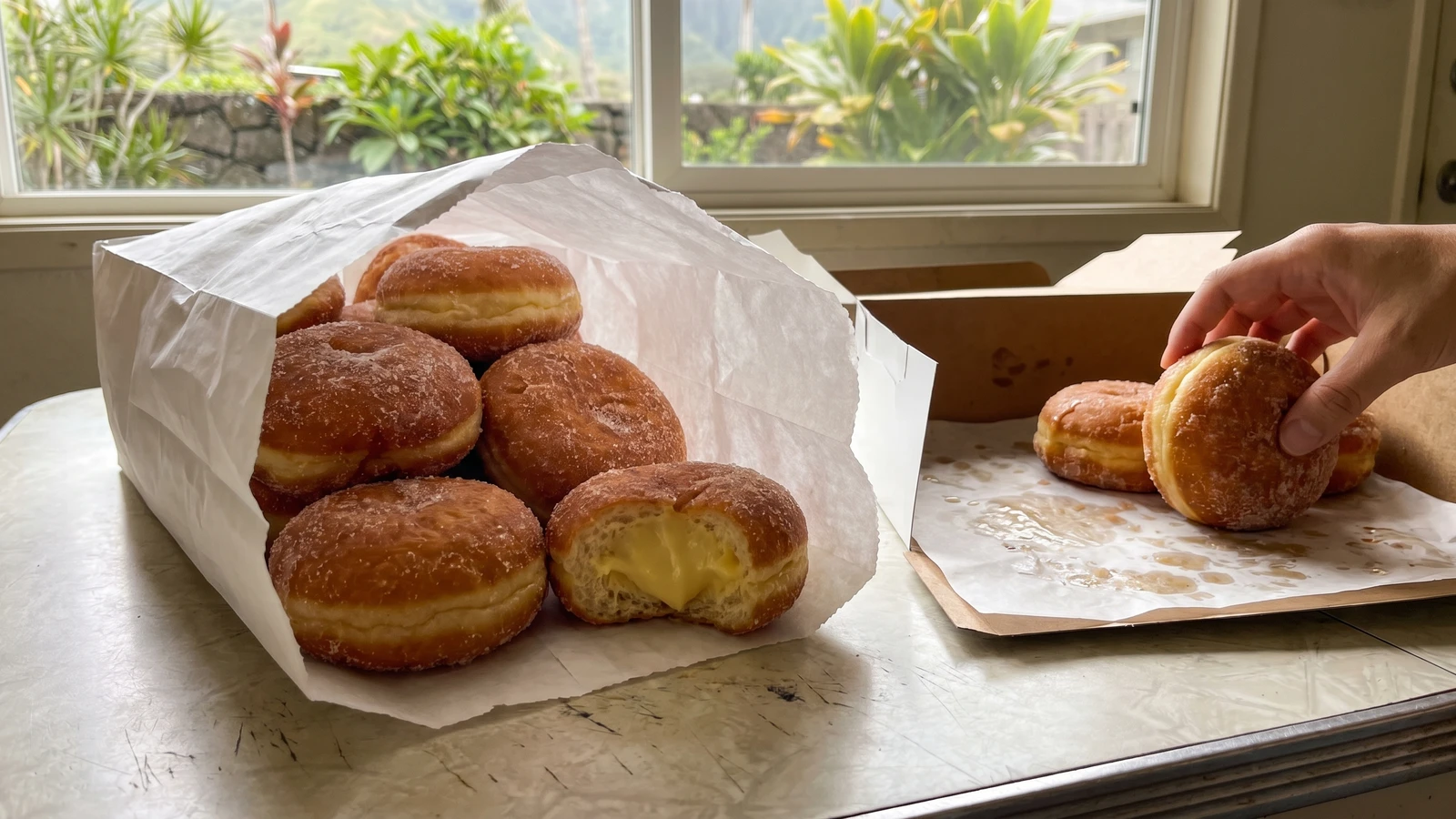
Portuguese dough brought to Hawaiʻi plantation camps in 1878, fried holeless and rolled hot in sugar until the paper bag turns sweet and warm in your hands.
Some foods come by canoe, and some come by ship. This one came by ship, with Portuguese families from Madeira and the Azores who landed in Hawaiʻi in 1878 and went into the hard sugar work that changed these islands for good. The malasada is theirs by hand, and Hawaiʻi made it Local by love, bakery counters, school fundraisers, Fat Tuesday lines, and aunties bringing a warm paper bag to the party.
This is not the food of the loʻi, the kalo patch. No need pretend. Hāloa is our elder brother, and the deep foods still sit at the center, but Hawaiʻi's table has another truth too: Portuguese, Japanese, Okinawan, Chinese, Filipino, Puerto Rican, Korean, all those hands feeding each other after long days in the fields. That is Local food. Keeper, not gatekeeper.
Across the Triangle, the cousins have their own fried breads and sweet doughs: Sāmoan panikeke, Tahitian firi firi with coconut, Māori parāoa parai, and this Portuguese-Hawaiʻi malasada. Same comfort, different island, different history. For this one, you watch the dough more than the clock. Let it rise soft and living, fry it golden, roll it while it's hot, and eat the first one standing up. That's how you know it came out right.
The first large group of Portuguese contract laborers from Madeira arrived in Honolulu in 1878, followed by more families from Madeira and the Azores, and they brought breads, sweet doughs, and the Catholic Shrove Tuesday habit of using up rich pantry foods before Lent. In Hawaiʻi, the malasada moved from Portuguese home kitchens into plantation-camp exchange and then into bakeries, becoming a Local sweet rather than a Kanaka Maoli deep food. Leonard's Bakery, opened in Honolulu in 1952, helped make the hot paper bag of sugared malasadas an everyday Hawaiʻi ritual, not only a Fat Tuesday one.
Quantity
2 1/4 teaspoons
Quantity
1/4 cup
105F to 110F
Quantity
1 teaspoon plus 1/2 cup
divided
Quantity
4 cups
plus more for dusting
Quantity
1/2 teaspoon
Quantity
4
lightly beaten
Quantity
3/4 cup
warmed
Quantity
1/4 cup
warmed
Quantity
4 tablespoons
melted and cooled slightly
Quantity
1 teaspoon
Quantity
for frying
Quantity
1 cup
for rolling
Quantity
1/2 teaspoon
| Ingredient | Quantity |
|---|---|
| active dry yeast | 2 1/4 teaspoons |
| warm water105F to 110F | 1/4 cup |
| granulated sugardivided | 1 teaspoon plus 1/2 cup |
| all-purpose flourplus more for dusting | 4 cups |
| fine sea salt | 1/2 teaspoon |
| large eggslightly beaten | 4 |
| whole milkwarmed | 3/4 cup |
| evaporated milkwarmed | 1/4 cup |
| unsalted buttermelted and cooled slightly | 4 tablespoons |
| vanilla extract | 1 teaspoon |
| neutral oil | for frying |
| granulated sugarfor rolling | 1 cup |
| ground cinnamon (optional) | 1/2 teaspoon |
Stir the yeast, warm water, and 1 teaspoon sugar together in a small bowl. Let it sit 5 to 10 minutes, until it looks foamy and alive. If it stays flat, no blame the dough. Start again with fresh yeast.
In a large bowl, whisk the flour, 1/2 cup sugar, and salt. Add the foamy yeast, eggs, warm whole milk, evaporated milk, melted butter, and vanilla. Mix until a sticky, soft dough comes together. It should be wetter than bread dough, more like something you have to coax than something you can boss around.
Cover the bowl and let the dough rise in a warm place for 1 1/2 to 2 hours, until doubled and puffy. The dough should jiggle when you move the bowl and pull in long soft strands when you touch it with floured fingers.
Turn the dough onto a well-floured surface and pat it gently to about 1/2 inch thick. Cut into 18 squares or rounds, then set them on floured parchment. Cover lightly and let them rest 20 to 30 minutes, until puffed again. Don't press the life out of them.
Pour 2 to 3 inches of oil into a heavy pot and heat to 350F. Keep the sugar for rolling in a wide bowl, with cinnamon mixed in if you like that bakery-case smell. Set a rack nearby. Once the frying starts, everything moves fast.
Fry 3 or 4 malasadas at a time, about 1 1/2 to 2 minutes per side, until deep golden and round-bellied. The outside should look smooth and glossy from the oil, with little pale seams where the dough puffed. Keep the oil near 350F so they cook through before they brown too hard.
Lift the malasadas to the rack for just a few seconds, then roll them hot in sugar so it grabs all over. Eat them warm, when the crust gives soft under your teeth and the inside is tender and eggy. A filled one is good too, custard, haupia, guava, lilikoi, but the plain sugar one tells the story first.
1 serving (about 76g)
Culinary guides, cultural storytelling, and the editorial depth that makes cooking meaningful.
Discover Culinary ExplorerChef Makoa
Buttery, sandy Chinese almond cookies from Hawaiʻi's Local table, marked with the lucky red dot, the kind you found in a bakery case, a manapua man's box, or a holiday tin.

Chef Makoa
A Hawaiʻi Local bakery pie from Oʻahu: firm coconut haupia over chocolate cream in a flaky shell, chilled clean, topped with soft whipped cream.

Chef Makoa
Honolulu bakery-case comfort: crisp choux puffs filled with soft chocolate pudding and capped with Hawaiʻi-style Chantilly, the buttery cooked frosting that belongs to Oʻahu birthdays, office boxes, and after-school hands.

Chef Makoa
The Oʻahu home-tin cookie, buttery and crackly with cornflakes and rice cereal, baked by aunties for Christmas exchanges, church potlucks, and one more cousin reaching across the table.