
Chef Lupita
Aporreadillo Michoacano con Huevo
Michoacán's Tierra Caliente almuerzo, where salted beef is softened, pounded, fried in lard, folded with egg and chile perón salsa, then served beside morisqueta like a proper working table.
A cooking platform built around craft, culture, and the stories behind what we eat.
Created by
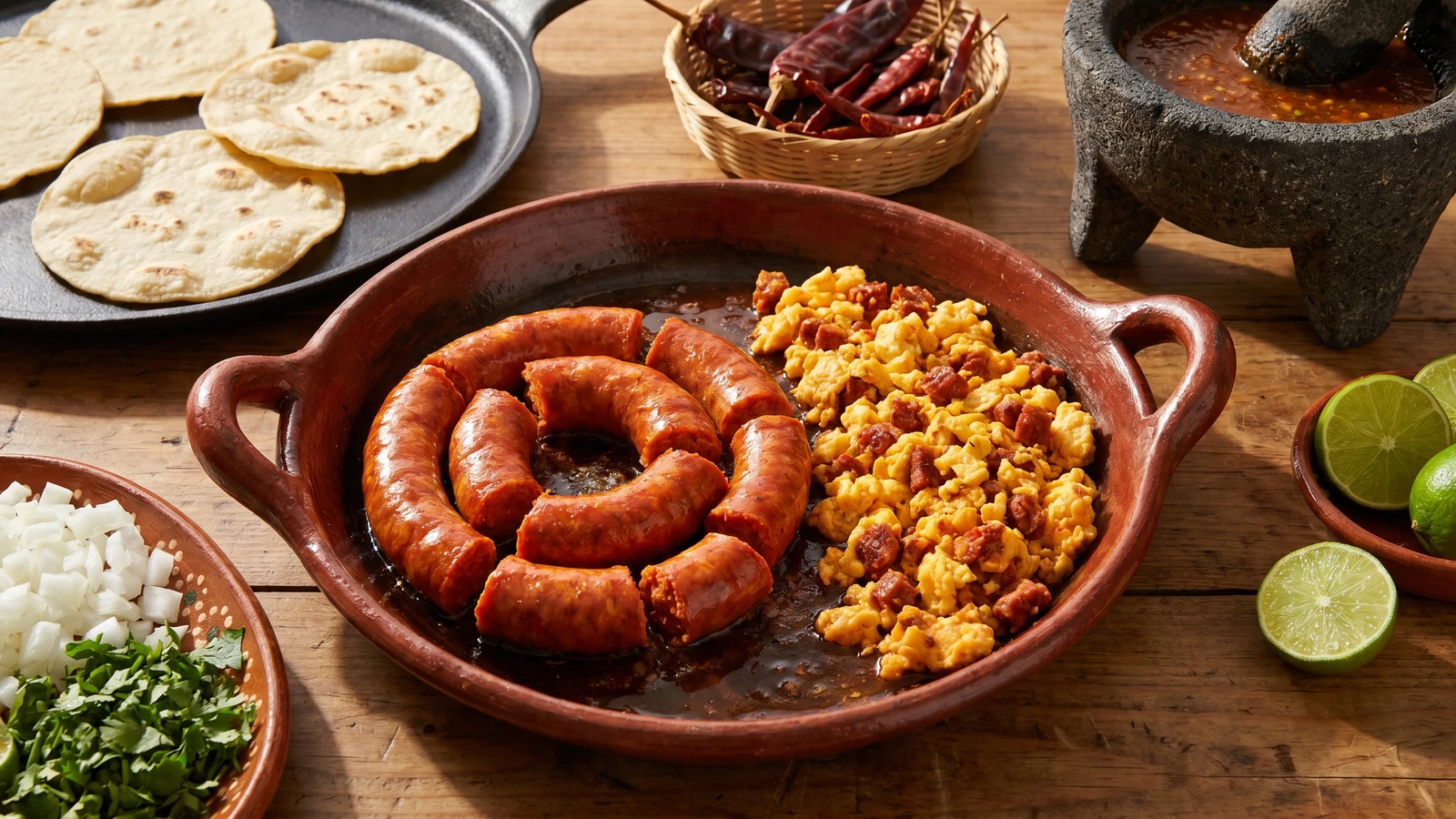
Guerrero's Chilapa longaniza is pork leg and lomo rubbed with guajillo, chile de árbol, bay, clove, and pineapple vinegar, rested overnight, then crisped in its own fat for almuerzo.
Guerrero, specifically Chilapa de Álvarez in the Región Centro near the Montaña Baja, is where this longaniza carries its name properly. The town sits between Chilpancingo and the mountain roads, with a market that pulls in Nahua sellers carrying corn, chiles, herbs, fruit, and whatever the hills gave that week. This is not a northern breakfast sausage and it does not belong in a flour tortilla. Corn tortillas, comal-warm, are the plate.
The defining taste is chile guajillo sharpened with vinagre de piña. Guajillo gives the red color and dried-fruit depth. Chile de árbol gives the quick bite. Laurel and clavo make it smell like a Guerrero butcher's morning, not like supermarket chorizo. The vinegar keeps the pork bright and pushes the adobo into the meat while it rests overnight.
I learned this kind of sausage from women who did not need a timer to know when meat had taken the seasoning. They pressed the mixture in the palm, smelled the vinegar, fried a pinch, corrected the salt, and only then filled the casing. That is the technique. Your hands learn before your notebook does.
Crisp it at dawn in its own fat, fold it into eggs, or eat it straight from the cazuela with salsa de chile de árbol and tortillas. Nothing fancy. Nothing timid. La cocina no es decoración, es trabajo. Recetas probadas y garantizadas.
Longaniza entered Mexico through Spanish sausage-making, but Mexican cooks rebuilt it around pork, local chiles, vinegar, and the market habits of each region; the name traces to the Latin lucanicia, a sausage associated with Lucania. In Chilapa, Guerrero, the documented version is made with ground pork leg or loin seasoned with chile guajillo, vinegar, bay leaf, clove, and salt, which is why this recipe keeps guajillo, laurel, clavo, and vinagre de piña at the center. The long, untied casing separates longaniza from much of Mexico's chorizo, which is usually tied into short segments.
Quantity
2 pounds
very cold, cut into 1-inch cubes
Quantity
12 ounces
very cold, cut into 1-inch cubes
Quantity
20 grams, about 1 tablespoon plus 1 teaspoon
Quantity
8
stemmed and seeded
Quantity
4
stemmed
Quantity
1/2 cup
Quantity
5
peeled
Quantity
2
Quantity
3
Quantity
1 teaspoon
Quantity
1/2 teaspoon
Quantity
6 feet
soaked in cool water for 30 minutes and rinsed inside and out
Quantity
1 tablespoon
only if the sausage is lean when frying
Quantity
8
beaten, optional for longaniza con huevo
Quantity
for serving
Quantity
for serving
Quantity
for serving
Quantity
for serving
Quantity
for serving
| Ingredient | Quantity |
|---|---|
| pork leg or pork loinvery cold, cut into 1-inch cubes | 2 pounds |
| pork back fat or firm pork belly fatvery cold, cut into 1-inch cubes | 12 ounces |
| fine sea salt | 20 grams, about 1 tablespoon plus 1 teaspoon |
| dried chile guajillostemmed and seeded | 8 |
| dried chile de árbolstemmed | 4 |
| vinagre de piña (pineapple vinegar) | 1/2 cup |
| garlic clovespeeled | 5 |
| dried bay leaves | 2 |
| whole cloves | 3 |
| black peppercorns | 1 teaspoon |
| dried Mexican oregano | 1/2 teaspoon |
| cleaned hog casingsoaked in cool water for 30 minutes and rinsed inside and out | 6 feet |
| manteca de cerdo (optional)only if the sausage is lean when frying | 1 tablespoon |
| large eggs (optional)beaten, optional for longaniza con huevo | 8 |
| warm corn tortillas (optional) | for serving |
| salsa de chile de árbol (optional) | for serving |
| diced raw white onion (optional) | for serving |
| chopped cilantro (optional) | for serving |
| lime halves (optional) | for serving |
Spread the pork and fat on a tray and put them in the freezer for 25 minutes, just until the edges firm up. Chill the grinder parts and the mixing bowl too. Cold fat cuts cleanly. Warm fat smears, and smeared fat gives you a dry sausage that leaks before it browns. Soak and rinse the casing while the meat chills.
Heat a dry comal over medium. Toast the guajillos about 20 seconds per side, just until they darken slightly and smell sweet. Toast the chile de árbol for only a few seconds. It burns fast and turns bitter fast. Toast the bay leaves, cloves, and peppercorns for 20 seconds, moving them constantly. The smell should be sharp and warm, like a Chilapa butcher stall at dawn.
Cover the toasted chiles with hot water and let them soften for 15 minutes. Drain them. Blend the softened chiles with the vinagre de piña, garlic, salt, bay leaves, cloves, peppercorns, and Mexican oregano until you have a smooth brick-red paste. If the blender struggles, add 1 or 2 tablespoons of the chile soaking water, no more. The adobo should coat a spoon, not run like soup.
Grind the chilled pork and fat through a coarse plate into the chilled bowl. If you asked the butcher to grind it, make sure it was ground once, coarse, and kept cold. This is longaniza, not supermarket paste. You want small pieces of meat and fat that will fry into texture.
Add the adobo to the ground pork. Mix with clean cold hands for 3 to 4 minutes, until the meat turns sticky and holds together when pressed. Fry a teaspoon of the mixture in a small skillet and taste it. It should be salty, acidic, and chile-forward. The overnight rest will calm the edges. Cover and refrigerate 8 to 12 hours. No me vengas con atajos. The meat needs time to take the adobo.
Thread the rinsed casing onto the stuffer. Fill it steadily, keeping the sausage long and slender, with enough slack that it bends without bursting. Do not tie it into little links. That is chorizo behavior. Longaniza stays long. Prick any air pockets with a clean needle and coil the sausage loosely on a tray.
Set the coil on a rack over a tray and refrigerate uncovered for 8 to 12 hours. The surface will dry, the casing will tighten, and the red color will deepen. Do not hang raw pork in a warm kitchen. Old market kitchens had airflow, salt, and habits built over generations. Your apartment does not. Saber cocinar es saber vivir.
Lay the coil in a wide clay cazuela or cast iron skillet. Add 1/4 cup water and cook over medium-low heat, turning carefully, until the water evaporates and the sausage starts frying in its own rendered fat. If the pork was lean, add the tablespoon of manteca de cerdo. Cook until the casing is blistered, the edges are mahogany-red, and the center reaches 160F. La manteca es el sabor, but raw pork is not a tradition.
Cut the longaniza into pieces and serve with warm corn tortillas, salsa de chile de árbol, raw white onion, cilantro, and lime. For longaniza con huevo, crumble 8 ounces of the cooked sausage back into the skillet, add the beaten eggs, and stir until just set. Almuerzo is the hearty mid-morning meal, not a timid snack. Corn tortillas belong here. Flour tortillas belong to the north. Cada estado, su propia cocina.
1 serving (about 140g)
Culinary guides, cultural storytelling, and the editorial depth that makes cooking meaningful.
Discover Culinary ExplorerChef Lupita
Michoacán's Tierra Caliente almuerzo, where salted beef is softened, pounded, fried in lard, folded with egg and chile perón salsa, then served beside morisqueta like a proper working table.

Chef Lupita
Guerrero's Costa Grande aporreado is salted cecina pounded soft, scrambled with egg, and finished in a red guajillo and chile de árbol salsa loud with garlic and cilantro.

Chef Lupita
Los Altos de Chiapas turns two-night fermented white corn into a tart-sweet atole, cooked with canela and piloncillo, then poured hot into jícaras for desayuno.

Chef Lupita
Oaxaca's Mixteca region ferments nixtamalized masa for days until it turns tart and alive, then simmers it with piloncillo and canela into a thick, warm atole served at first light in clay.