
Chef Jeong-sun
Agwi-jjim (Braised Monkfish with Bean Sprouts)
Firm monkfish buried under crisp soybean sprouts, minari, and a red gochugaru sauce thickened at the end; Masan's market dish asks for heat, timing, and a steady hand.
A cooking platform built around craft, culture, and the stories behind what we eat.
Created by
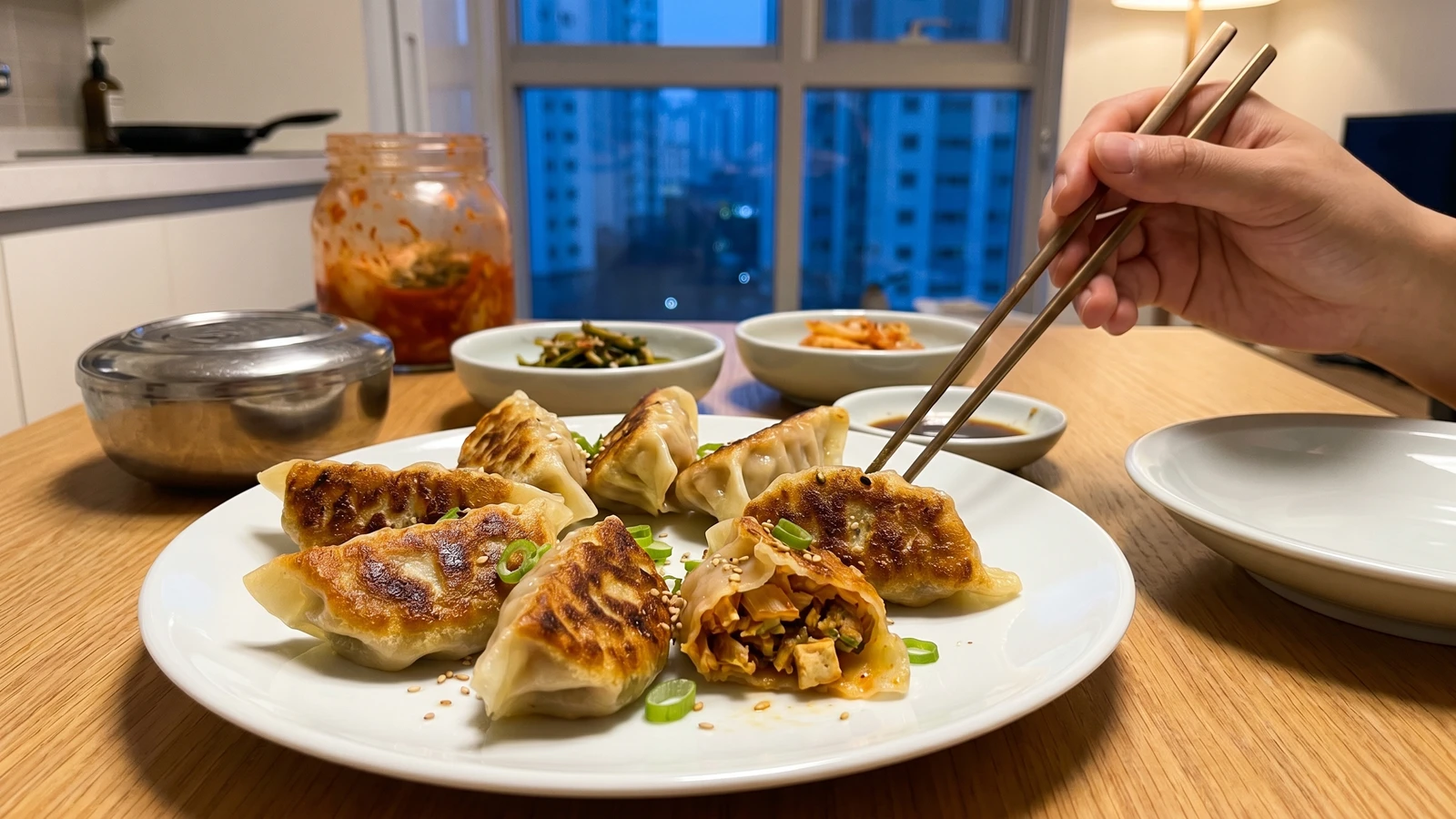
Well-sour kimchi, wrung out hard and chopped fine, folded with pork, tofu, and glass noodles into dumplings that can be boiled for soup or pan-fried for the table.
Kimchi-mandu lives or dies by the squeeze. Not the folding. Not the pretty pleat. The filling has to be dry enough to hold together, because kimchi carries more liquid than people respect, and that liquid will burst a dumpling faster than bad hands ever will.
My teacher Master Seong-nyeo made us wring the kimchi in a cloth until our wrists complained, then she would weigh it after. 눈동냥, 귀동냥, borrowing with the eyes and ears, taught me the motion before anyone gave me the number. Notebook 31 says this clearly: 300 grams of chopped sour kimchi should become about 200 grams after squeezing. That is not fussiness. That is the difference between a dumpling and a leaking pot.
These are weeknight dumplings, not festival mandu dressed for a ceremony, though the same hands can make both. Use kimchi that has gone properly sour, pork with enough fat to stay tender, and tofu pressed until it stops weeping. The filling should taste bright, savory, and clean, with the kimchi first and the pork rounding it out underneath. Let it taste like itself.
You can boil them for mandu-guk (dumpling soup), pan-fry them for a crisp-bottomed plate, or freeze a tray for the next tired evening. The safe corner to cut is the wrapper: bought dumpling skins are honest help. The corner not to cut is draining the filling. Write that down. Memory is a borrowed bowl.
Mandu came into Korea through northern and Central Asian routes and became especially rooted in the northern provinces, where wheat and buckwheat wrappers were more common than in the rice-growing south. Kimchi-mandu reflects the home logic of winter and kimjang: well-fermented cabbage kimchi, pork, tofu, and noodles turned into a filling that stretches ingredients and feeds many hands. After the Korean War, northern-style mandu shops and home recipes spread more widely through Seoul and other southern cities with displaced families.
Quantity
300g before squeezing, about 200g after
squeezed dry and finely chopped
Quantity
250g
preferably 20 percent fat
Quantity
200g
pressed and crumbled
Quantity
80g
Quantity
120g
trimmed if needed
Quantity
3
finely chopped
Quantity
2 cloves
minced
Quantity
1 tablespoon
Quantity
1 tablespoon
Quantity
1 teaspoon
Quantity
1/2 teaspoon
Quantity
1/4 teaspoon
freshly ground
Quantity
1 large
lightly beaten
Quantity
36, about 3 1/2 inches wide
Quantity
small bowl
for sealing
Quantity
2 tablespoons
for pan-frying
Quantity
1/3 cup
for pan-frying
Quantity
to serve
| Ingredient | Quantity |
|---|---|
| well-sour napa cabbage kimchisqueezed dry and finely chopped | 300g before squeezing, about 200g after |
| ground porkpreferably 20 percent fat | 250g |
| firm tofupressed and crumbled | 200g |
| dried dangmyeon (sweet potato starch noodles) | 80g |
| mung bean sprouts or soybean sproutstrimmed if needed | 120g |
| scallionsfinely chopped | 3 |
| garlicminced | 2 cloves |
| soy sauce | 1 tablespoon |
| toasted sesame oil | 1 tablespoon |
| gochugaru (Korean chili flakes) (optional) | 1 teaspoon |
| fine sea salt | 1/2 teaspoon |
| black pepperfreshly ground | 1/4 teaspoon |
| egglightly beaten | 1 large |
| round mandu wrappers | 36, about 3 1/2 inches wide |
| waterfor sealing | small bowl |
| neutral oilfor pan-frying | 2 tablespoons |
| waterfor pan-frying | 1/3 cup |
| soy-vinegar dipping sauce (optional) | to serve |
Chop the kimchi roughly, wrap it in a clean kitchen towel, and wring it hard over the sink. Start with 300 grams and aim for about 200 grams after squeezing. Then chop it fine, no pieces longer than 1/4 inch. Big wet kimchi pieces tear wrappers and make the filling leak, so this is the step that decides the dumpling.
Wrap the tofu in a clean towel and press it under a plate for 15 minutes, then crumble it finely with your fingers. You want the texture of damp crumbs, not paste. Tofu softens the pork and rounds the kimchi's sourness, but only if its water has been pressed out first.
Boil the dangmyeon for 6 to 7 minutes, until tender all the way through. Rinse briefly under cold water, drain very well, and chop into 1/4-inch pieces. Long noodles pull out of the filling when you bite, so cut them short enough to bind the dumpling instead of dragging through it.
Boil the sprouts for 2 minutes, then drain and squeeze them dry in your hands once cool enough to handle. Chop them fine. They bring a clean crunch, but their water is quiet trouble, the kind you only notice when the wrapper splits.
In a wide bowl, combine the squeezed kimchi, pork, tofu, noodles, sprouts, scallions, garlic, soy sauce, sesame oil, gochugaru if using, salt, pepper, and beaten egg. Mix by hand in one direction for 2 minutes, until the filling turns sticky and holds together when pressed. Taste by cooking 1 teaspoon of filling in a small pan. It should be bright from kimchi, savory from pork, and only lightly salty because the dipping sauce will add more.
Lay 6 wrappers on the counter and keep the rest covered so they do not dry. Put 1 level tablespoon, about 18 grams, of filling in the center of each wrapper. Wet the edge with water, fold into a half-moon, and press the air out before sealing. Air pockets expand in the pot and split the wrapper, so do not trap them for the sake of speed.
Pleat the sealed edge if you like, or leave it plain and firm. Pretty pleats are not dinner; a tight seal is dinner. Set the mandu on a lightly floured tray with space between them, and cover with a towel while you finish the batch.
For boiled mandu, lower them into gently boiling water or broth and cook 5 to 6 minutes, until they float and the pork filling is cooked through. For pan-fried mandu, heat 2 tablespoons oil in a wide skillet, set the dumplings flat-side down, and cook 2 to 3 minutes until the bottoms are deep golden. Add 1/3 cup water, cover, and cook 5 minutes, then uncover and cook until the bottoms are crisp again.
Serve the mandu hot with a small dish of soy-vinegar dipping sauce. If pan-fried, set the crisp bottoms facing up so they stay that way. If boiled, lift them gently with a slotted spoon and do not pile them too high; tender wrappers stick when they are crowded.
1 serving (about 270g)
Culinary guides, cultural storytelling, and the editorial depth that makes cooking meaningful.
Discover Culinary ExplorerChef Jeong-sun
Firm monkfish buried under crisp soybean sprouts, minari, and a red gochugaru sauce thickened at the end; Masan's market dish asks for heat, timing, and a steady hand.

Chef Jeong-sun
A quick Korean rice bowl built on contrast: warm rice, cold popping flying-fish roe, chopped vegetables, gim, sesame oil, and the crisp rice bottom a hot stone bowl gives you.

Chef Jeong-sun
Andong's guest noodles, wheat and roasted soybean flour rolled thin, boiled and rinsed cold, then set in a clear chilled anchovy broth with careful strips of beef, egg, and cucumber.

Chef Jeong-sun
Andong's ritual-table rice served on an ordinary day: separate soy-sesame namul, warm rice, and clear radish soup, mixed without gochujang so every vegetable keeps its own voice.