Chef Fai
Sticky Rice Dumplings in Coconut Cream (Bua Loi)
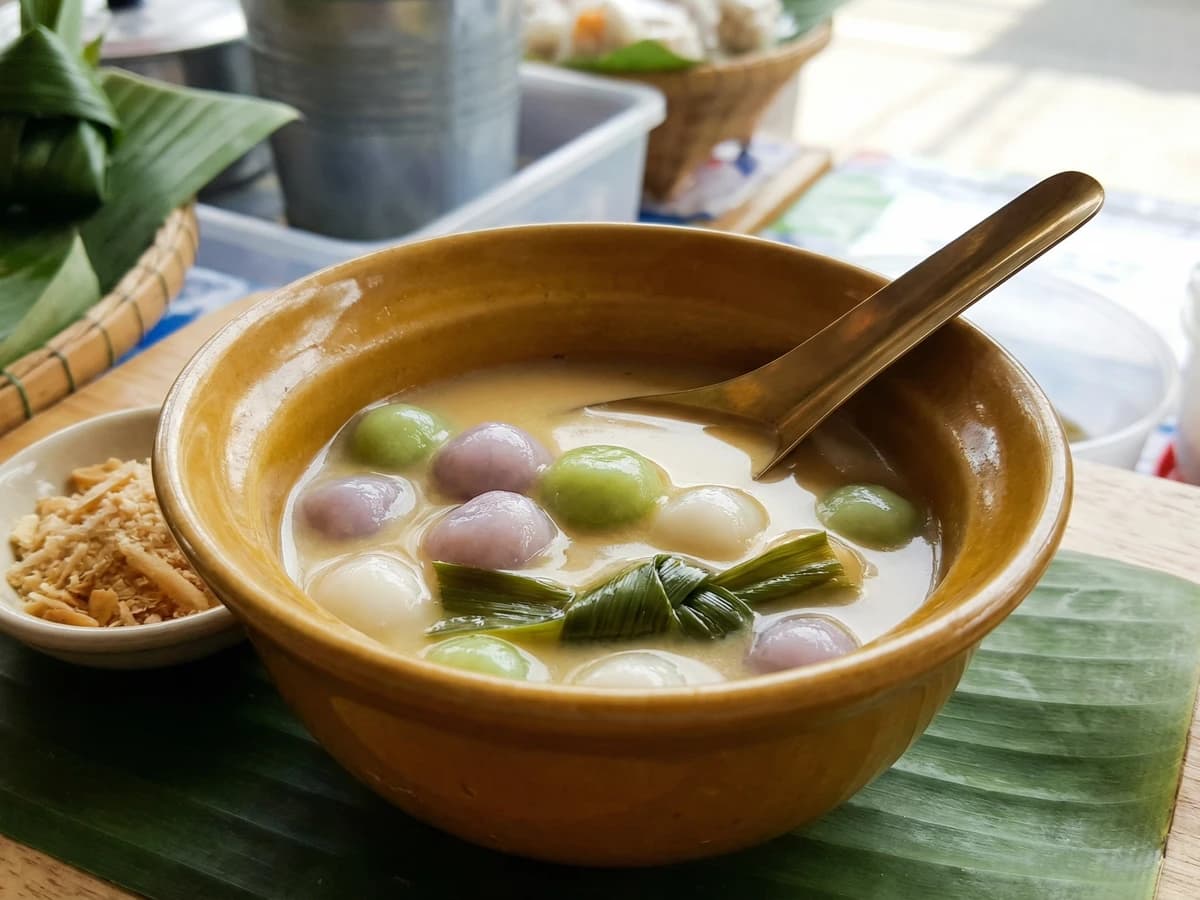
Glutinous rice flour, palm sugar, coconut cream, and a pinch of salt. Thai dessert follows the same governing rules as every savory dish. The system doesn't stop at the sweet course.
A cooking platform built around craft, culture, and the stories behind what we eat.

Created by
Rice flour and mung bean flour. No wheat, no butter, no oven. Spread paper-thin on a hot griddle, filled sweet or savory, folded and gone in two bites. Single-dish mastery is the principle. The vendor's wrist is the technology.
Khanom buang is not a crepe. Don't call it a crepe. A crepe is wheat flour, butter, milk, French technique. Khanom buang is rice flour and mung bean flour bound with coconut cream, spread so thin on a hot griddle that it turns to glass in seconds. The batter has no gluten. The crispiness comes from starch gelatinization on contact with heat: mung bean starch hits the surface, the water flashes off, and what's left is a shell that shatters like a wafer. That's physics, not pastry.
Ajarn always said that Thai food is a system, and the system doesn't stop at savory dishes. The same principles that govern a green curry govern this street snack. Rice-based, coconut-enriched, built for the tropics. No dairy culture. No wheat tradition. The ingredients follow the land. Coconut cream replaces butter. Rice flour replaces wheat. Lime water (nam poon sai) replaces baking powder. Everything has a reason.
Here's what makes khanom buang brilliant: one batter, one griddle, two completely different experiences. The vendor spreads the shell, and in the seconds before it sets, she puts sweet meringue and shredded coconut on one, savory shrimp floss with cilantro and pepper on the next. Sweet, savory, sweet, savory. The customer never picks just one. That duality isn't a sales trick. It's how Thais eat. You don't commit to one flavor. You alternate. You contrast. The same reason a Thai table has curries and salads and soups and relishes all at once. Balance across the spread, not in a single bite.
I watched a khanom buang vendor near Sanam Luang work her griddle for an hour without stopping. Ladle, spread, fill, fold, plate. Under thirty seconds per crepe. Her wrist moved the same way every time, the same arc, the same pressure, the same tilt. She's been doing that motion for decades. That's not cooking. That's craft. That's single-dish mastery, the highest expression of street food. She doesn't need a recipe. She needs her griddle, her batter, and ten thousand hours of muscle memory.
Khanom buang (ขนมเบื้อง) dates to the Ayutthaya period (14th-18th century) and is among the oldest documented sweets in Thai culinary records. The meringue topping reflects the influence of Maria Guyomar de Pinha and Portuguese traders who introduced egg-based confections to the Siamese court in the 17th century, the same wave that gave Thailand foi thong (golden egg threads) and thong yip (pinched egg yolk sweets). The savory shrimp floss version is a later Bangkok street adaptation, and the sweet-savory duality that defines the modern vendor's griddle likely solidified in the Rattanakosin period as khanom buang migrated from court snack to street commodity.
Quantity
150g
Quantity
50g
Quantity
60g
Quantity
1
Quantity
200ml
Quantity
100ml
Quantity
2 tablespoons
Quantity
pinch
Quantity
4
Quantity
200g
Quantity
1/2 teaspoon
Quantity
100g
lightly sweetened
Quantity
80g
pounded into fine floss
Quantity
1 small bunch
Quantity
1/2 teaspoon
| Ingredient | Quantity |
|---|---|
| rice flour (paeng khao jao) | 150g |
| mung bean flour (paeng thua khiaw) | 50g |
| granulated sugar (for batter) | 60g |
| whole egg | 1 |
| coconut cream (hua kathi) | 200ml |
| water | 100ml |
| lime water (nam poon sai) | 2 tablespoons |
| salt | pinch |
| egg whites (for meringue) | 4 |
| granulated sugar (for meringue) | 200g |
| white vinegar | 1/2 teaspoon |
| shredded young coconut (maprao khut)lightly sweetened | 100g |
| dried shrimp (goong haeng)pounded into fine floss | 80g |
| fresh cilantro leaves (pak chi) | 1 small bunch |
| ground white pepper (prik thai) | 1/2 teaspoon |
Combine the rice flour, mung bean flour, sugar, and salt in a mixing bowl. Whisk the egg into the coconut cream, then pour the wet mixture into the dry. Add the water gradually, stirring until smooth. The consistency should be like heavy cream: it flows off a spoon in a thin, continuous stream but isn't watery. Add the lime water (nam poon sai) last and stir it through. This is the ingredient most people skip and then wonder why their shells aren't crispy enough. The calcium in the lime water tightens the starch network as it cooks, giving you that glass-like shatter. Let the batter rest for at least thirty minutes. An hour is better. Overnight in the fridge is best.
In a very clean, dry bowl, whip the egg whites with the vinegar until they hold soft peaks. Add the sugar in three batches, whipping after each addition until fully dissolved. Keep going until you hit stiff, glossy peaks. Rub a bit between your fingers. If it feels gritty, the sugar isn't dissolved yet. Keep whipping. The meringue should be dense, smooth, and hold its shape on a spoon without weeping. This is your sweet filling. It goes on the shell while the shell is still on the griddle, so it needs to be thick enough to stay put.
For the sweet crepes: have your shredded young coconut ready. If it's unsweetened, toss it with a tablespoon of sugar. The coconut should be moist, not dry. For the savory crepes: take the dried shrimp and pound them in a mortar until they break into fine, fluffy threads. Not powder. Floss. You want wispy strands that feel light and airy, almost cotton-like. Pick your cilantro leaves from the stems. Have the white pepper within arm's reach. Once you start cooking, everything happens fast. Organize your station before the griddle heats up.
Set a flat griddle or large non-stick pan over medium heat. Not high. Not low. Medium. This is where most people fail. Too hot and the batter sets before you can spread it. Too cool and it won't crisp. Test it: drop a tiny bit of batter on the surface. It should sizzle gently and begin to set at the edges within three seconds, but give you enough time to spread. If it seizes immediately, lower the heat. If it just sits there doing nothing, raise it. The right temperature is the entire technique. Everything else is secondary.
Lightly grease the griddle with a thin film of oil on a paper towel. Spoon about one tablespoon of batter onto the surface. Immediately use the back of the spoon to spread it into a thin oval, about 8 centimeters long and 5 centimeters wide. The motion is fast: one smooth outward stroke from the center. You have maybe two seconds before the batter starts setting. Don't go back over it. Don't try to fix thin spots. One stroke. Done. The shell should be translucent and paper-thin. If it's thick enough to be opaque, you used too much batter or spread too slowly.
While the shell is still on the heat and the surface has just set (about ten seconds after spreading), add your filling. For sweet: spoon a line of meringue down the center, then scatter shredded coconut on top. For savory: place a line of shrimp floss down the center, add a few cilantro leaves, dust with white pepper. Work quickly. The edges of the shell will start curling upward as it crisps, which is exactly what you want. That curl is the starch drying out. It means the shell is ready to fold.
Use a thin spatula to gently fold the shell in half, pressing the edges together lightly. The filling should be enclosed in a half-moon shape. Lift the crepe off the griddle and place it on a rack or plate. It should feel rigid and crispy, not floppy. If it bends without breaking, it needed more time on the heat. If it crumbles when you fold it, the griddle was too hot. The perfect khanom buang snaps cleanly when you bite it, and the filling inside is cool and soft against the hot, crispy shell. That temperature contrast is part of the design. Repeat with the remaining batter, alternating sweet and savory. A good rhythm is one crepe every twenty to thirty seconds.
1 serving (about 35g)
Culinary guides, cultural storytelling, and the editorial depth that makes cooking meaningful.
Discover Culinary ExplorerChef Fai
Glutinous rice flour, palm sugar, coconut cream, and a pinch of salt. Thai dessert follows the same governing rules as every savory dish. The system doesn't stop at the sweet course.
Chef Fai
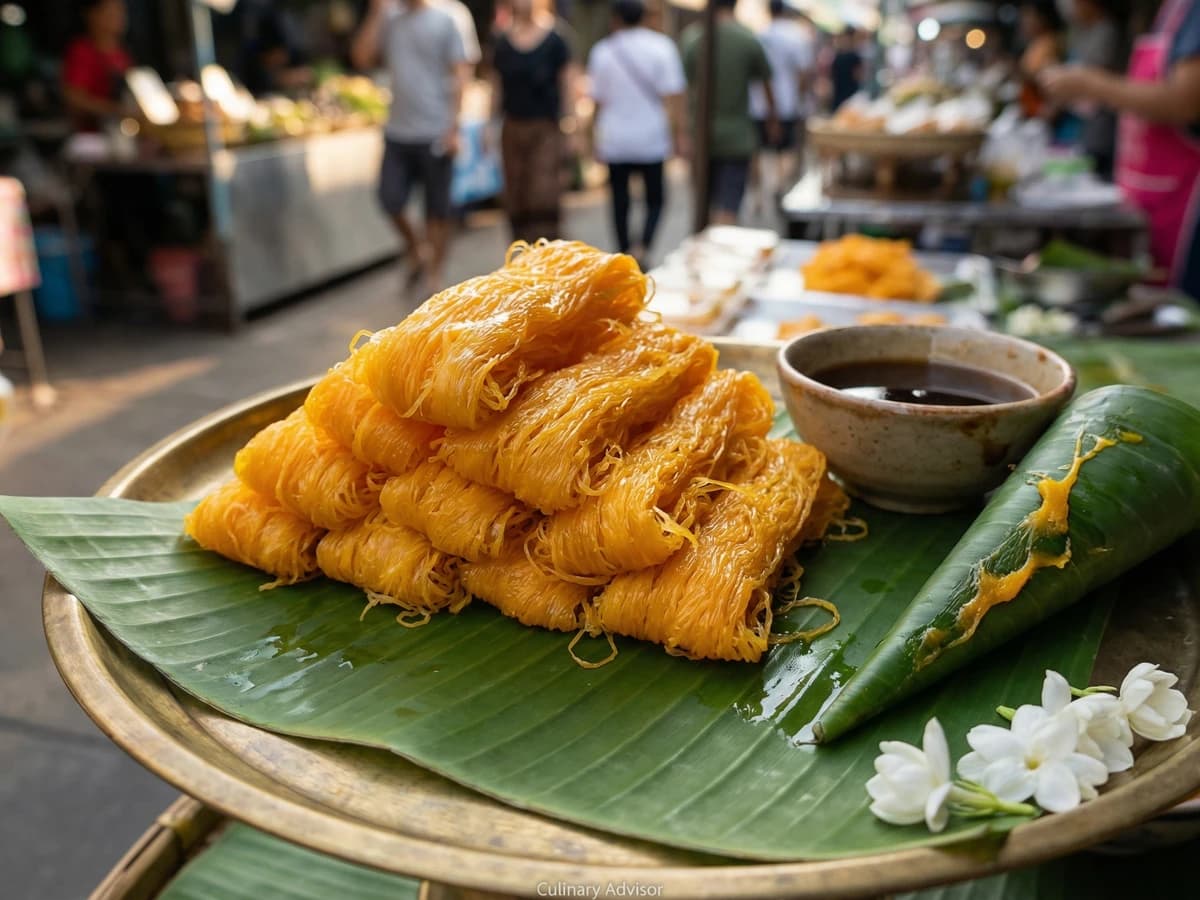
Portuguese fios de ovos arrived in Ayutthaya and Thailand rewrote the rules: palm sugar replaced white, jasmine water replaced plain, and a foreign technique became Thai the moment it followed the system.
Chef Fai
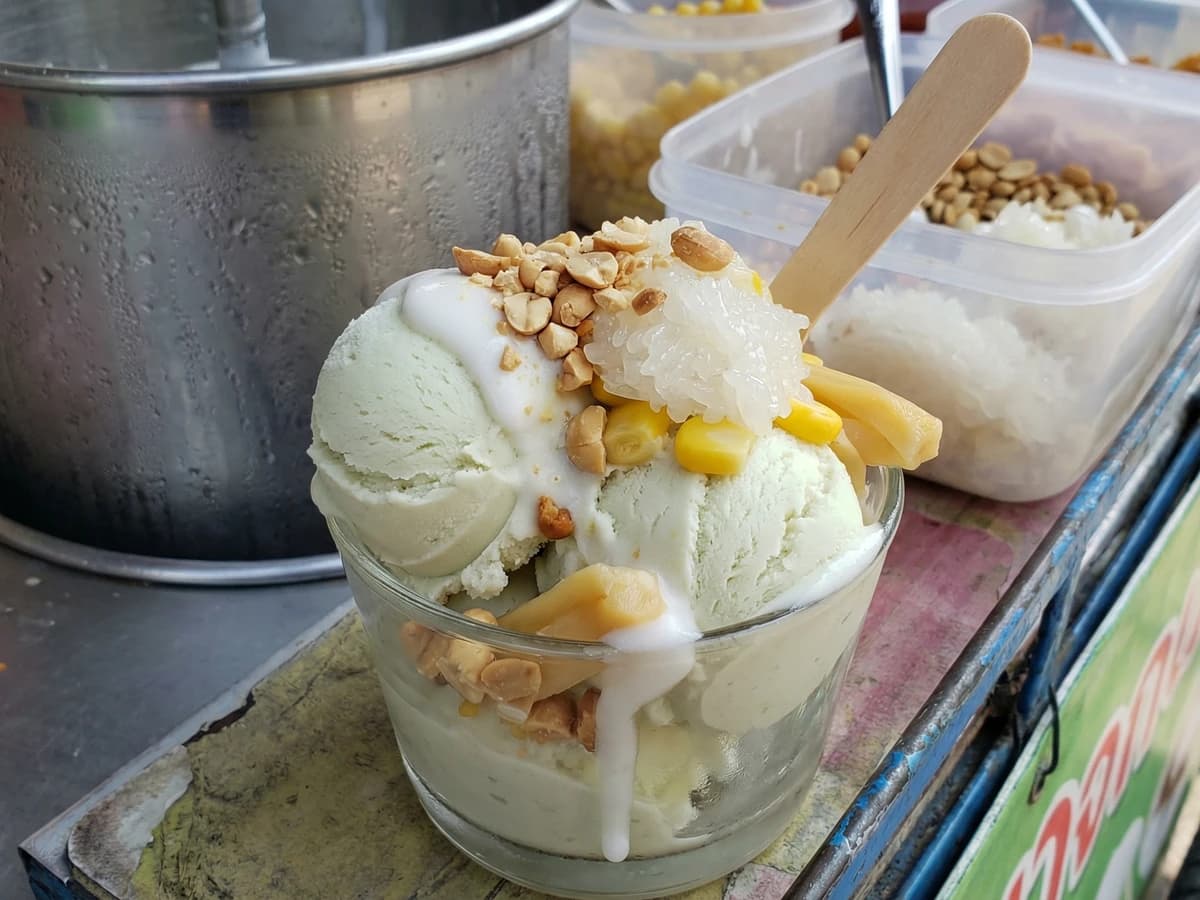
Palm sugar and coconut cream frozen on a street cart with nothing but salted ice and strong arms. The sweet pillar of Thai cuisine in its coldest, purest form. Three ingredients in the base. A lifetime of principle behind them.
Chef Fai
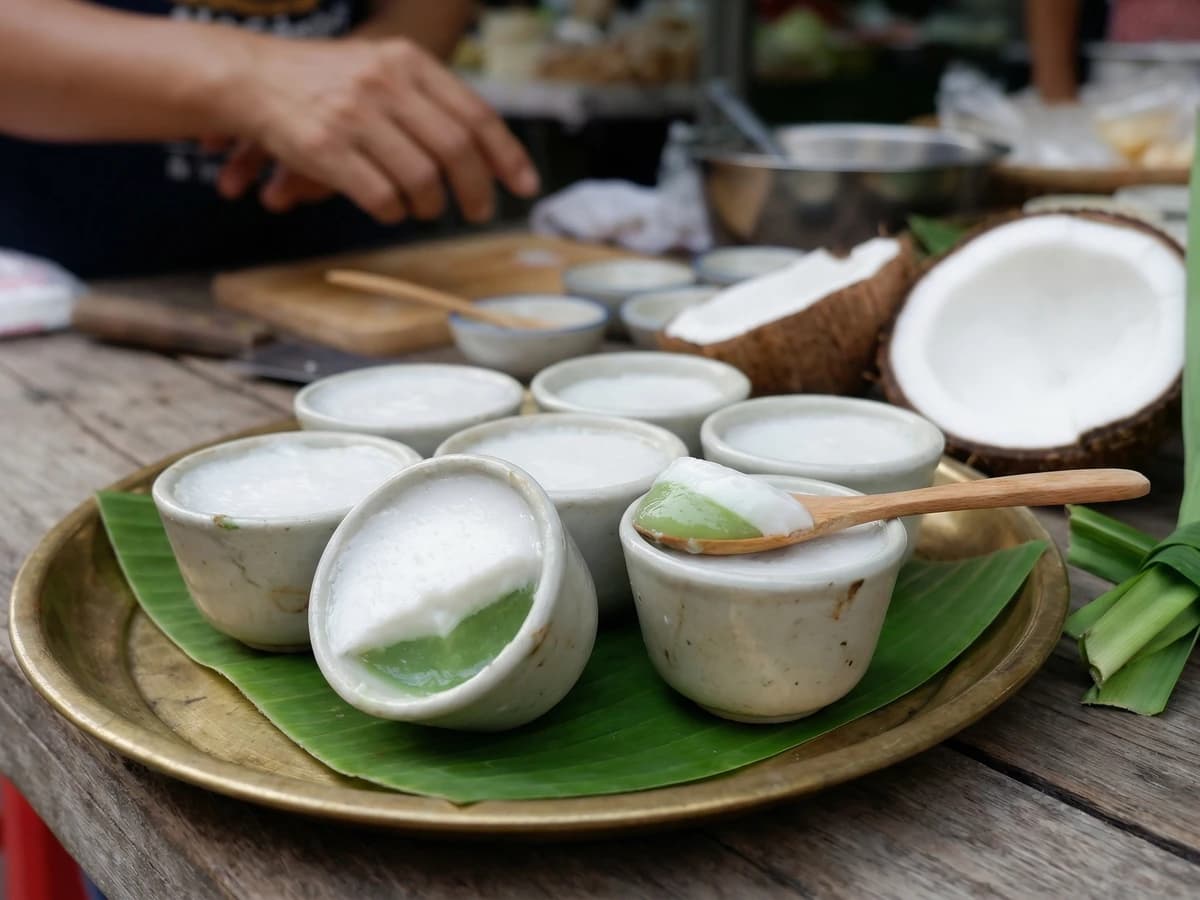
Two layers, one principle: palm sugar for sweet, coconut cream for richness, pandan for fragrance, salt on top to prove that Thai cuisine balances even its desserts. The system governs everything, including sweets.