Culinary Explorer

A cooking platform built around craft, culture, and the stories behind what we eat.
Discover Culinary Explorer
Hoedeopbap (Raw Fish Rice Bowl)

Hoedeopbap (Raw Fish Rice Bowl)

Created by

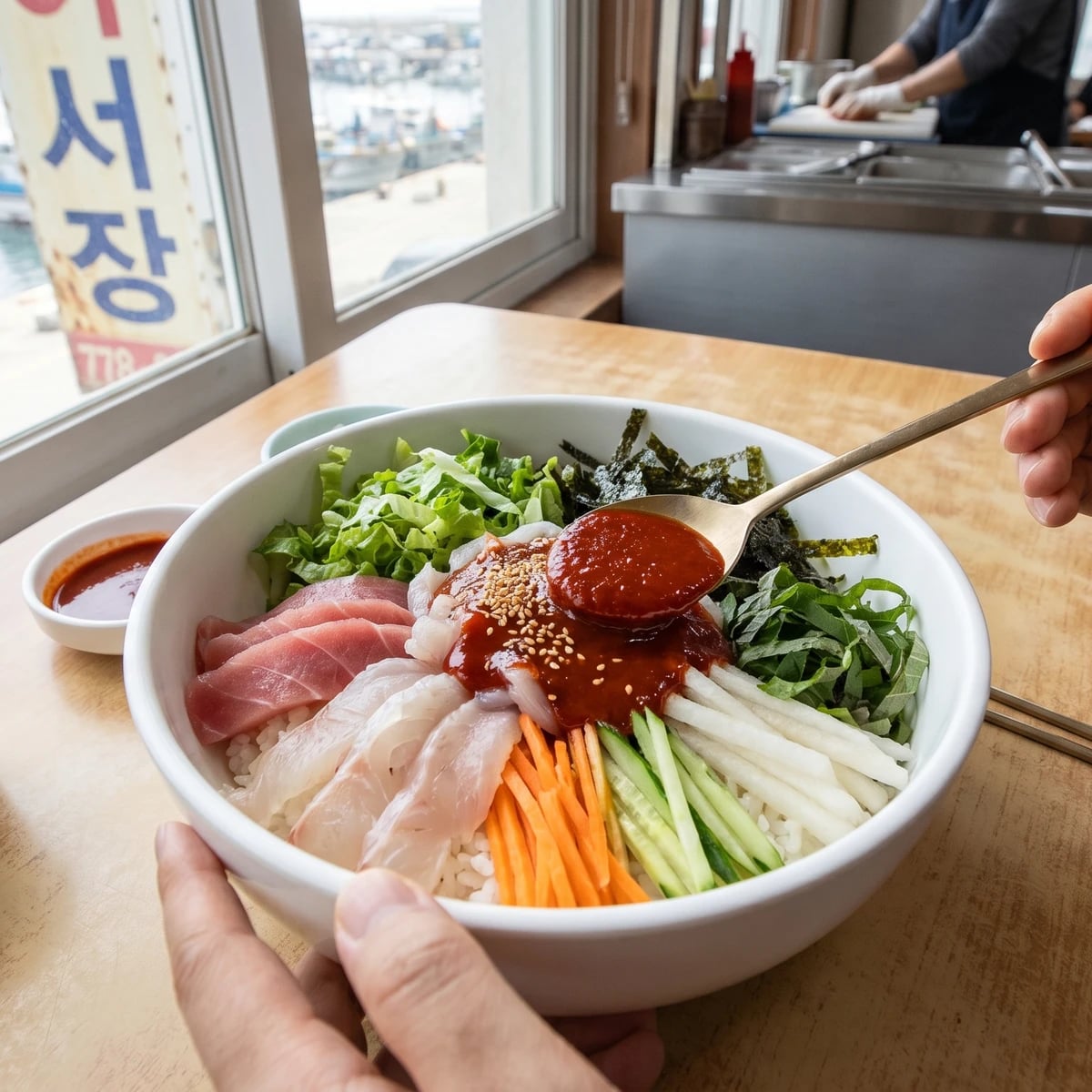
A coastal Korean lunch bowl of cold sliced hoe, warm rice, crisp vegetables, and chojang measured so the sauce brightens the catch instead of burying it.

Main Dishes
Korean
Weeknight
Quick Meal
30 min
Active Time
20 min cook50 min total
Yield2 generous servings

Hoedeopbap belongs to the fish market hour, when the lunch crowd wants raw fish but not a long table of platters and side dishes. A few clean slices of hoe (raw fish), warm rice, crisp vegetables, and a spoon of chojang (vinegared gochujang sauce) become one bowl. It is casual, but casual food still needs good hands.

The dish lives or dies by temperature and cutting. The rice should be warm enough to comfort you, never hot enough to cook the fish. The fish must stay cold until the last minute, and the vegetables need to be cut thin so every spoonful carries rice, crunch, leaf, fish, and sauce together. This is not bibimbap with seafood thrown on top. It is hoe made into a meal.

My notebook says 1 1/2 tablespoons of chojang per bowl before mixing, with more at the table. People pour until the fish disappears, then complain that all raw fish tastes the same. Let it taste like itself. 손맛 is real; I measure it anyway, because the difference between a bright bowl and a muddy one is often one spoon.

Hoedeopbap has no palace pedigree to borrow; it grew from Korea's coastal hoe culture and the practical rice-bowl habit of market restaurants and raw-fish shops. In ports such as Busan's Jagalchi Market and the fish markets of the east coast, diners have long chosen fresh fish to be sliced as hoe, and hoedeopbap turns that same catch into a quick meal with rice, vegetables, and chojang. The modern bowl became especially common in late twentieth-century casual restaurants, where it offered the flavor of a hoe table without the cost or time of a full sliced-fish spread.

The technique, the tradition, and the story behind every dish.

Discover Culinary Explorer

Ingredients

short-grain white rice

Quantity

1 cup

rinsed until the water runs mostly clear

water

Quantity

1 1/4 cups

toasted sesame oil

Quantity

1 teaspoon, divided

fine sea salt

Quantity

1/4 teaspoon, divided

sashimi-grade white fish or tuna

Quantity

240g

very cold, cut into 1/4-inch strips

cucumber

Quantity

1/2 small

julienned

green leaf lettuce

Quantity

1 cup

sliced into thin ribbons

perilla leaves (kkaennip)

Quantity

1/2 cup

sliced into thin ribbons

carrot

Quantity

1/3 cup

julienned

Korean radish or daikon

Quantity

1/3 cup

julienned

soybean sprouts

Quantity

1/2 cup

blanched and drained

toasted sesame seeds

Quantity

1 tablespoon, divided

roasted gim (seaweed)

Quantity

1 sheet

cut into thin strips

gochujang (Korean red chili paste)

Quantity

2 tablespoons

rice vinegar

Quantity

1 1/2 tablespoons

maesil-cheong (green plum syrup) or sugar

Quantity

1 tablespoon syrup or 2 teaspoons sugar

water

Quantity

1 tablespoon

soy sauce

Quantity

1 teaspoon

toasted sesame oil

Quantity

1 teaspoon

garlic

Quantity

1 small clove

finely grated

toasted sesame seeds

Quantity

1/2 teaspoon

crushed

raw egg yolks or soft-boiled eggs (optional)

Quantity

2

only if very fresh

Equipment Needed

  • Sharp chef's knife or sashimi knife
  • Rice cooker or heavy small pot with lid
  • Two wide rice bowls
  • Small mixing bowls for vegetables and sauce

Instructions

  1. 1

    Cook the rice

    Cook the rinsed rice with 1 1/4 cups water until tender, then let it rest covered for 10 minutes. Spread it in two wide bowls and let it lose its sharp heat for 5 minutes. Hoedeopbap needs warm rice, not hot rice, because hot rice wilts the vegetables and warms the fish, and that is careless.

    If you already have cooked rice, use 3 cups total. Warm it gently, then cool it until it feels just warm through the bowl.
  2. 2

    Mix the chojang

    Stir together the gochujang, rice vinegar, maesil-cheong, water, soy sauce, sesame oil, grated garlic, and crushed sesame seeds. Taste it with one leaf of lettuce, not from the spoon alone. It should be bright, lightly sweet, and sharp enough to wake the fish, not so thick or sweet that it turns the whole bowl into red paste.

  3. 3

    Season the vegetables

    Keep each vegetable in its own small bowl. Toss the cucumber with a pinch of salt, the radish with a pinch of salt, and the soybean sprouts with 1/2 teaspoon sesame oil and a pinch of sesame seeds. Leave the lettuce, perilla, and carrot plain. This small discipline matters: each vegetable should keep its own voice before the bowl is mixed.

    Do not salt the lettuce or perilla. They bruise and go limp. Their job is freshness and fragrance.
  4. 4

    Cut the fish

    Keep the fish cold until the last minute. Pat it dry, then slice it into strips about 1/4 inch thick and 2 inches long with a sharp knife. Ragged pieces taste the same but eat badly, and hoe is a dish where the knife shows its manners. If the fish smells strong or feels sticky, do not use it raw.

  5. 5

    Build the bowls

    Drizzle each bowl of warm rice with 1/4 teaspoon sesame oil. Arrange the lettuce, perilla, cucumber, carrot, radish, and soybean sprouts in separate small piles over the rice, then lay the cold fish across the center. Spoon 1 1/2 tablespoons chojang over each bowl and serve the rest on the side. You can add more at the table, but you cannot take back a buried fish.

  6. 6

    Mix at table

    Scatter gim and sesame seeds over the top. Add an egg yolk or soft-boiled egg if you are using one. Mix firmly with a spoon until the rice, vegetables, fish, and sauce are evenly dressed, then eat at once while the vegetables still crunch and the fish is still cold.

Chef Tips

  • Buy fish from a shop that sells fish meant to be eaten raw, and tell them you are making hoe. Sashimi-grade is a market promise, not a government grade, so trust the fishmonger, the turnover, the smell, and the cold chain.
  • White fish such as fluke, sea bream, rockfish, or yellowtail makes a clean bowl. Tuna is common and easy to find, but do not let it be the only fish you ever use. Cook the month you are standing in, and buy what your coastal market would be proud to slice that day.
  • Chojang should loosen enough to mix through rice. If your gochujang is very thick, add water 1 teaspoon at a time. Do not add extra sugar first; sweetness climbs quickly and makes the fish taste dull.
  • For a safer weeknight version, replace the raw fish with quickly blanched squid, cooked shrimp, or seared salmon cooled before slicing. That changes the eating, but it keeps the bowl honest.

Advance Preparation

  • The chojang can be mixed up to 5 days ahead and refrigerated. Stir it before using, and loosen with 1 teaspoon water if it thickens.
  • Vegetables can be washed and cut up to 4 hours ahead, then covered and refrigerated separately. Salt the cucumber, radish, and soybean sprouts only shortly before serving so they do not weep into the bowl.
  • Do not slice the fish ahead for home storage. Keep it cold in one piece and cut it just before serving, then eat the assembled bowls immediately.

Frequently Asked Questions

Nutrition Information

1 serving (about 530g)

Calories
650 calories
Total Fat
11 g
Saturated Fat
2 g
Trans Fat
0 g
Unsaturated Fat
9 g
Cholesterol
50 mg
Sodium
1010 mg
Total Carbohydrates
97 g
Dietary Fiber
5 g
Sugars
13 g
Protein
40 g

Note: Chef personas and recipes are created with AI assistance. Cook with care: follow safe food-handling practices, check doneness with a thermometer when needed, and adapt for allergies and your kitchen.

Where cooking meets culture.

Culinary guides, cultural storytelling, and the editorial depth that makes cooking meaningful.

Discover Culinary Explorer

More from Hoe & the Raw Table

Browse the full collection