
Chef Freja
Danablu Mad med Rå Æggeblomme
Danish blue cheese layered on dark rye with a raw egg yolk nestled on top, red onion rings, and chives. The last piece at a Danish lunch, and the one that stays with you longest.
A cooking platform built around craft, culture, and the stories behind what we eat.
Created by Chef Freja
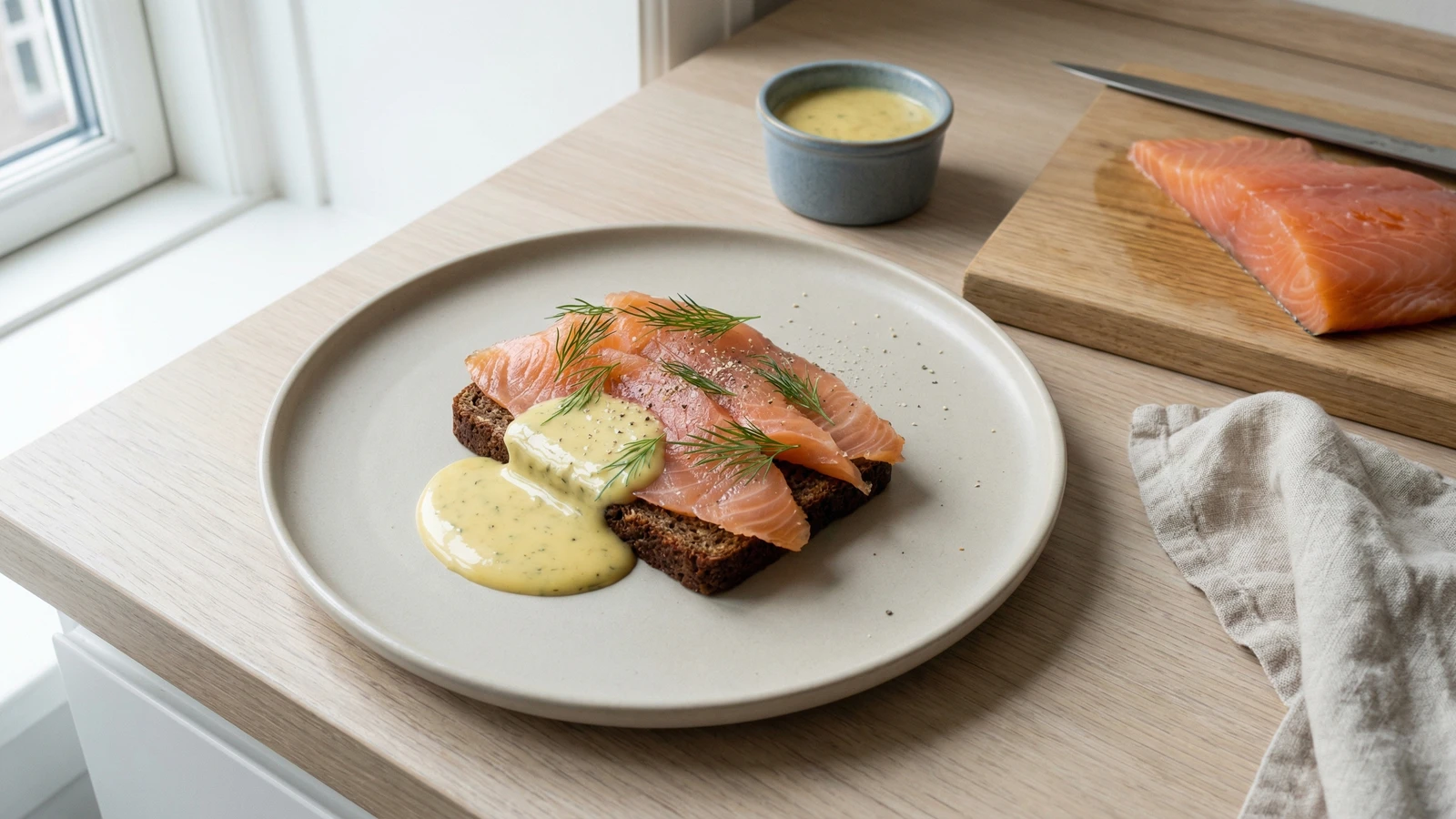
Salmon cured with salt, sugar, and a blanket of dill for two full days, then sliced thin across buttered rugbrod with the sweet mustard-dill sauce that belongs to this fish and no other.
There are dishes in the Danish kitchen that mark time. Gravad laks is one of them. It arrives at julefrokost in December, at the long Easter table in April, at midsummer when the evenings stretch past ten o'clock, and every time it appears the room slows down a little. This is food that asks for patience and rewards it.
The method is almost shockingly simple. Salt, sugar, white pepper, and a forest of fresh dill, pressed into a good side of salmon and left to cure for two days under a weight. The fish does most of the work. What you need to bring is a fishmonger you trust and the willingness to wait, which is the second-most Danish virtue after the willingness to share.
The sauce is the other half of the dish and it has no other life. Hovmestersovs, the head waiter's sauce, belongs to gravad laks the way butter belongs to rugbrod. Sweet, sharp, and thick as soft cream, made with two mustards and a generous handful of dill. You whisk it together in five minutes and you will use it for nothing else, which is exactly the point.
What I want you to pay attention to: the weight on top of the fish while it cures, and the slicing at the end. The weight is what turns salted salmon into gravad laks, so don't skip it. And the knife must be sharp and held at a shallow angle, long slices away from the skin, drape like silk. You'll know when it's right.
The word gravad means buried, a memory of the medieval technique where Scandinavian fishermen would salt whole salmon and bury them in the cold sand above the high tide line, letting them ferment slowly for weeks. By the 1800s the burying had stopped but the cure of salt, sugar, and dill remained, and the name stuck to a dish that is no longer buried at all. Hovmestersovs, literally the head waiter's sauce, is a later Copenhagen invention from the lunch restaurants of the late 19th century, where the hovmester would finish the sauce tableside as a small gesture of service to guests who had ordered the fish.
Quantity
1kg
skin on, center cut, pin bones removed
Quantity
100g
Quantity
80g
Quantity
1 tablespoon
coarsely crushed
Quantity
2 large bunches
stems and all
Quantity
2 tablespoons
Quantity
3 tablespoons
Quantity
2 tablespoons
Quantity
2 tablespoons
Quantity
2 tablespoons
Quantity
150ml
Quantity
large handful
finely chopped
Quantity
to taste
Quantity
to taste
Quantity
to serve
Quantity
to serve
softened
| Ingredient | Quantity |
|---|---|
| salmon filletskin on, center cut, pin bones removed | 1kg |
| coarse sea salt | 100g |
| caster sugar (for the cure) | 80g |
| white peppercornscoarsely crushed | 1 tablespoon |
| fresh dillstems and all | 2 large bunches |
| aquavit (optional) | 2 tablespoons |
| Dijon mustard | 3 tablespoons |
| sweet Danish mustard | 2 tablespoons |
| caster sugar (for the sauce) | 2 tablespoons |
| white wine vinegar | 2 tablespoons |
| neutral oil | 150ml |
| fresh dill (for the sauce)finely chopped | large handful |
| fine sea salt | to taste |
| white pepper | to taste |
| dark rugbrod | to serve |
| unsalted buttersoftened | to serve |
Lay the salmon skin-side down on a board and run your fingertips along the length of the flesh. Any pin bones you find, pull out with tweezers. Nothing ruins a thin slice faster than a stray bone. If there is a strip of dark grey flesh running along the skin, trim it away. It is oily and assertive, and the cure wants a clean canvas.
In a bowl, combine the coarse salt, the 80g of caster sugar, and the crushed white peppercorns. The ratio matters. Salt draws moisture out of the flesh and firms it. Sugar rounds the salt's edge and balances it so the finished fish tastes silky rather than harsh. White pepper, not black, because white is more floral and it leaves no dark specks on the pink flesh.
Place the salmon skin-side down in a shallow non-reactive dish, glass or ceramic, just big enough to hold it. If using aquavit, brush it across the flesh now. Press the cure mixture firmly into the top of the fillet in an even layer, covering every part of the flesh. Then cover the whole surface with the dill, stems and all, in a thick blanket. The dill is not garnish here. It is the third leg of the cure, and it perfumes the flesh while it rests.
Wrap the dish tightly in plastic, pressing it down against the dill. Place another dish or a small chopping board on top, and weight it with two heavy tins or a jar of something. The weight is what turns salted salmon into gravad laks. Without it you have cured fish. With it you have the dense, silky texture that makes this dish what it is. Not optional.
Refrigerate the weighted fish for 48 hours. Every 12 hours, take it out and turn it over, keeping the cure and dill pressed against the flesh. The fish will release a pool of pinkish brine into the dish. This is exactly what should happen. Turning bathes both sides in that brine and ensures the cure works evenly. This is the joy of waiting. The season decides many things in a Danish kitchen; the clock decides this one.
While you wait, or closer to serving, make the sauce. In a bowl, whisk together the two mustards, the 2 tablespoons of sugar, and the vinegar until smooth. Then, whisking constantly, pour the oil in a thin steady stream until the sauce thickens into an emulsion the consistency of soft cream. This is the same principle as mayonnaise. Add the oil too fast and the sauce will split. Whisk in the chopped dill and season with salt and white pepper. Taste it. It should be sweet, sharp, and heavy with dill, all three at once.
When the 48 hours are up, unwrap the salmon and scrape off the dill and most of the cure. Rinse the fillet briefly under cold water, just enough to take off the crust, and pat it completely dry with kitchen paper. Place it skin-side down on a board. With a long, very sharp knife held at a shallow angle, almost parallel to the board, start at the tail end and carve long, paper-thin slices away from the skin. Stop at the skin each time. The shallow angle is what gives you the wide, translucent slices that drape like silk. A straight-down cut gives you thick chunks and wastes the fish.
Spread slices of rugbrod thickly with softened butter, going right to the edges. Drape three or four slices of gravad laks across each piece, overlapping gently so the bread is mostly covered but a dark edge still shows. Spoon a generous pool of hovmestersovs in one corner. Scatter a few extra dill fronds across the top and finish with a grind of white pepper. Serve at once, with a knife and a fork. This is how we greet each other at a Danish table. Tak for mad.
1 serving (about 180g)
Culinary guides, cultural storytelling, and the editorial depth that makes cooking meaningful.
Discover Culinary ExplorerChef Freja
Danish blue cheese layered on dark rye with a raw egg yolk nestled on top, red onion rings, and chives. The last piece at a Danish lunch, and the one that stays with you longest.

Chef Freja
Thick-sliced Danbo on properly buttered rugbrod with sweet pepper rings and a crown of garden cress. The cheese smorrebrod that lives in every Danish lunchbox, from the first day of school to the last day at the office.

Chef Freja
Copenhagen's most storied smorrebrod: leverpostej, cold salt beef, trembling aspic, onion rings, and fresh cress on dark rugbrod. Invented at Oskar Davidsen's in the 1880s for a hungry veterinarian and still one of the great pieces of the Danish lunch table.

Chef Freja
Pungent Esrom from North Zealand on dark rye with paper-thin radish and fresh chives. The cheese course that closes a proper Danish smorrebrod spread, one of the quietest, most satisfying bites in the whole tradition.