
Chef Graziella
Coppia Ferrarese
The ancient twisted bread of Ferrara, where four delicate horns create maximum crust and the dough demands the patience of generations of Emilian bakers who understood that shape is not decoration but function.
A cooking platform built around craft, culture, and the stories behind what we eat.
Created by
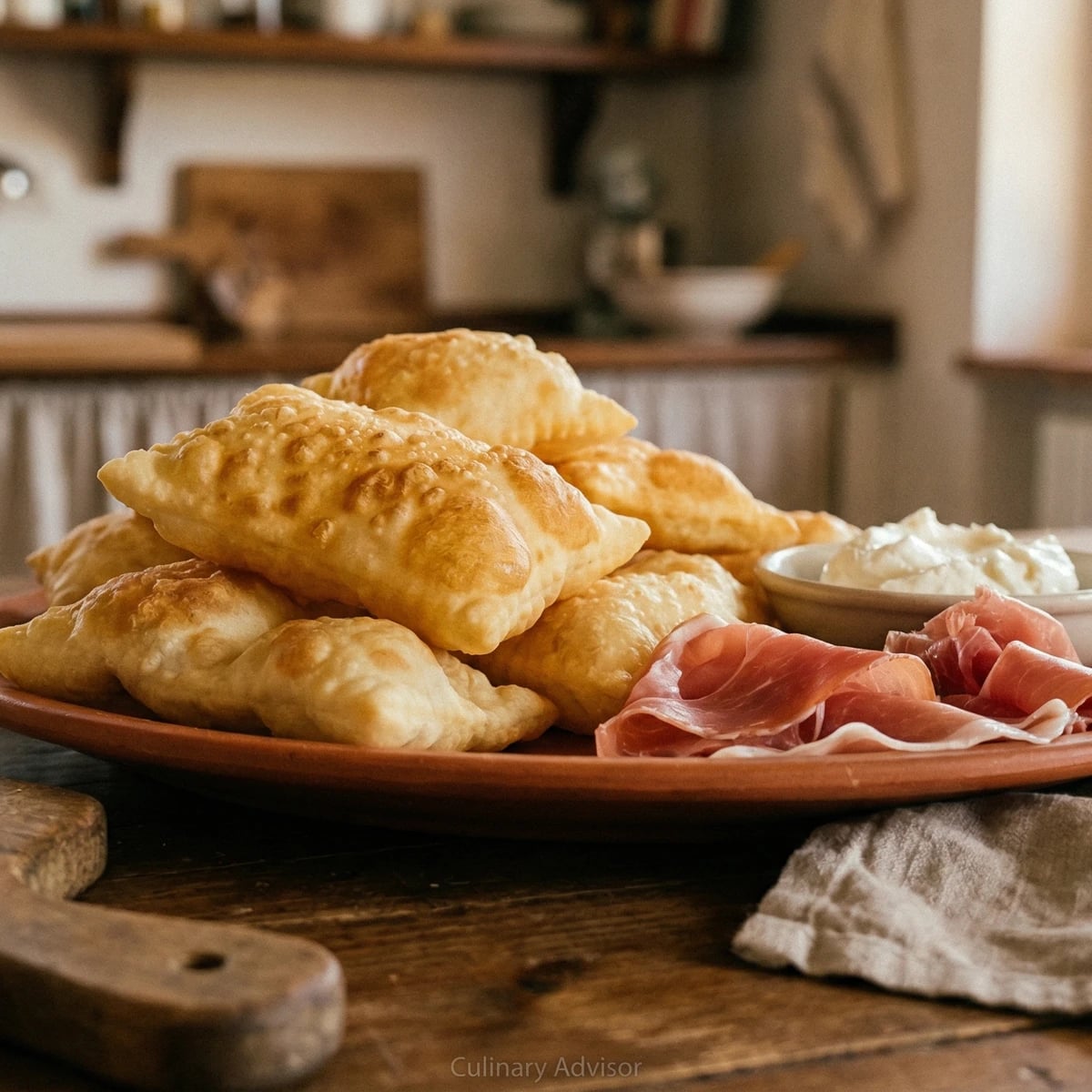
The puffed fried bread of Modena, impossibly light and hollow inside, served hot from the oil with prosciutto di Parma and soft stracchino cheese. This is how Emilians begin a meal.
In Modena, where I grew up watching my grandmother's hands work dough, gnocco fritto appeared at every gathering worth remembering. The name varies across Emilia-Romagna: gnocco fritto in Modena, crescentina in Bologna, torta fritta in Parma. The arguments about naming are endless and pointless. What matters is the technique.
The dough is simple: flour, lard, water, salt, and a whisper of leavening. The lard is not optional. Butter will work if you must, but the texture changes. Lard creates the characteristic lightness, the way the dough puffs into hollow pillows when it hits the hot oil. Vegetable shortening is an abomination I will not discuss further.
These must be served immediately. Within minutes of leaving the oil, they begin to deflate and toughen. Your guests should be seated, the prosciutto sliced, the stracchino at room temperature, before you begin frying. This is not a dish you make ahead. This is a dish that demands your guests wait for it, not the other way around.
Gnocco fritto dates to the peasant kitchens of Emilia-Romagna, where rendered pork fat was precious and nothing was wasted. Farm wives fried scraps of bread dough in lard to accompany salumi and soft cheeses, creating what became the essential start to any Modenese meal. The dish appears in regional cookbooks from the 19th century, though the tradition is certainly older.
Quantity
500g (about 4 cups)
Quantity
100g (about 7 tablespoons)
at room temperature
Quantity
200ml (about 3/4 cup plus 2 tablespoons)
lukewarm
Quantity
7g (1 packet)
Quantity
1 teaspoon
Quantity
1/2 teaspoon
Quantity
about 1 liter
for frying
Quantity
for serving
thinly sliced
Quantity
for serving
| Ingredient | Quantity |
|---|---|
| all-purpose flour | 500g (about 4 cups) |
| lardat room temperature | 100g (about 7 tablespoons) |
| whole milklukewarm | 200ml (about 3/4 cup plus 2 tablespoons) |
| instant yeast | 7g (1 packet) |
| fine sea salt | 1 teaspoon |
| baking powder | 1/2 teaspoon |
| lard or vegetable oilfor frying | about 1 liter |
| prosciutto di Parmathinly sliced | for serving |
| stracchino or squacquerone cheese | for serving |
Mound the flour on a wooden board or in a large bowl. Make a well in the center. Add the softened lard, lukewarm milk, yeast, salt, and baking powder to the well. Begin mixing with a fork, gradually incorporating flour from the inner walls of the well. When the dough becomes too stiff for the fork, use your hands.
Knead the dough vigorously for 8 to 10 minutes. You are developing gluten, which creates the structure that allows the dough to puff. The dough should become smooth, soft, and slightly elastic. It will not be as stiff as bread dough. If it feels too dry, add milk one tablespoon at a time. If too wet, add flour sparingly.
Form the dough into a ball and place it in a lightly oiled bowl. Cover with plastic wrap or a damp towel. Let it rise in a warm place until doubled in size, about one hour. The yeast and the rest both matter. The yeast creates air pockets; the rest relaxes the gluten so you can roll the dough thin.
Turn the risen dough onto a lightly floured surface. Do not punch it down aggressively. Roll it out to a thickness of about 3 millimeters, roughly one-eighth inch. This is thin. If the dough resists and springs back, let it rest five minutes, then continue. Work in batches if your surface is small.
Using a sharp knife or pastry wheel, cut the dough into diamonds or rectangles, roughly 8 by 10 centimeters (about 3 by 4 inches). The traditional shape is a diamond with slightly ragged edges from the pastry wheel. Do not reroll scraps immediately; let them rest ten minutes first, or they will be tough.
Pour lard or oil into a heavy pot or deep skillet to a depth of at least 5 centimeters (2 inches). Heat to 180°C (350°F). Use a thermometer. The temperature is critical. Too cool and the gnocco absorbs oil and becomes greasy. Too hot and it browns before puffing.
Slide two or three pieces of dough into the hot fat. Do not crowd the pot. The gnocco should sink briefly, then rise to the surface and begin to puff almost immediately. Use a slotted spoon or spider to gently turn them and keep them submerged so they puff evenly. Fry until golden on both sides, about one to two minutes total. They should be the color of light toast.
Transfer the fried gnocco to a plate lined with paper towels. Let them drain for only a few seconds, then transfer to a warm serving platter. Serve immediately with thin slices of prosciutto di Parma and soft stracchino cheese. Your guests should eat while you continue frying. This is the only way.
1 serving (about 110g)
Culinary guides, cultural storytelling, and the editorial depth that makes cooking meaningful.
Discover Culinary Explorer
Chef Graziella
The ancient twisted bread of Ferrara, where four delicate horns create maximum crust and the dough demands the patience of generations of Emilian bakers who understood that shape is not decoration but function.

Chef Graziella
The mountain bread of Modena, cooked between heated molds until golden and puffed, split while still warm and filled with lardo that melts into the crumb.

Chef Juliette
Pâte à brioche ordinaire teaches enriched dough properly: wake the leaven, build strength before the last egg, then work in pliable butter by stages and let one long fermentation do its quiet work.

Chef Juliette
Ordinary brioche takes one exact measure of butter and a patient rise in the mould, becoming so light and silken that it can cradle fruit without losing its tender crumb.