
Chef Lupita
Aporreadillo Michoacano con Huevo
Michoacán's Tierra Caliente almuerzo, where salted beef is softened, pounded, fried in lard, folded with egg and chile perón salsa, then served beside morisqueta like a proper working table.
A cooking platform built around craft, culture, and the stories behind what we eat.
Created by
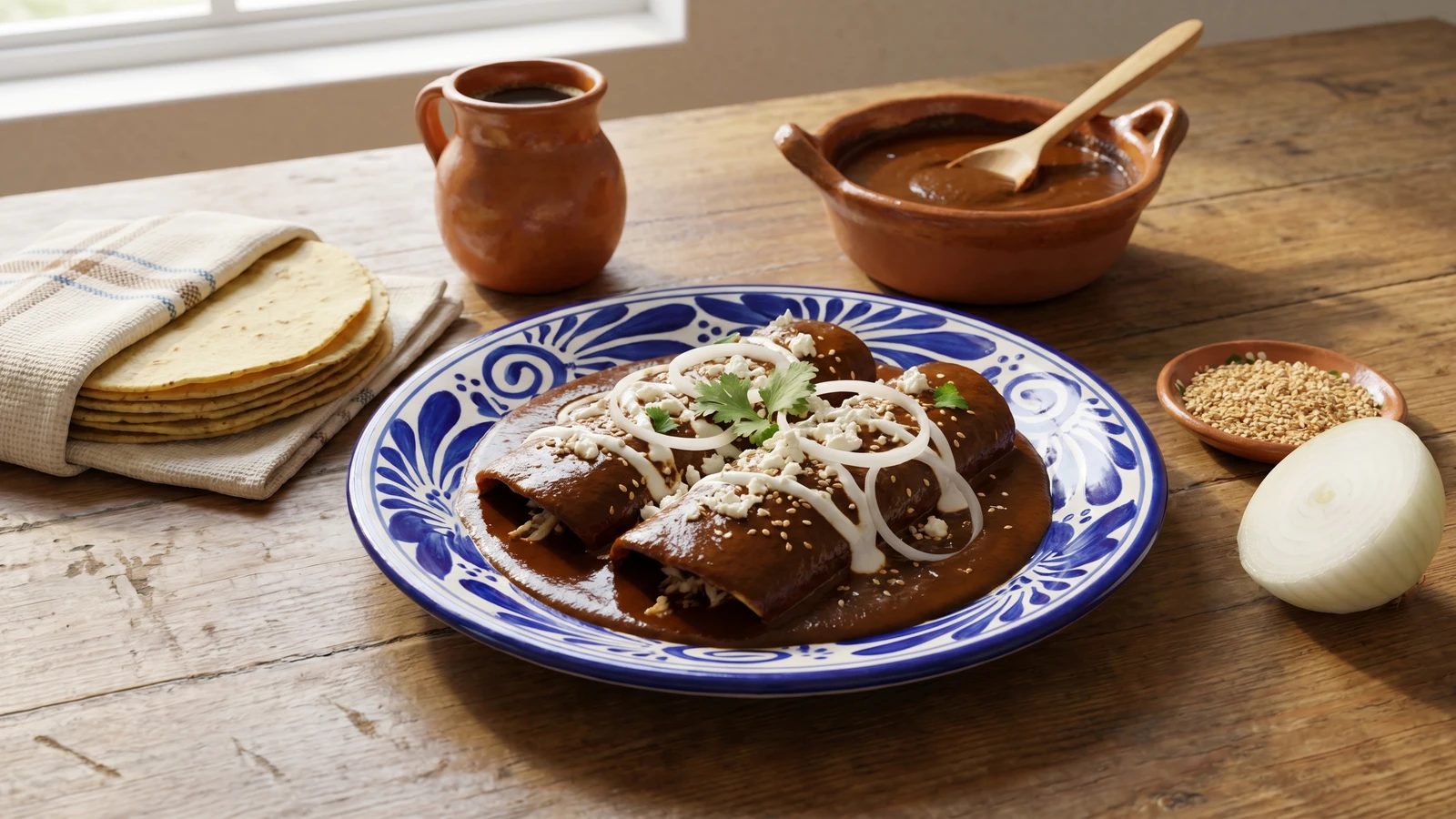
Puebla's morning answer to yesterday's mole, corn tortillas warmed in lard, folded around shredded pollo, and blanketed in mole poblano under crema, queso fresco, and sharp raw onion.
Enmoladas are from Puebla. They exist because mole poblano is too important and too laborious to throw away, and because the cook who spent two days building yesterday's pot understands that the second-day mole is better than the first-day mole. This is the dish that honors the pot.
Understand what you are doing here. You are not making mole from scratch this morning. You are reviving a sauce that already exists, loosening it with broth, and using it to bathe tortillas around a simple filling of pollo deshebrado. The tortillas have to be warmed in manteca first, briefly, just enough to soften them and seal the surface. A cold tortilla will tear. A tortilla fried crisp is enchilada territory. Enmoladas live in the middle: pliable, supple, ready to drink in the mole without falling apart on the fork.
The finish is non-negotiable. Crema mexicana, not sour cream. Queso fresco crumbled with your fingers, not shredded mozzarella. Raw white onion sliced thin enough to read through, not pickled, not caramelized. Toasted ajonjoli scattered across the top because mole poblano has sesame in it and the garnish should echo the sauce. My mother kept a frasco of toasted sesame on the counter for exactly this reason. She wrote in the margin of her notebook: 'siempre con cebolla cruda, nunca sin.' Always with raw onion, never without. She was right. The sharpness of the onion is what cuts the richness of the mole and lets you eat a second plate.
This is breakfast food in Puebla. It is also late lunch food, supper food, and the meal you make for a guest who shows up unannounced and you happen to have mole in the refrigerator. Cada estado, su propia cocina, and Puebla's morning kitchen knows what to do with yesterday's work. Saber cocinar es saber vivir.
Enmoladas belong to a family of central Mexican antojitos built on the principle of bathing a tortilla in sauce, alongside enchiladas, entomatadas, and enfrijoladas; the suffix '-adas' attached to the sauce that defines each one. The dish is inseparable from mole poblano itself, which Puebla's culinary establishment claims through the apocryphal but still-repeated story of the nuns at the Convento de Santa Rosa preparing it for a 17th-century viceroy. More reliably, enmoladas emerged as a domestic strategy in Puebla's household economy, a way to stretch a mole that might require thirty ingredients and two days of labor across several meals, transforming the same pot into a different dish each time it appeared on the table. Mexico's UNESCO inscription of Traditional Mexican Cuisine in 2010 cited specifically this kind of resourceful, repetition-based home cooking, in which a single laborious preparation feeds a family through the week.
Quantity
2 cups
from yesterday's pot or jarred Puebla-style mole reconstituted with broth
Quantity
2 to 3 cups, plus more as needed
Quantity
2 cups
preferably from the bird that made the broth
Quantity
8
day-old or slightly dried
Quantity
1/4 cup
for warming the tortillas
Quantity
1/2 cup
Quantity
3/4 cup
crumbled
Quantity
1
sliced into very thin rings
Quantity
2 tablespoons
Quantity
for serving
Quantity
for serving
Quantity
for serving
| Ingredient | Quantity |
|---|---|
| prepared mole poblanofrom yesterday's pot or jarred Puebla-style mole reconstituted with broth | 2 cups |
| chicken broth | 2 to 3 cups, plus more as needed |
| shredded poached chicken (pollo deshebrado)preferably from the bird that made the broth | 2 cups |
| hand-pressed corn tortillasday-old or slightly dried | 8 |
| manteca de cerdo (pork lard)for warming the tortillas | 1/4 cup |
| crema mexicana | 1/2 cup |
| queso frescocrumbled | 3/4 cup |
| small white onionsliced into very thin rings | 1 |
| toasted sesame seeds (ajonjoli) | 2 tablespoons |
| fresh cilantro leaves (optional) | for serving |
| refried black beans (optional) | for serving |
| Mexican rice or sliced ripe plantain (optional) | for serving |
Pour the mole poblano into a wide cazuela or heavy saucepan over medium-low heat. Cold mole from the refrigerator will be the texture of paste. Add chicken broth a half cup at a time, stirring with a wooden spoon, until the mole loosens to the consistency of heavy cream that coats the spoon and falls in a slow ribbon. Taste. If it tastes shy, add a pinch of salt. If it tastes flat, a small piece of Mexican chocolate (a quarter ounce) will wake it back up. Keep it warm over the lowest heat while you work, stirring every few minutes so the bottom does not catch.
Place the shredded chicken in a small saucepan with a half cup of chicken broth. Warm over low heat just until the chicken is heated through and the broth is mostly absorbed. The chicken should be moist, never wet. Wet chicken makes a sloppy enmolada that falls apart on the plate.
Heat the manteca in a small skillet over medium until it shimmers. Working one at a time, slide a tortilla into the hot lard for about five seconds per side. You are not frying the tortilla crisp. You are softening it and sealing the surface so it can take the mole without disintegrating. Lift it out with tongs and let the excess lard drip back into the skillet. La manteca es el sabor, and it is also what keeps the tortilla intact when the mole hits it. Stack the softened tortillas on a plate as you go.
Working one tortilla at a time, drag the softened tortilla through the warm mole, coating both sides. Lay it on a warm plate. Place about three tablespoons of the shredded chicken across the center. Fold the tortilla in half over the filling, or roll it into a tube, whichever the cook in your house prefers. In Puebla I have seen both. Repeat with the rest, arranging two enmoladas per plate side by side.
Once the enmoladas are folded and plated, ladle another generous spoonful of warm mole over the top of each one. The blanket should pool slightly around the edges. This is not a stingy dish. A poblana would look at a thin coat of mole and shake her head. The mole is the point. The tortilla and chicken are the vehicle.
Drizzle crema mexicana across the top in a back-and-forth motion. Scatter the crumbled queso fresco generously. Arrange the thin rings of raw white onion across the cheese. Shower with toasted sesame seeds and a few cilantro leaves if you are using them. Serve immediately with refried black beans and either Mexican rice or a few slices of fried ripe plantain on the side. This is breakfast in Puebla. Eat it while the mole is still hot and the onion is still sharp. Así se hace y punto.
1 serving (about 490g)
Culinary guides, cultural storytelling, and the editorial depth that makes cooking meaningful.
Discover Culinary ExplorerChef Lupita
Michoacán's Tierra Caliente almuerzo, where salted beef is softened, pounded, fried in lard, folded with egg and chile perón salsa, then served beside morisqueta like a proper working table.

Chef Lupita
Guerrero's Costa Grande aporreado is salted cecina pounded soft, scrambled with egg, and finished in a red guajillo and chile de árbol salsa loud with garlic and cilantro.

Chef Lupita
Los Altos de Chiapas turns two-night fermented white corn into a tart-sweet atole, cooked with canela and piloncillo, then poured hot into jícaras for desayuno.

Chef Lupita
Oaxaca's Mixteca region ferments nixtamalized masa for days until it turns tart and alive, then simmers it with piloncillo and canela into a thick, warm atole served at first light in clay.