
Chef Lupita
Acitrón de Cidra Conventual
Puebla's convent-style acitrón, made from cidra peel instead of endangered biznaga, built through repeated syrup soakings until the cubes turn firm, translucent, and ready for rosca or chiles en nogada.
A cooking platform built around craft, culture, and the stories behind what we eat.
Created by
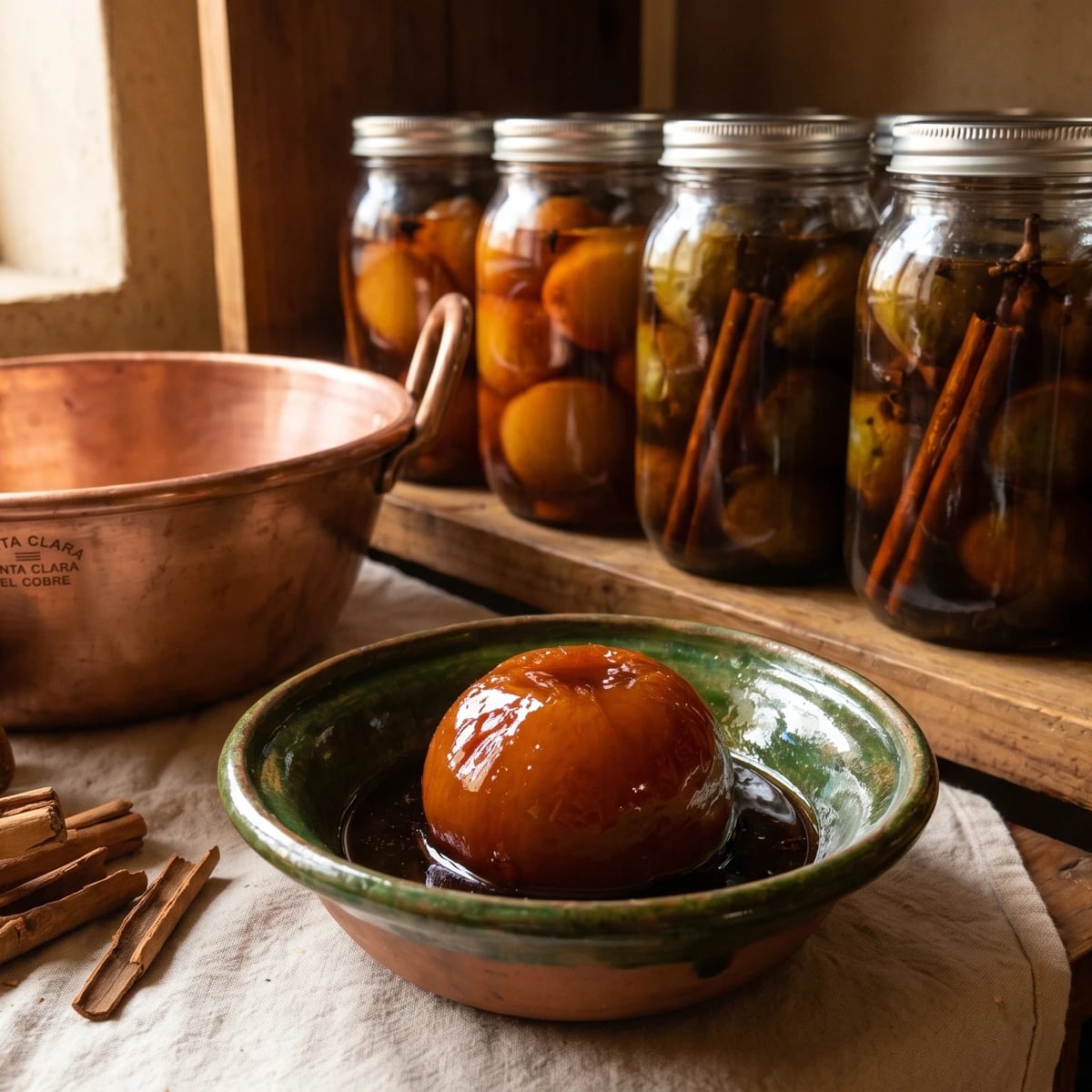
Tlalpujahua's orchard peaches, peeled whole and rested overnight in piloncillo, canela, and clove syrup, the old Michoacán Real de Minas method that turns a short harvest into winter dessert.
Michoacán's eastern highlands, Tlalpujahua, the old Real de Minas, this is where these duraznos belong. The town sits high and cool, with orchards that give peaches, apples, pears, and capulines when the season is generous. A peach does not last long after it leaves the branch. The dulceras knew that. The women in those kitchens turned fruit into winter.
The defining thing here is not a chile or a fat. It is the almíbar: dark piloncillo melted with Mexican canela and clove until the syrup turns amber and serious. The peaches stay whole, pit intact, peeled carefully, pricked so the syrup can enter, firmed briefly in agua de cal, then rested overnight. No me vengas con atajos. A peach rushed in syrup stays pale at the center and soft at the edges. That is bad work.
I learned this version from Tlalpujahua cooks who spoke about preserves the way other people speak about money: carefully, with respect. The fruit was free when the tree was full. The technique made it last. La paciencia es la regla del huerto, patience is the rule of the orchard. Cada estado, su propia cocina.
Tlalpujahua was a colonial Real de Minas in eastern Michoacán by the late 16th century, and its cool highland orchards supplied peaches that had to be preserved before winter or wasted. Unlike camote tied to Santa Clara de Puebla or ates to Morelia's Augustinian dulcerías, duraznos en conserva are documented by town: Tlalpujahua, where convent-style dulceras and household cooks kept the fruit whole in piloncillo almíbar. Piloncillo came from the 16th-century expansion of Spanish sugarcane in New Spain, while canela and clove arrived through colonial trade routes, giving this local orchard fruit the spice grammar of Mexican convent sweets.
Quantity
8 pounds
preferably durazno criollo from Michoacán highland orchards
Quantity
3 quarts
for the limewater bath
Quantity
2 tablespoons
cal para nixtamal or pickling lime, not construction lime
Quantity
8 cups
for the syrup
Quantity
4 pounds
chopped or grated
Quantity
4 large sticks
Quantity
8
Quantity
1/2 teaspoon
Quantity
1/4 cup
Quantity
as needed
for blanching and processing jars
| Ingredient | Quantity |
|---|---|
| small firm ripe yellow peachespreferably durazno criollo from Michoacán highland orchards | 8 pounds |
| cold waterfor the limewater bath | 3 quarts |
| food-grade calcium hydroxidecal para nixtamal or pickling lime, not construction lime | 2 tablespoons |
| waterfor the syrup | 8 cups |
| dark piloncillochopped or grated | 4 pounds |
| Mexican canela | 4 large sticks |
| whole cloves | 8 |
| sea salt | 1/2 teaspoon |
| fresh Mexican lime juice | 1/4 cup |
| boiling waterfor blanching and processing jars | as needed |
Use small peaches that smell ripe but still feel firm in the hand. If the fruit is bruised or mealy, make jam, not conserva. If peaches are not good in the market, wait for the season. Tlalpujahua preserves are orchard food, not supermarket punishment.
Stir the food-grade calcium hydroxide into 3 quarts cold water in a nonreactive bowl. Let it settle for 10 minutes, then pour the clear limewater into a second bowl, leaving the gritty sediment behind. This is the old firming step. It keeps the peaches from collapsing in the syrup.
Bring a large pot of water to a boil. Cut a shallow X in the bottom of each peach. Lower the peaches into the water for 30 to 60 seconds, just until the skin loosens. Move them to cold water, then peel with your fingers or a small knife. Keep the peaches whole and leave the pits intact. Prick each peach 8 to 10 times with a clean needle or skewer so the syrup can enter without tearing the fruit.
Lower the peeled peaches into the clear limewater and weight them with a plate so they stay submerged. Soak for 30 minutes. Drain and rinse under cool running water three times, turning the fruit gently with your hands. You should not feel any slippery residue. The peaches should feel slightly firmer, not hard.
Combine 8 cups water, the piloncillo, canela, cloves, and salt in a wide preserving pot or copper cazo. Bring to a simmer and stir until the piloncillo dissolves completely. Simmer for 15 minutes, then strain the syrup through a fine sieve to remove grit from the piloncillo. Return the syrup to the pot and stir in the lime juice. The color should be deep amber and the kitchen should smell of canela, not raw sugar.
Add the peaches to the syrup in one layer if your pot allows it. Keep the heat low enough that the syrup moves gently around the fruit. Cook 25 to 35 minutes, turning the peaches carefully once or twice, until a skewer enters with slight resistance and the edges begin to look translucent. Do not boil them hard. A hard boil breaks the flesh and clouds the syrup.
Turn off the heat, cover the pot, and let the peaches cool in the syrup. Rest 8 to 12 hours. If your kitchen is hot, refrigerate the pot once it has cooled. This rest is not laziness. It is how the syrup reaches the center without beating up the fruit. La paciencia es la regla del huerto.
The next day, lift the peaches out with a slotted spoon and set them in a clean bowl. Boil the syrup over medium heat for 20 to 30 minutes, until it coats a spoon in a glossy sheet and the drops fall slowly. Return the peaches to the pot and simmer 10 minutes to heat them through. The syrup should be heavy but pourable, not candy.
Pack the hot peaches into hot clean quart jars, leaving 1/2 inch headspace. Add one piece of canela to each jar if you want the convent look on the shelf. Pour in hot syrup to cover the fruit, keeping the same headspace. Slide a clean chopstick along the inside of the jar to release trapped air, wipe the rims, and close with new lids.
For pantry storage, process the quart jars in a boiling water bath with water covering the lids by at least 1 inch. Process 25 minutes below 1000 feet altitude; at Tlalpujahua altitude, process about 45 minutes. Check your local altitude chart if you live higher or lower. If you do not process the jars, refrigerate them and eat within 1 month. Sugar syrup is not permission to ignore a seal.
Let processed jars stand undisturbed for 12 hours, then check the seals. Any jar with a lid that flexes goes into the refrigerator. Wait at least 1 week before opening so the peach and piloncillo settle into each other. Serve one whole peach in a small green-glazed Michoacán clay bowl with enough syrup to shine around it. Recetas probadas y garantizadas.
1 serving (about 300g)
Culinary guides, cultural storytelling, and the editorial depth that makes cooking meaningful.
Discover Culinary Explorer
Chef Lupita
Puebla's convent-style acitrón, made from cidra peel instead of endangered biznaga, built through repeated syrup soakings until the cubes turn firm, translucent, and ready for rosca or chiles en nogada.

Chef Lupita
Ciudad de México's Tulyehualco alegría is popped huautli folded into piloncillo honey, pressed with peanuts, pepitas, and raisins, then cut into the rectangular bars that built a pueblo's identity.

Chef Lupita
Oaxaca's pre-Columbian amaranth bar, popped on a hot comal and bound with piloncillo, honey, and the sacred Zapotec grain that the Spanish tried, and failed, to outlaw.

Chef Lupita
Querétaro's mercado candy of popped amaranto pressed with dark piloncillo syrup, pepitas, pecans, and cacahuate, a Bajío sweet that respects the seed before it decorates the table.