
Chef Lupita
Acitrón de Cidra Conventual
Puebla's convent-style acitrón, made from cidra peel instead of endangered biznaga, built through repeated syrup soakings until the cubes turn firm, translucent, and ready for rosca or chiles en nogada.
A cooking platform built around craft, culture, and the stories behind what we eat.
Created by
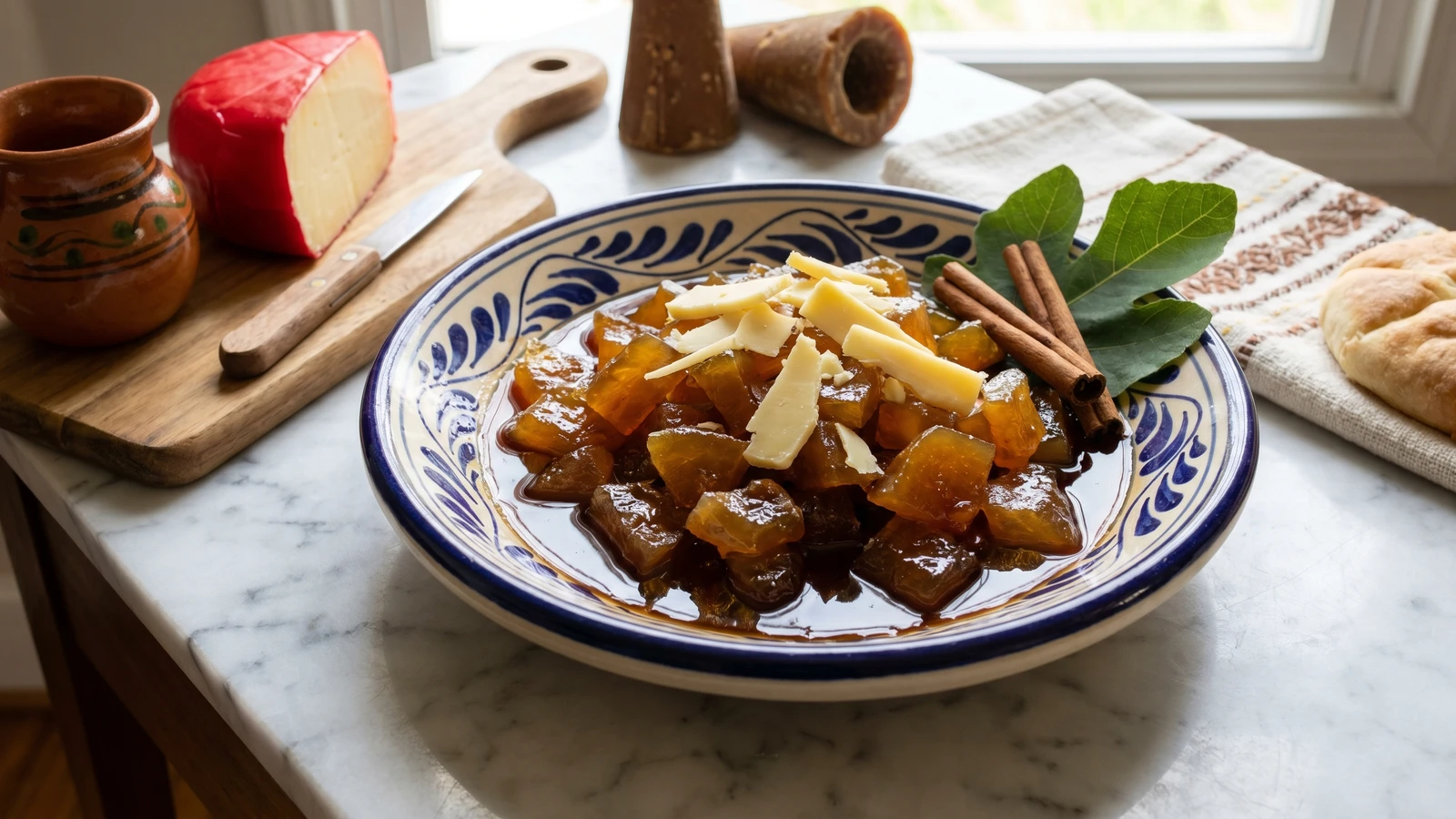
Yucatán's amber-glass dessert of green papaya crystallized in piloncillo syrup with hojas de higo, anise, and canela, served with shavings of salty queso de bola the way they do it in Mérida.
This is from Yucatán. Mérida specifically, where the dulcerías around the centro and the señoras of the Lucas de Gálvez market have been making this postre the same way for generations. It is not a Mexican dessert in any general sense. It is yucateco, and the cheese on top is the proof.
The queso de bola is Edam, the red-waxed Dutch cheese that arrived in Yucatán by way of the Caribbean trade routes in the 19th century and stayed because the peninsula's cooks understood immediately what it could do. Salty, dense, sharp. The peninsula adopted it so thoroughly that today there is no yucateco kitchen without a wedge of it in the refrigerator. The dulce de papaya without queso de bola is unfinished. The salt is what makes the sweet taste like something. Cada estado, su propia cocina, and this contrast belongs to Yucatán.
The technique is patient and not negotiable. The papaya has to be green, the cal bath cannot be skipped, the fig leaf is not optional, and the syrup is built with piloncillo and canela, never refined sugar. Each step does a specific job. The cal firms the flesh so it goes translucent like amber glass instead of collapsing into jam. The hoja de higo perfumes the syrup with that green, almost coconut-like note that marks this as a recipe from the peninsula and nowhere else.
I carried this recipe back from Mérida ten years ago, written on the back of a card by Doña Esperanza, a vendor who has been selling dulces in the market for fifty-two years. She made me repeat the proportions of cal back to her twice before she would let me leave. She said too many cooks now skip it and call the result dulce de papaya. It is not. It is something else. Saber cocinar es saber vivir.
Dulces cristalizados of fruits and vegetables, papaya, chilacayote, camote, biznaga, calabaza, became a fixture of Mexican convent kitchens during the colonial period, when Spanish nuns adapted Old World confitería techniques to the abundant New World produce around them. The use of cal for firming dates to pre-Columbian nixtamalization practices and was absorbed into the sweets tradition because it solved the structural problem of fruits that would otherwise dissolve in syrup. The pairing with queso de bola is specifically yucateca, dating to the late 19th century when Edam cheese became a staple of peninsular trade through the port of Progreso, and is part of the same Caribbean and European exchange that gave Yucatán its distinctive culinary identity separate from the rest of Mexico.
Quantity
1 medium (about 3 pounds)
unripe and firm
Quantity
2 tablespoons
for the firming bath
Quantity
8 cups
for the cal bath
Quantity
1 1/2 pounds (about 3 cones)
chopped
Quantity
6 cups
for the syrup
Quantity
4
rinsed
Quantity
2 sticks
Quantity
1 tablespoon
Quantity
from 1 orange
in wide strips
Quantity
1 (8-ounce) wedge
for serving
Quantity
for serving
| Ingredient | Quantity |
|---|---|
| green papayaunripe and firm | 1 medium (about 3 pounds) |
| cal (slaked lime/calcium hydroxide)for the firming bath | 2 tablespoons |
| cold waterfor the cal bath | 8 cups |
| piloncillochopped | 1 1/2 pounds (about 3 cones) |
| waterfor the syrup | 6 cups |
| fresh hojas de higo (fig leaves)rinsed | 4 |
| Mexican canela (cinnamon) | 2 sticks |
| whole anise seed | 1 tablespoon |
| orange peelin wide strips | from 1 orange |
| queso de bola (Edam cheese)for serving | 1 (8-ounce) wedge |
| pan francés or galletas marías (optional) | for serving |
The papaya must be green, hard, and heavy in the hand. The skin should be dark green with no yellow patches and no soft give when you press it. A ripe papaya will turn to mush in the syrup. A green one holds its shape and goes translucent like stained glass. At the Lucas de Gálvez market in Mérida, the señoras will hand you the right one if you tell them it is for dulce. They have done this before.
Peel the papaya with a sharp paring knife. Halve it lengthwise, scoop out the white seeds and the soft membrane, and cut the flesh into rectangular batons about the size of a thumb. Uniform pieces cook evenly and crystallize evenly. Lopsided pieces give you some that fall apart and some that stay raw.
Stir the cal into 8 cups of cold water in a large glass or ceramic bowl until it dissolves and the water turns chalky. Add the papaya pieces. Submerge them with a plate if they float. Leave them to soak for two hours. This is the step nobody outside Yucatán talks about and it is the reason real dulce de papaya holds its shape like crystal. The cal locks the cell walls. Without it you have papaya jam.
Drain the papaya and rinse it under cold running water for a full five minutes, agitating with your hands. Then soak it in fresh cold water for 15 minutes and drain again. The cal must be gone. If you taste a piece and it is bitter or chalky, rinse longer. The cal does its work in the bath; what stays on the surface ruins the syrup.
Combine the chopped piloncillo and 6 cups of water in a heavy pot wide enough to hold the papaya in a single layer. Add the fig leaves, the canela sticks, the anise seed, and the orange peel. Bring to a simmer over medium heat, stirring until the piloncillo dissolves completely. The syrup should be the color of dark amber and smell of cane, leaf, and spice. The hoja de higo is what marks this as yucateco. It gives the syrup a green, almost coconut-like perfume that nothing else can do. No me vengas con atajos. If the fig leaf is missing, the dulce is not the same dulce.
Add the drained papaya to the syrup. The liquid should just cover the pieces. Bring to a gentle simmer over medium-low heat. Cook uncovered for 2 to 2 1/2 hours, stirring gently every 20 minutes with a wooden spoon. The papaya will slowly turn translucent, starting at the edges and working in, until the pieces look like pieces of amber glass. The syrup will reduce by about half and thicken to a loose honey consistency. Do not let it bubble hard. Hard bubbles break the pieces and burn the syrup at the bottom.
The dulce is ready when the papaya is fully translucent, holds its shape when you lift a piece with a spoon, and the syrup coats the back of the spoon and leaves a clear path when you draw a finger through it. Pull the pot off the heat. Leave it to cool in the syrup for at least one hour. The papaya keeps drinking the syrup as it cools and that is when the flavor settles in. Pulling it out early gives you a dulce that tastes flat.
Spoon the papaya into shallow bowls or onto Talavera plates with a generous puddle of the syrup. Grate or shave a thick layer of queso de bola directly over the top while the dulce is still slightly warm. The salt of the Edam against the dark sweetness of the piloncillo is the entire point of the dish. One without the other is half a recipe. Así se hace y punto.
1 serving (about 250g)
Culinary guides, cultural storytelling, and the editorial depth that makes cooking meaningful.
Discover Culinary ExplorerChef Lupita
Puebla's convent-style acitrón, made from cidra peel instead of endangered biznaga, built through repeated syrup soakings until the cubes turn firm, translucent, and ready for rosca or chiles en nogada.

Chef Lupita
Ciudad de México's Tulyehualco alegría is popped huautli folded into piloncillo honey, pressed with peanuts, pepitas, and raisins, then cut into the rectangular bars that built a pueblo's identity.

Chef Lupita
Oaxaca's pre-Columbian amaranth bar, popped on a hot comal and bound with piloncillo, honey, and the sacred Zapotec grain that the Spanish tried, and failed, to outlaw.

Chef Lupita
Querétaro's mercado candy of popped amaranto pressed with dark piloncillo syrup, pepitas, pecans, and cacahuate, a Bajío sweet that respects the seed before it decorates the table.