
Chef Lupita
Acitrón de Cidra Conventual
Puebla's convent-style acitrón, made from cidra peel instead of endangered biznaga, built through repeated syrup soakings until the cubes turn firm, translucent, and ready for rosca or chiles en nogada.
A cooking platform built around craft, culture, and the stories behind what we eat.
Created by
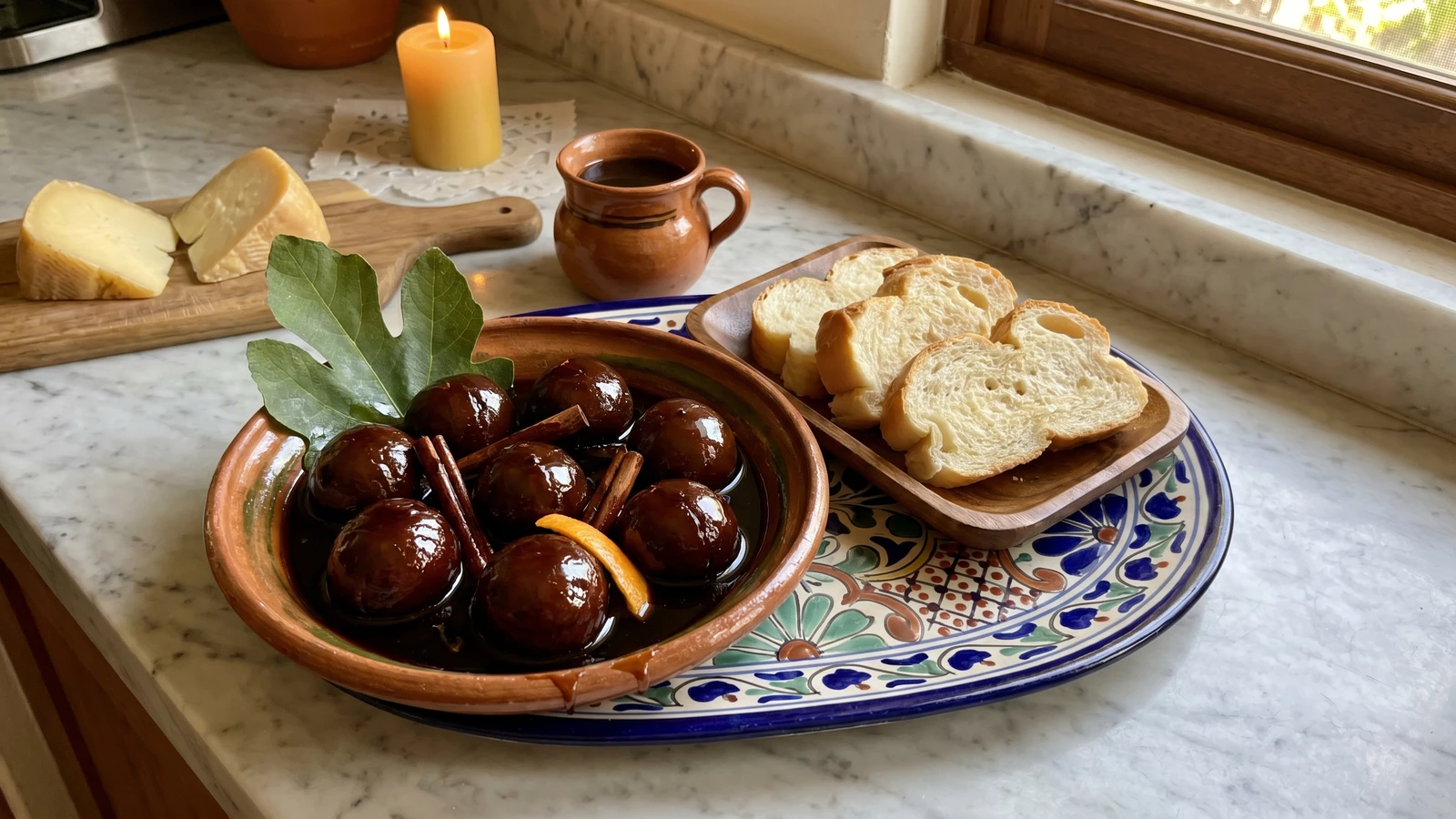
Campeche's signature dulce de almíbar, built on wild ciruela de monte, piloncillo, and fresh hojas de higo, cooked low and slow until the syrup runs dark as molasses and the fruit holds the perfume of the canela.
This is from Campeche. Not from Yucatán next door, not from Tabasco below it, from Campeche, where the dulcerías of the historic center have been making fruit in almíbar the same way for four generations. The Peninsula has a serious sweet tradition that most of Mexico forgets exists, and Campeche is its quiet capital.
The fruit is ciruela de monte. Wild jocote. Spondias purpurea. This is not the European plum and it is not the round red ciruela you find in U.S. supermarkets. It is a small oval fruit the size of a quail egg, with a thin skin that turns from green to yellow to deep red, a single large pit, and a tart-sweet flesh that holds up to hours of slow cooking. The trees grow wild across the Yucatán Peninsula and the fruit appears in the mercados of Campeche, Mérida, and Valladolid from late spring through early summer. If you cannot find ciruela de monte where you live, wait for the season or find a Yucatecan mercado. Do not substitute Italian prune plums and call it the same dish. It is not.
The other ingredient that makes this dulce is the hoja de higo, fresh fig leaf, laid in the pot above and below the fruit. The leaves give the almíbar a green, almost coconut perfume that lifts the heaviness of the piloncillo and turns the syrup into something you cannot identify by smell alone. Pregúntale a las señoras del mercado Lucas de Gálvez and they will tell you the same thing: sin hoja de higo, no es dulce campechano.
My mother never made this. Jalisco does not have ciruela de monte. I learned this from Doña Aurelia in the Mercado Principal of Campeche, who keeps a copper cazo on the back burner of her stall and adds fruit to it whenever the season turns. She wrote down the proportions for me on the back of a paper bag in 2014. She told me the only secret was time. Saber cocinar es saber vivir, and saber esperar también.
The Yucatán Peninsula's dulces de almíbar tradition arose from the convergence of pre-Columbian Maya fruit cultivation, ciruela, papaya, nance, and zapote were all grown and dried by the Maya long before contact, with the colonial sugar economy that flowed through the ports of Campeche and Sisal beginning in the 16th century. Campeche's relative isolation from central Mexico after the colonial era allowed its dulcerías to develop a distinct repertoire of slow-cooked fruit preserves, including dulce de papaya verde, dulce de cocoyol, and the famous dulce de ciruela, that share more in common with Cuban and Spanish convent confections than with the candies of the central highlands. The use of fresh hoja de higo as an aromatic, rather than bay or canela alone, is a regional marker found almost exclusively in Campeche and parts of Tabasco, and remains the single most reliable way to distinguish a dulce campechano from its Yucatecan or Veracruzan cousins.
Quantity
3 pounds
firm and just barely yielding
Quantity
2 pounds
broken into rough chunks
Quantity
2 cups
Quantity
4 sticks
Quantity
8
rinsed and patted dry
Quantity
1 strip (about 3 inches long)
no white pith
Quantity
1/2 teaspoon
Quantity
for serving
Quantity
for serving
Quantity
for serving
| Ingredient | Quantity |
|---|---|
| wild ciruela de monte (Spondias purpurea)firm and just barely yielding | 3 pounds |
| piloncillo conobroken into rough chunks | 2 pounds |
| water | 2 cups |
| canela de Ceylán (true Mexican cinnamon) | 4 sticks |
| fresh hojas de higo (fig leaves)rinsed and patted dry | 8 |
| orange peelno white pith | 1 strip (about 3 inches long) |
| sea salt | 1/2 teaspoon |
| queso de bola wedge (optional) | for serving |
| pan francés or pan de muerto (optional) | for serving |
| crema fresca (optional) | for serving |
Rinse the ciruelas in cold water and pat them dry. Take a wooden toothpick and prick each fruit four or five times, deep enough to pierce the flesh but not so deep that the pit comes loose. This is the step most people skip and most people regret. If you do not prick the fruit, the skin will not let the almíbar in and the fruit will not let its juice out. You will end up with sweet syrup and dry ciruelas. Hours of work wasted.
In a heavy clay cazuela or a wide heavy-bottomed pot, combine the piloncillo and water. Set over medium-low heat and stir occasionally as the cones break down. Do not rush this. The piloncillo needs to dissolve completely before the fruit goes in. Once the syrup is smooth, add the canela sticks, orange peel, and salt. Let it come to a gentle simmer and cook for ten minutes so the canela has time to open up. The kitchen will smell like a Campeche dulcería at dusk.
Lower the heat to its gentlest setting. Lay four of the fig leaves across the bottom of the syrup, pushing them down with a wooden spoon. The leaves are not decoration. The hoja de higo is what gives this dulce its signature flavor: green, faintly coconut, with a back-of-the-throat herbal depth you cannot get any other way. Without them, you have piloncillo syrup with fruit in it. With them, you have a Campeche dulce.
Lower the pricked ciruelas into the syrup in a single layer if you can, two layers at most. Lay the remaining four fig leaves on top so the fruit is sandwiched between leaves. The syrup should come about three-quarters of the way up the fruit. Do not stir. Stirring breaks the skin and the fruit will fall apart before the almíbar concentrates. From now on, you move the pot, not the contents.
Cover the pot loosely so a little steam can escape. Cook on the lowest possible heat for ten to fifteen hours. Yes, that long. Esto no es comida de un solo México and this is not a thirty-minute dessert. The señoras of Campeche start the pot at night and let it whisper until late the next morning. Every two or three hours, lift the lid, tilt the pot to redistribute the syrup, and replace the lid. Do not stir.
The dulce is done when the syrup has reduced to the color and consistency of dark molasses, when it coats the back of a spoon and falls in lazy ribbons. The ciruelas will have shriveled slightly and turned a deep mahogany red, almost black at the skin, but they should still hold their shape. Taste a tiny drop of the syrup on a cold plate. It should be intense, dark, with the canela and hoja de higo still distinct behind the piloncillo. If it tastes only of sweetness, cook longer.
Turn off the heat and leave the pot uncovered to cool on the stove. Do not move the ciruelas yet. As the dulce cools over two or three hours, the fruit drinks the almíbar back in and the syrup thickens further. This is the resting step that separates a good dulce de ciruela from a great one. Eat it warm with a wedge of queso de bola and a piece of pan francés to soak up the almíbar. Así se hace y punto.
1 serving (about 200g)
Culinary guides, cultural storytelling, and the editorial depth that makes cooking meaningful.
Discover Culinary ExplorerChef Lupita
Puebla's convent-style acitrón, made from cidra peel instead of endangered biznaga, built through repeated syrup soakings until the cubes turn firm, translucent, and ready for rosca or chiles en nogada.

Chef Lupita
Ciudad de México's Tulyehualco alegría is popped huautli folded into piloncillo honey, pressed with peanuts, pepitas, and raisins, then cut into the rectangular bars that built a pueblo's identity.

Chef Lupita
Oaxaca's pre-Columbian amaranth bar, popped on a hot comal and bound with piloncillo, honey, and the sacred Zapotec grain that the Spanish tried, and failed, to outlaw.

Chef Lupita
Querétaro's mercado candy of popped amaranto pressed with dark piloncillo syrup, pepitas, pecans, and cacahuate, a Bajío sweet that respects the seed before it decorates the table.