
Chef Thomas
A Bloomer
A proper British bloomer, slashed deep and baked until the cuts open wide and the crust turns deep, glossy gold. The kind of loaf that makes the rest of the day feel deliberate.
A cooking platform built around craft, culture, and the stories behind what we eat.
Created by Chef Thomas
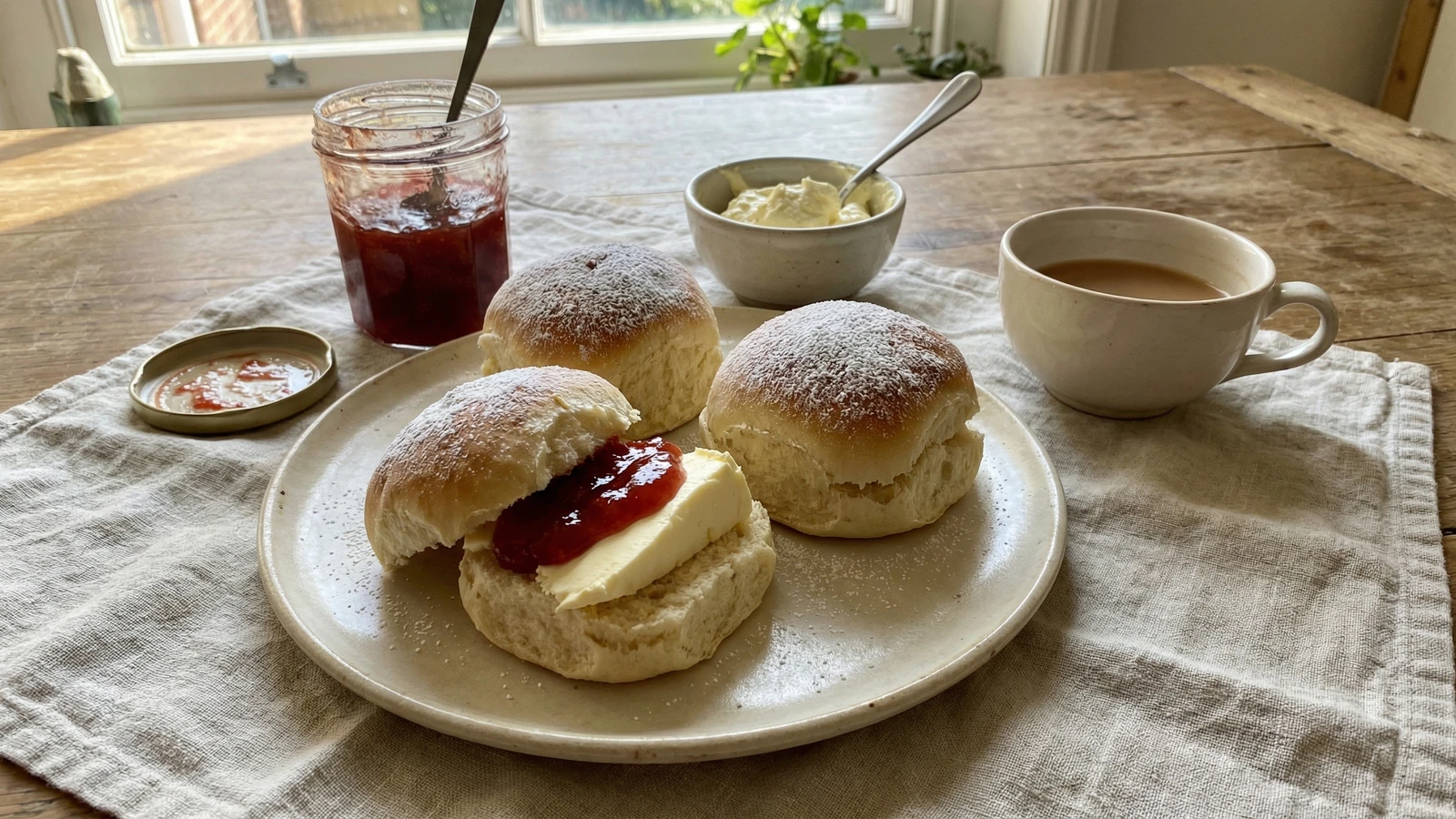
Soft, pale yeasted buns split open and filled with thick clotted cream and good jam, the older and quieter cousin of the cream tea scone, and the one Devon got right first.
ADevonshire split is a Sunday afternoon in bun form. Pale, soft, faintly sweet, dusted with icing sugar, and split open to take a wedge of clotted cream and a heaped spoon of jam. There's nothing complicated about them. There never was. They were the original cream tea bread, made all over the West Country before scones took over the conversation, and to my mind they're the better of the two. A scone is dry without its filling. A split is tender on its own and transformed by it.
The order matters. In Devon, the cream goes on first and the jam sits on top. In Cornwall, it's the other way round. People take this seriously, and so they should. I'm not here to start a war, but if you're calling these Devonshire Splits then the cream goes first. Those are the rules of the room.
Make them on a Saturday afternoon when the kitchen has time and the weather has turned soft, the kind of day when the rain is steady and there's nowhere you have to be. The dough is forgiving. The shaping is gentle. The bake is short. And the moment when you carry a plate of them to the table, still dusted in sugar, the cream cool against the warm bun, the jam catching the light, is one of the few things in cooking I'd call quietly perfect.
I wrote it down in the notebook last June: "Splits. Strawberry jam from the market. Rain on the window. Three each." That was the whole entry. Some afternoons don't need more than that.
Quantity
500g
plus extra for dusting
Quantity
7g
Quantity
50g
Quantity
7g
Quantity
250ml
warmed to body temperature
Quantity
60g
melted and cooled slightly
Quantity
1
lightly beaten
Quantity
1 teaspoon
Quantity
a little
Quantity
for dusting
Quantity
200g
Quantity
300g
| Ingredient | Quantity |
|---|---|
| strong white bread flourplus extra for dusting | 500g |
| fine sea salt | 7g |
| caster sugar | 50g |
| fast-action dried yeast | 7g |
| whole milkwarmed to body temperature | 250ml |
| unsalted buttermelted and cooled slightly | 60g |
| large egglightly beaten | 1 |
| vanilla extract | 1 teaspoon |
| melted butter, for brushing | a little |
| icing sugar | for dusting |
| strawberry or raspberry jam | 200g |
| clotted cream | 300g |
Tip the flour into a large bowl. Put the salt on one side, the sugar and yeast on the other. Salt knocks back yeast if they meet directly, so keep them apart for a moment longer than feels necessary. Pour in the warm milk, the melted butter, the beaten egg, and the vanilla. Bring it together with your hands into a shaggy, slightly sticky dough. It will feel softer than a bread dough should. That's right. Don't be tempted to add more flour.
Turn the dough out onto a lightly floured surface and knead for ten minutes. It will go from sticky and ragged to smooth and supple, springing back when you press it with a finger. If you have a stand mixer with a dough hook, six or seven minutes on a low speed does the same job. Trust your hands either way. The dough is ready when it feels alive.
Put the dough into a lightly oiled bowl, cover with a clean tea towel, and leave somewhere warm to rise until doubled. An hour to an hour and a half, depending on the kitchen. The top of the boiler, near a sunny window, on top of the oven while something else is cooking. The dough decides, not the clock. Press a fingertip in and if the dent stays, it's ready.
Knock the dough back gently, no need to be aggressive about it. Divide into twelve equal pieces. A scale helps if you want them uniform; eyes do fine if you don't mind a bit of variation. Roll each piece into a smooth round by cupping your hand over it and circling on an unfloured patch of work surface. The friction tightens the skin. Place them on a parchment-lined baking tray, leaving a finger's width between each. They'll close the gap as they prove.
Cover loosely with the tea towel and leave to prove for forty-five minutes or so, until the buns are puffed and pillowy and just touching their neighbours. Heat the oven to 200C/180C fan. Brush the tops gently with a little melted butter. No egg wash here. You want them pale and soft, not glossy and golden.
Bake for twelve to fifteen minutes. They should be barely coloured, the colour of pale honey on top, paler still where they've kissed each other. The bottoms should sound hollow when you tap them. This isn't a crusty bread. It's a bun, and it should stay soft. Pull them out the moment the colour is right.
Lift the whole sheet of buns onto a cooling rack and brush again with melted butter while they're still warm. The butter sinks into the tops and keeps them tender. Leave to cool completely. Dust generously with icing sugar. Generously means more than you think.
Now the part that matters. Cut each bun at an angle, almost halfway through, so it opens like a book. Spoon a thick wedge of clotted cream into the cut first. Cream first. This is Devon, and Devon puts the cream on first. Then top the cream with a heaped spoon of jam. Strawberry, raspberry, whatever you've got that's good. A final dusting of icing sugar over the lot. Eat at once, with tea, with the kettle still warm and someone you like sitting opposite.
1 serving (about 122g)
Culinary guides, cultural storytelling, and the editorial depth that makes cooking meaningful.
Discover Culinary ExplorerChef Thomas
A proper British bloomer, slashed deep and baked until the cuts open wide and the crust turns deep, glossy gold. The kind of loaf that makes the rest of the day feel deliberate.

Chef Thomas
A simple white loaf made from flour, water, yeast, and salt. The kind of bread that fills the kitchen with the smell of a Saturday morning and teaches you, slowly, everything you need to know about baking.

Chef Thomas
A dark, fruit-heavy Welsh tea loaf, soaked overnight in strong tea and baked slowly until the kitchen smells of spice and orange peel. Sliced thick and buttered cold.

Chef Thomas
Rich, butter-laden Georgian buns from Bath, glazed deep gold and crowned with crushed sugar nibs that crack beneath your teeth, the kind of bake that turns a Sunday afternoon into something deliberate.