
Chef Jeong-sun
Aehobak-guk (애호박국, Korean Zucchini Soup)
A clean summer soup of Korean zucchini and salted shrimp, built on quick anchovy-kelp broth and finished before the half-moons lose their shape on a weeknight table.
A cooking platform built around craft, culture, and the stories behind what we eat.
Created by
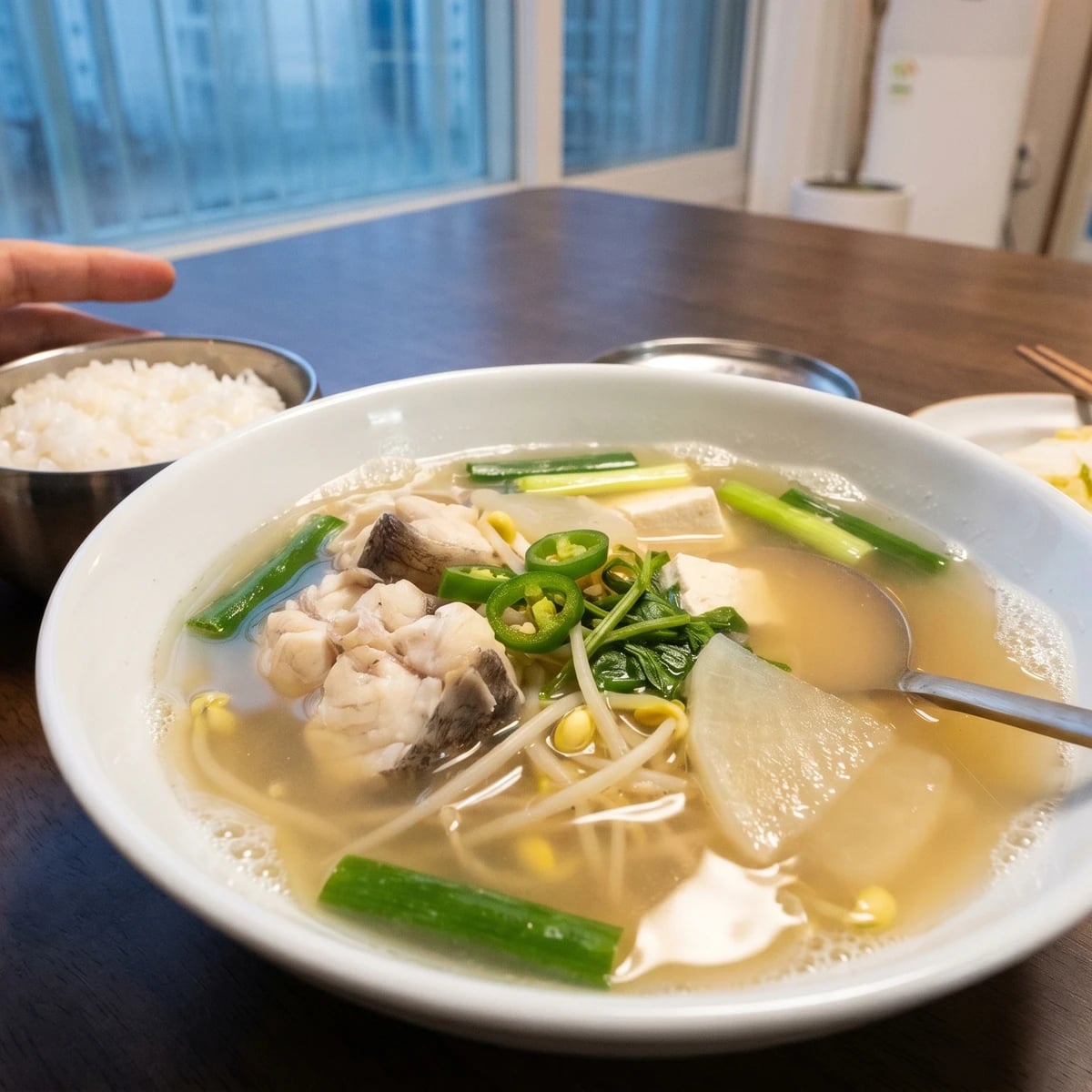
A clear winter cod soup with radish, bean sprouts, and scallion, cooked gently so the broth stays clean and the fish tastes like the sea it came from.
Daegutang belongs to winter market mornings, when cod is firm, cold, and worth carrying home whole. Cook the month you're standing in. If the cod looks tired, don't force the soup. Make kongnamul-guk (soybean sprout soup) instead and wait for better fish.
This is not maeuntang (spicy fish stew). The work here is restraint: clean the cod well, build a quiet kelp broth, simmer the radish until it sweetens the pot, then let the fish cook just until it flakes. Too much garlic, too much soy sauce, too much boiling, and the soup turns cloudy and loud. Let it taste like itself.
Notebook 42 says the salt goes in at the end, 1 teaspoon first, then 1/4 teaspoon more only if the cod and radish ask for it. 손맛 is real. I still measure it, so it can be handed on. Tonight this dish asks for fresh fish, a sharp knife, and a calm hand with the seasoning.
Daegu (Pacific cod) has long been a winter fish of Korea's eastern and southern coasts, especially around Gyeongsang ports such as Geoje, Jinhae, and Busan, where cod was dried, salted, and cooked fresh in clear soups. Daegutang sits beside maeuntang in Korean fish cooking, but its clear style, often called jiri in restaurants, shows a different habit: using radish, bean sprouts, and light seasoning to make fresh fish taste cleaner rather than hotter.
Quantity
800g
including head if available
Quantity
1 tablespoon
for cleaning the fish
Quantity
6 cups
Quantity
1 piece, about 4 inches square
Quantity
6
heads and guts removed
Quantity
350g
cut into 1/3-inch half-moons
Quantity
150g
rinsed
Quantity
150g
cut into thick squares
Quantity
3 cloves
minced
Quantity
1 teaspoon
finely minced
Quantity
1 tablespoon
Quantity
1 teaspoon, plus 1/4 teaspoon more if needed
Quantity
2
cut into 2-inch lengths
Quantity
1
sliced on the diagonal
Quantity
1
sliced on the diagonal
Quantity
40g
trimmed
Quantity
1/4 teaspoon
| Ingredient | Quantity |
|---|---|
| fresh cod steaks or bone-in cod piecesincluding head if available | 800g |
| coarse saltfor cleaning the fish | 1 tablespoon |
| water | 6 cups |
| dried kelp (dasima) | 1 piece, about 4 inches square |
| large dried anchovies (myeolchi) (optional)heads and guts removed | 6 |
| Korean radish (mu)cut into 1/3-inch half-moons | 350g |
| soybean sprouts (kongnamul)rinsed | 150g |
| medium-firm tofu (optional)cut into thick squares | 150g |
| garlicminced | 3 cloves |
| gingerfinely minced | 1 teaspoon |
| soup soy sauce (guk-ganjang) | 1 tablespoon |
| sea salt | 1 teaspoon, plus 1/4 teaspoon more if needed |
| scallionscut into 2-inch lengths | 2 |
| green chili (optional)sliced on the diagonal | 1 |
| red chili (optional)sliced on the diagonal | 1 |
| minari (Korean water dropwort) or ssukgat (crown daisy) (optional)trimmed | 40g |
| freshly ground black pepper (optional) | 1/4 teaspoon |
Rub the cod pieces gently with 1 tablespoon coarse salt, especially along the belly cavity and around the bones, then rinse under cold running water. Pull away any dark bloodline or black membrane. This is not fussiness. Those bits are where the muddy smell hides, and a clear soup has nowhere to conceal it.
Put 6 cups water, the kelp, and the anchovies if using in a wide pot. Bring to a gentle simmer over medium heat. Pull the kelp out as soon as the water begins to move, after about 8 minutes, because kelp left too long turns the broth slick. Simmer the anchovies 7 minutes more, then remove them.
Add the radish and simmer 10 to 12 minutes, until the edges turn translucent and a chopstick goes in with a little resistance. Radish goes first because it sweetens the broth and needs more time than the fish. If you add everything together, the cod will be tired before the radish is ready.
Lower the cod pieces into the pot in one layer, then add the garlic, ginger, and soup soy sauce. Keep the broth at a quiet simmer, not a rolling boil, for 7 to 9 minutes. Do not stir hard. Spoon broth over the fish instead, because cod flakes easily and broken fish clouds the soup.
Add the soybean sprouts and tofu, if using, and simmer 4 minutes. Keep the lid off so the sprouts stay clean-tasting. They should bend but still keep a little crunch, giving the soup its plain, fresh lift.
Add 1 teaspoon sea salt and taste the broth. Wait ten seconds before deciding, because hot broth hides salt at first. Add the extra 1/4 teaspoon only if it tastes flat. The soup should taste of cod, radish, and kelp, with salt holding the line underneath.
Scatter in the scallions, chilies if using, and minari or ssukgat. Cook 30 seconds, just until the greens relax. Finish with black pepper if you like, then serve at once with rice and a clean kimchi or mild banchan. Strong side dishes will bully this soup.
1 serving (about 540g)
Culinary guides, cultural storytelling, and the editorial depth that makes cooking meaningful.
Discover Culinary Explorer
Chef Jeong-sun
A clean summer soup of Korean zucchini and salted shrimp, built on quick anchovy-kelp broth and finished before the half-moons lose their shape on a weeknight table.

Chef Jeong-sun
A Masan coast monkfish stew with firm white meat, gelatin at the bones, soybean sprouts for crunch, and a red broth seasoned to carry the fish, not bury it.

Chef Jeong-sun
A weeknight fish roe stew with radish and crown daisy in a clean spicy broth, where the whole success depends on adding the roe late enough that it sets tender, not chalky.

Chef Jeong-sun
Late-summer mallow leaves rubbed with salt until the bitter green water runs off, then simmered in a clean doenjang broth with dried shrimp, the quiet soup a Korean weeknight deserves.