
Chef Jeong-sun
Agwi-jjim (Braised Monkfish with Bean Sprouts)
Firm monkfish buried under crisp soybean sprouts, minari, and a red gochugaru sauce thickened at the end; Masan's market dish asks for heat, timing, and a steady hand.
A cooking platform built around craft, culture, and the stories behind what we eat.
Created by
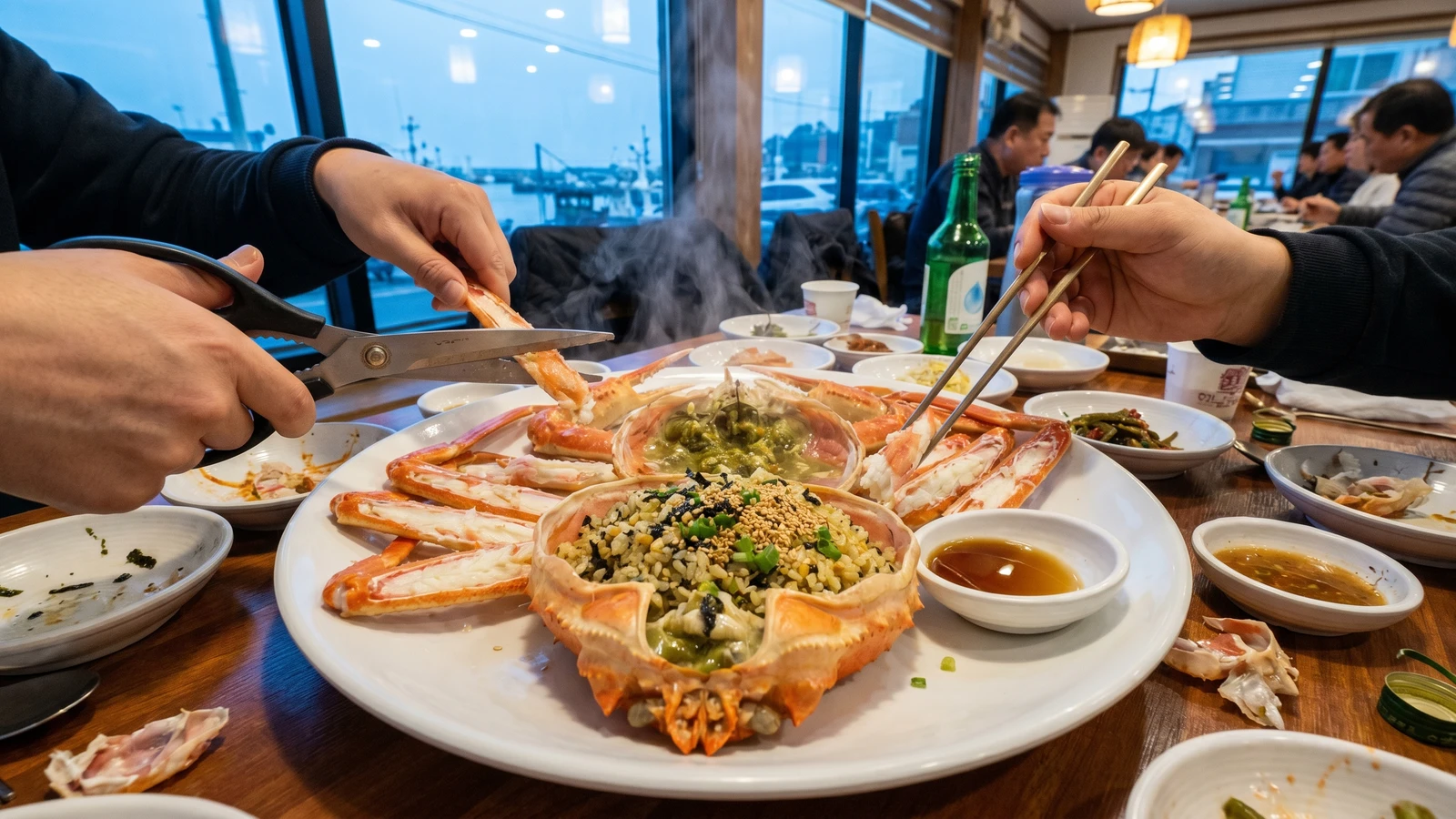
Whole snow crab steamed belly-up so the sweet juices stay inside, then finished the Korean way with warm rice stirred into the crab roe and green innards.
Daege-jjim belongs to winter and the east coast. In the market, you don't buy the prettiest crab. You buy the heavy one, the one that feels full for its size, with legs that hold firm and a shell that doesn't look newly molted. Cook the month you're standing in. Snow crab is at its best in the cold months, when the meat is sweet and the shell carries something worth saving.
There is almost no seasoning here, which makes people nervous. Don't be nervous. The work is in choosing the crab, keeping the juices inside, and stopping the cooking before the meat tightens. Steam it belly-up. That one detail matters because the crab's own broth gathers in the body instead of draining away. My teacher would tap the lid of the steamer once and say, "Now don't fuss with it." She was not gentle about lids.
This is celebration food because the ingredient is precious, not because the method is complicated. You eat the legs first, slowly, with scissors and fingers, then you open the body and mix warm rice into the roe and green crab innards, with sesame oil and gim (roasted seaweed). That rice is not an afterthought. It is the last chapter of the dish. Write it down. Memory is a borrowed bowl.
Daege, Korean snow crab, is closely associated with the East Sea coast, especially Yeongdeok and Uljin in North Gyeongsang Province, where winter crab markets and restaurant streets grew around the local catch. Yeongdeok daege became nationally famous through Ganggu Port and the annual Yeongdeok Snow Crab Festival, which promotes a regional fishing culture rather than a court dish. The usual Korean serving style is restrained: steamed whole crab, eaten plain or with a little dipping sauce, followed by rice mixed in the crab shell with its roe and innards.
Quantity
2, 700 to 900g each
live or very fresh
Quantity
6 cups
for steaming
Quantity
1/2 cup
Quantity
1 teaspoon
Quantity
2 cups
Quantity
2 teaspoons
Quantity
2 sheets
crushed
Quantity
1
finely sliced
Quantity
1 teaspoon
Quantity
1 tablespoon
for crab rice only if needed
Quantity
2 tablespoons
for dipping sauce
Quantity
1 tablespoon
for dipping sauce
Quantity
1 teaspoon
for dipping sauce
| Ingredient | Quantity |
|---|---|
| whole snow crabs (daege)live or very fresh | 2, 700 to 900g each |
| waterfor steaming | 6 cups |
| cheongju or dry sake (optional) | 1/2 cup |
| coarse sea salt (optional) | 1 teaspoon |
| hot cooked short-grain rice | 2 cups |
| toasted sesame oil | 2 teaspoons |
| gim (roasted seaweed)crushed | 2 sheets |
| scallionfinely sliced | 1 |
| toasted sesame seeds | 1 teaspoon |
| soy sauce (optional)for crab rice only if needed | 1 tablespoon |
| rice vinegarfor dipping sauce | 2 tablespoons |
| soy saucefor dipping sauce | 1 tablespoon |
| gochugaru (Korean chili flakes) (optional)for dipping sauce | 1 teaspoon |
Choose crabs that feel heavy for their size, with firm legs and a shell that is not soft or papery. A light crab has little meat, and no sauce fixes that. If buying live crab, keep it cold and cook it the same day. If buying cooked or frozen crab, thaw it overnight in the refrigerator and shorten the steaming time later.
Chill live crabs in the freezer for 15 minutes to slow them, then scrub the shell, leg joints, and underside under cold running water. Lift the apron and rinse away grit, but do not soak the crab in fresh water, which dulls the flavor. If you prefer to dispatch the crab before cooking, use a firm knife point through the center underside before it goes into the steamer.
Pour 6 cups water into a large steamer pot with the cheongju and salt, if using. The liquid should sit below the rack, not touch the crab. Bring it to a strong boil before the crab goes in, because slow heating can make the meat cling stubbornly to the shell.
Set the crabs on the rack belly-up, with the shell side down and the apron facing upward. Cover tightly and steam over high heat for 20 to 25 minutes for 700 to 900g crabs. Keep the lid closed. Belly-up steaming keeps the sweet crab liquid, roe, and green innards in the body instead of letting them run into the pot.
Turn off the heat and let the crabs rest, covered, for 5 minutes. This rest lets the juices settle and makes the shell easier to handle. Lift the crabs out belly-up and set them on a wide platter so nothing spills.
Pull off the legs and claws. Use kitchen shears to cut lengthwise along the softer side of each leg so the meat can be lifted out in long pieces. Open the body shell carefully over a bowl or platter, saving every spoonful of roe, green innards, and crab liquid. Discard the feathery gills and the hard stomach sac near the mouth.
Spoon the saved roe, green innards, and crab liquid back into the top shell. Add 2 cups hot rice, 2 teaspoons sesame oil, crushed gim, scallion, and sesame seeds. Mix gently with a spoon until the rice is glossy and evenly coated. Taste before adding soy sauce; good crab usually needs none, but 1 tablespoon is enough if the innards are mild.
Serve the crab legs and body pieces with the shell rice in the center. If you want a dipping sauce, stir together 2 tablespoons rice vinegar, 1 tablespoon soy sauce, and 1 teaspoon gochugaru, but keep it on the side. The crab should taste like crab first. Let it taste like itself.
1 serving (about 290g)
Culinary guides, cultural storytelling, and the editorial depth that makes cooking meaningful.
Discover Culinary ExplorerChef Jeong-sun
Firm monkfish buried under crisp soybean sprouts, minari, and a red gochugaru sauce thickened at the end; Masan's market dish asks for heat, timing, and a steady hand.

Chef Jeong-sun
A quick Korean rice bowl built on contrast: warm rice, cold popping flying-fish roe, chopped vegetables, gim, sesame oil, and the crisp rice bottom a hot stone bowl gives you.

Chef Jeong-sun
Andong's guest noodles, wheat and roasted soybean flour rolled thin, boiled and rinsed cold, then set in a clear chilled anchovy broth with careful strips of beef, egg, and cucumber.

Chef Jeong-sun
Andong's ritual-table rice served on an ordinary day: separate soy-sesame namul, warm rice, and clear radish soup, mixed without gochujang so every vegetable keeps its own voice.