
Chef Lupita
Acitrón de Cidra Conventual
Puebla's convent-style acitrón, made from cidra peel instead of endangered biznaga, built through repeated syrup soakings until the cubes turn firm, translucent, and ready for rosca or chiles en nogada.
A cooking platform built around craft, culture, and the stories behind what we eat.
Created by
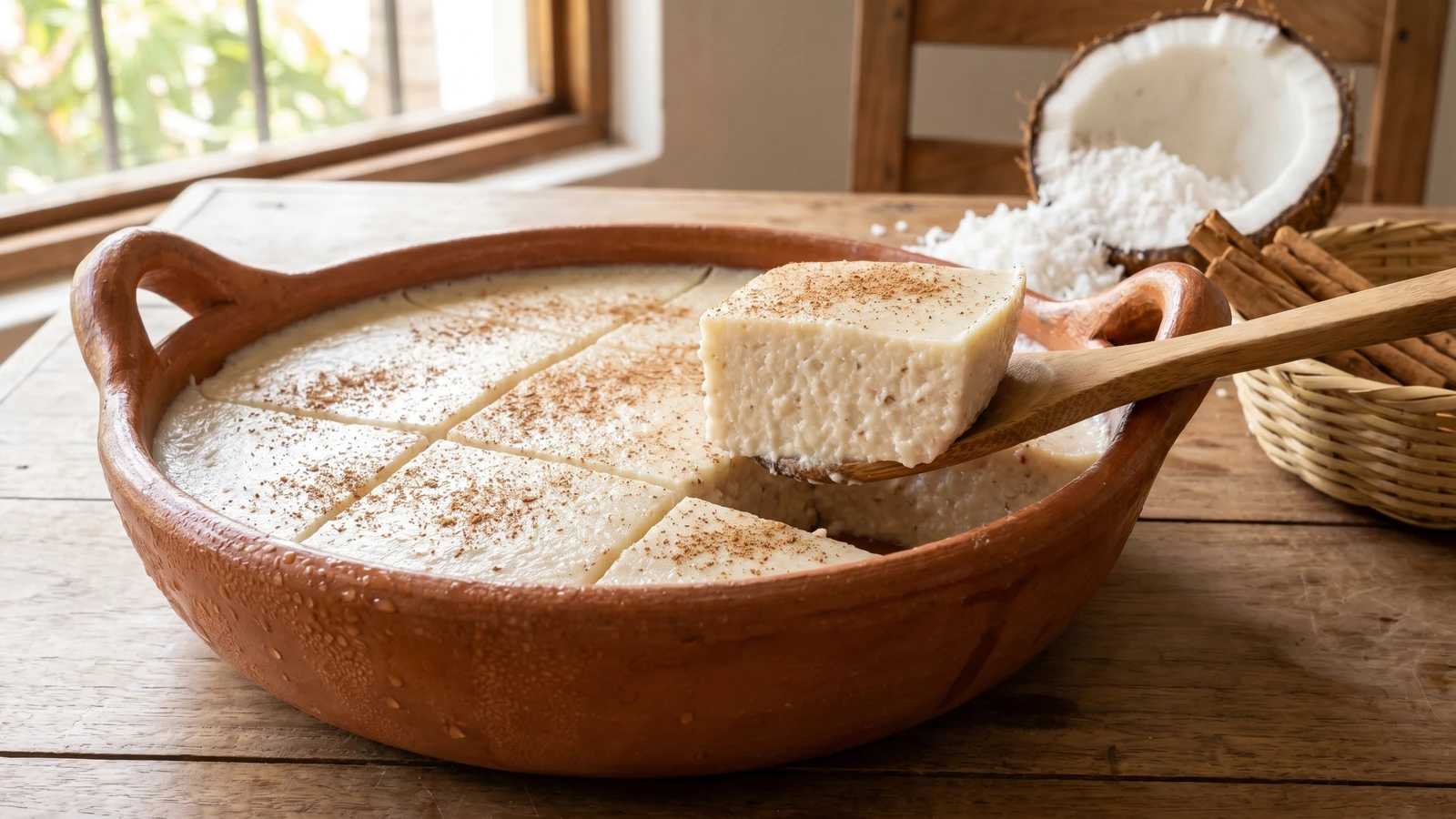
From the Nayarit coast around San Blas, fresh coconut, milk, cinnamon, and corn masa cook into a cold pudding with a faint chew and a clean coastal sweetness.
Nayarit owns this dish along the coast, especially around San Blas, where coconut palms stand close enough to the Pacific that the market smells of salt, ripe fruit, and damp husk. Cuala de coco is not flan. It is not mousse. It is a milk pudding thickened with corn masa, poured into a shallow dish, chilled, and cut into squares. That corn is the hand of Mexico in the dessert.
The coconut must taste like coconut. Use fresh if you can, grated fine, with its water saved if it is sweet. The milk carries it, the cinnamon warms it, and the masa gives the pudding its body. A blender can help, yes, but the pot still needs your arm. You stir until the spoon leaves a path and the mixture falls back slowly. No me vengas con atajos. If you stop early, it will not set.
I learned a version like this from a woman near the San Blas market who cooked it in an aluminum pot blackened at the bottom from years of sugar and milk. She poured it into a clay cazuela, not little cups. Family food goes to the table whole. Cada estado, su propia cocina, and Nayarit's coast knows what to do with coconut and corn.
Coconut became firmly established along Mexico's Pacific coast after the Manila galleon trade linked Asia, Acapulco, and western Mexico beginning in the late 16th century. San Blas, founded as a Spanish naval port in 1768, became one of the Pacific points where coastal ingredients, trade goods, and local cooking met. Cuala de coco reflects that geography: Asian-origin coconut folded into a Mexican technique of thickening with nixtamalized corn masa.
Quantity
2 cups
finely grated from 1 large mature coconut
Quantity
1/2 cup
strained from the fresh coconut, or use water
Quantity
4 cups
Quantity
3/4 cup, plus more to taste
Quantity
1/2 cup
or 1/2 cup masa harina mixed with 1/2 cup warm water
Quantity
1
Quantity
1/4 teaspoon
Quantity
1 teaspoon
Quantity
for serving
| Ingredient | Quantity |
|---|---|
| fresh coconutfinely grated from 1 large mature coconut | 2 cups |
| coconut waterstrained from the fresh coconut, or use water | 1/2 cup |
| whole milk | 4 cups |
| granulated sugar | 3/4 cup, plus more to taste |
| fresh nixtamal masaor 1/2 cup masa harina mixed with 1/2 cup warm water | 1/2 cup |
| Mexican cinnamon stick (canela) | 1 |
| fine sea salt | 1/4 teaspoon |
| Mexican vanilla extract | 1 teaspoon |
| ground canela (optional) | for serving |
Crack the coconut and save the water. Taste it. If it is sweet and clean, strain it and use it. If it tastes flat or sour, use plain water. Pry out the meat, peel away the brown skin if you want a paler pudding, and grate the coconut fine. Big shreds stay tough in the pudding. Fine coconut gives you that coastal, velvety texture.
Put the grated coconut, coconut water, 2 cups of the milk, and the masa in a blender. Blend until the coconut is very fine and the masa is fully dispersed, about 1 minute. If using masa harina, hydrate it first with warm water and let it sit 5 minutes before blending. Dry masa harina thrown straight into hot milk makes lumps. Ask any señora who has had to strain a ruined pot.
In a heavy 3-quart saucepan or clay cazuela, combine the remaining 2 cups milk, sugar, canela stick, and salt. Warm over medium heat, stirring until the sugar dissolves. Do not boil it hard. Milk that scorches at the bottom will make the whole pudding taste tired.
Pour the blended coconut and masa mixture into the warm milk through a medium strainer if you want a smoother set, or directly if you like more coconut texture. Stir constantly with a wooden spoon over medium-low heat for 20 to 25 minutes. The mixture will look thin at first, then glossy, then heavy. It is ready when the spoon leaves a clear path across the bottom of the pot and the pudding falls from the spoon in thick ribbons. This is the step that sets the dessert. Así se hace y punto.
Remove the canela stick. Stir in the Mexican vanilla. Taste carefully. It should be sweet, but not candy-sweet, because cold dulls sugar and coconut carries its own richness. If it needs more sugar, add 1 tablespoon at a time and stir until dissolved.
Rinse a shallow 8-inch clay cazuela, ceramic dish, or glass dish with cold water and shake out the excess. Pour in the hot pudding and smooth the top. Let it cool at room temperature for 30 minutes, then cover and refrigerate at least 3 hours, until firm enough to cut into squares. Do not rush the chilling. The masa needs time to settle into its texture.
Cut the cuala into squares with a wet knife. Lift each piece with a small spatula and serve cold, with a light dusting of ground canela if you use it. No berries, no whipped cream, no chocolate drizzle. This is Nayarit coconut and corn. Let it speak clearly.
1 serving (about 185g)
Culinary guides, cultural storytelling, and the editorial depth that makes cooking meaningful.
Discover Culinary ExplorerChef Lupita
Puebla's convent-style acitrón, made from cidra peel instead of endangered biznaga, built through repeated syrup soakings until the cubes turn firm, translucent, and ready for rosca or chiles en nogada.

Chef Lupita
Ciudad de México's Tulyehualco alegría is popped huautli folded into piloncillo honey, pressed with peanuts, pepitas, and raisins, then cut into the rectangular bars that built a pueblo's identity.

Chef Lupita
Oaxaca's pre-Columbian amaranth bar, popped on a hot comal and bound with piloncillo, honey, and the sacred Zapotec grain that the Spanish tried, and failed, to outlaw.

Chef Lupita
Querétaro's mercado candy of popped amaranto pressed with dark piloncillo syrup, pepitas, pecans, and cacahuate, a Bajío sweet that respects the seed before it decorates the table.