
Chef Lupita
Aguascalientes Beef Tongue Pozole (Pozole de Lengua)
Aguascalientes' Bajio pozole de lengua, built with cacahuazintle hominy, tender beef tongue, chile ancho and guajillo, with xoconostle brightness and table garnishes.
A cooking platform built around craft, culture, and the stories behind what we eat.
Created by
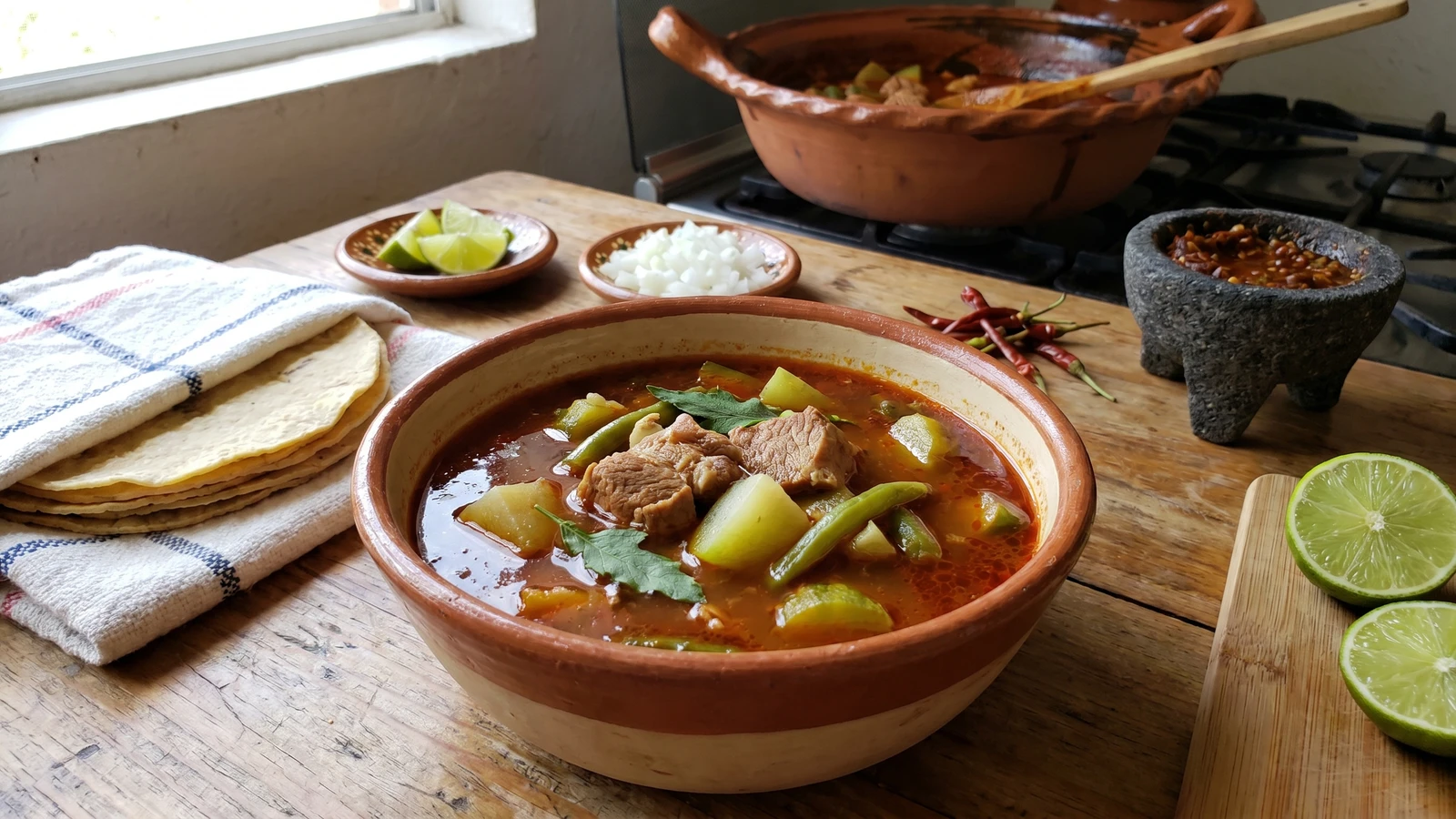
Morelos's weekday guisado of pork, chayote, ejote, and calabacita simmered in a thin mole of guajillo and pasilla, thickened with toasted tortilla and masa. The everyday food of the central highlands.
Clemole is from Morelos. The central highlands, the warm valleys around Cuautla and Yautepec and Tepoztlan where the chayote grows on the fence and the calabacita ripens on the vine and a cook puts both into a pot of toasted chile and calls it lunch. This is not a fancy mole. This is a guisado, the everyday cooking that feeds a family on a Tuesday.
The name comes from the Nahuatl. Tle-molli, fire-sauce, the same root that gives us mole. But where the moles of Puebla and Oaxaca are baroque compositions with thirty ingredients and two days of work, clemole is direct: guajillo, pasilla, ancho, tomato, a few spices, a toasted tortilla and a spoon of masa to give it body. The broth is thin. You ladle it into a clay cuenco and the vegetables sit in it like islands. The pork pulls apart with a spoon.
What makes it morelense, not just any chile stew, is the vegetable trinity: chayote, ejote, calabacita. All three grow in the state, all three are at their best from the local mercados, and all three are added to the pot in the correct order so each one is tender but not collapsed. The epazote at the end is non-negotiable. It belongs to this cuisine and there is no substitute.
My mother did not make clemole. She was from Jalisco and her chile stews were different. I learned this one in the mercado of Cuautla, from a señora named Doña Hermelinda who cooked it for the vendors every Wednesday in a clay cazuela the size of a wash basin. She told me: the broth should be thin, the chile should be deep, the vegetables should taste like vegetables. Cada estado, su propia cocina, and this one belongs to Morelos. Saber cocinar es saber vivir.
The word clemole, sometimes spelled clemol or tlemole, derives from the Nahuatl 'tletl' (fire) and 'molli' (sauce or concoction), the same root that produces mole, mole de olla, and guacamole. It is one of the older Nahuatl-named dishes still cooked daily in central Mexico, with documented variants across Morelos, the State of Mexico, Tlaxcala, and parts of Puebla, each state defending its own version of the vegetable mix and the thickener. The Morelos version's defining inclusion of chayote, a domesticated cucurbit native to Mesoamerica, and the use of toasted tortilla as a thickener reflect a continuity of indigenous technique that survived four centuries of culinary colonialism in the central highlands.
Quantity
2 pounds
cut into 2-inch chunks
Quantity
1 pound
cut into individual ribs
Quantity
1 medium, plus 1/4 onion
halved for the broth, the quarter reserved for blending
Quantity
1, plus 3 cloves
halved crosswise for the broth, the 3 cloves reserved for blending
Quantity
2
Quantity
1 tablespoon, plus more to taste
Quantity
8
stemmed and seeded
Quantity
4
stemmed and seeded
Quantity
2
stemmed and seeded
Quantity
3 medium
Quantity
2
husked and rinsed
Quantity
1
Quantity
2 tablespoons
Quantity
1 teaspoon
Quantity
4
Quantity
2
Quantity
3 tablespoons
Quantity
1/2 pound
trimmed and cut into 2-inch pieces
Quantity
2
peeled, pitted, and cut into 1-inch chunks
Quantity
2 medium
cut into 1-inch chunks
Quantity
2 large sprigs
Quantity
for serving
warmed
Quantity
for serving
Quantity
for serving
| Ingredient | Quantity |
|---|---|
| bone-in pork shouldercut into 2-inch chunks | 2 pounds |
| pork ribscut into individual ribs | 1 pound |
| white onionhalved for the broth, the quarter reserved for blending | 1 medium, plus 1/4 onion |
| head of garlichalved crosswise for the broth, the 3 cloves reserved for blending | 1, plus 3 cloves |
| bay leaves | 2 |
| kosher salt | 1 tablespoon, plus more to taste |
| dried chile guajillostemmed and seeded | 8 |
| dried chile pasillastemmed and seeded | 4 |
| dried chile anchostemmed and seeded | 2 |
| ripe tomatoes | 3 medium |
| tomatilloshusked and rinsed | 2 |
| day-old corn tortilla | 1 |
| masa harina | 2 tablespoons |
| whole cumin seed | 1 teaspoon |
| whole black peppercorns | 4 |
| whole cloves | 2 |
| manteca de cerdo (pork lard) | 3 tablespoons |
| ejotes (green beans)trimmed and cut into 2-inch pieces | 1/2 pound |
| chayotespeeled, pitted, and cut into 1-inch chunks | 2 |
| calabacitas (Mexican gray squash)cut into 1-inch chunks | 2 medium |
| fresh epazote | 2 large sprigs |
| hand-pressed corn tortillas (optional)warmed | for serving |
| lime wedges (optional) | for serving |
| diced white onion (optional) | for serving |
Place the pork shoulder and ribs in a heavy stockpot. Cover with cold water by two inches. Add the halved onion, halved garlic head, bay leaves, and salt. Bring to a gentle simmer over medium heat. Skim the gray foam that rises in the first fifteen minutes. Lower the heat and cook at a lazy simmer for one hour, until the meat is tender but not falling apart. Lift the pork out with a slotted spoon and reserve. Strain the broth and keep it warm. You will need every drop.
Heat a dry comal or heavy skillet over medium. Toast the guajillo, pasilla, and ancho chiles separately, about 20 to 30 seconds per side. The skin will puff and turn fragrant. They should never blacken. On the same comal, toast the day-old tortilla until it is dry and brown at the edges, almost like a tostada. The toasted tortilla is the body of the clemole. It is what makes this a clemole and not a sopa de chile.
Move the toasted chiles to a heatproof bowl and cover with hot tap water. Hot, not boiling. Boiling water cooks the skin and turns the salsa bitter. Let them soften for 20 minutes while you toast the rest.
On the same comal, char the tomatoes and tomatillos until the skins blister and blacken in patches and the flesh softens. Turn them with tongs so they color all over. Set them aside. In a small dry skillet, toast the cumin, peppercorns, and cloves over low heat for about a minute, until they smell awake. Pull them off the heat the moment you can smell them. Burned spice is bitter spice.
Drain the soaked chiles. Combine them in a blender with the charred tomatoes and tomatillos, the reserved 1/4 onion, the 3 raw garlic cloves, the toasted spices, the broken-up toasted tortilla, the masa harina, and one and a half cups of the warm pork broth. Blend on high until completely smooth. Strain through a fine-mesh sieve into a bowl, pressing on the solids with a wooden spoon. Discard the skins. You want a clean, deep brick-red puree with body.
In a wide cazuela or heavy Dutch oven, melt the manteca de cerdo over medium heat until it shimmers. Pour in the strained chile puree. Stand back. It will sputter and pop. Cook for eight to ten minutes, stirring constantly with a wooden spoon, scraping the bottom so nothing sticks. The puree will darken, the color will deepen from brick to a rich red-brown, and the lard will start to separate at the edges. La manteca es el sabor. This step is the difference between a clemole that tastes like the kitchen of a señora in Tepoztlan and one that tastes like raw chile.
Pour in the remaining warm pork broth, about six cups. Whisk to combine. The clemole should be the thickness of heavy cream, not a thick mole. If it is too thick, add a little more broth or hot water. If it is too thin, let it reduce a few minutes more. Return the reserved pork to the pot. Simmer gently for 15 minutes so the meat drinks the chile back in. Taste for salt now. The vegetables will need a broth that is already well-seasoned.
Add the chayotes first. They are the firmest and need the most time, about 10 minutes. Then add the ejotes. They take about 6 to 7 more minutes. Finally add the calabacitas and the epazote sprigs. Calabacita cooks fast and falls apart if you forget about it. Five more minutes and everything should be tender but still holding its shape. This is the order the señoras in the mercado of Cuautla will tell you, and they are right.
Pull the pot off the heat and let it sit for five minutes. The masa-thickened broth will settle and the flavors will marry. Ladle into deep clay cuencos, making sure each bowl gets pork, ejote, chayote, and calabacita. Serve with warm hand-pressed corn tortillas, lime wedges, and diced white onion at the table. This is everyday food in Morelos. No fanfare. Así se hace y punto.
1 serving (about 520g)
Culinary guides, cultural storytelling, and the editorial depth that makes cooking meaningful.
Discover Culinary ExplorerChef Lupita
Aguascalientes' Bajio pozole de lengua, built with cacahuazintle hominy, tender beef tongue, chile ancho and guajillo, with xoconostle brightness and table garnishes.

Chef Lupita
Veracruz's Gulf coast rice from Alvarado, built with seafood stock, tomato, chile chipotle, epazote, shrimp, fish, jaiba, and pulpo, served loose and brothy in a clay cazuela.

Chef Lupita
Costa Chica's wet salt-beef stew, built from chile costeño, guajillo, tomato, manteca, yuca, plantain, and masa dumplings, the ranching pot of Cuajinicuilapa and Pinotepa.

Chef Lupita
Michoacán's P'urhépecha atápakua is a masa-thickened sauce and stew at once, built with pork, chile guajillo, and hierbabuena added only at the end.