
Chef Lupita
Agua de Alfalfa
Ciudad de México's highland market agua fresca, fresh alfalfa blended with pineapple and lime until bright green, strained clean, and poured cold from the vitrolero.
A cooking platform built around craft, culture, and the stories behind what we eat.

Created by
The Costa Chica's coconut champurrado, masa and cacao whisked thick with a molinillo and finished with coconut milk instead of dairy. The Afro-Mexican Pacific coast's answer to the champurrado of central Mexico, and proof that one cuisine has many faces.
This is from the Costa Chica, the band of Pacific coast that runs from below Acapulco through Guerrero and into Oaxaca. This is Afro-Mexican country. Cuajinicuilapa, Ometepec, San Marcos, towns where the people descend from Africans enslaved and brought to this coast in the colonial period, and where the kitchen still carries that history in every pot.
Champurrado is a chocolate atole: corn masa and cacao cooked until it is thick enough to coat a spoon. Central Mexico builds it on water or milk. The Costa Chica builds it on coconut. The palms grow right down to the sand here, so the cooks reach for what the coast gives them. Coconut milk instead of dairy. That one change is the whole dish, and it tastes like nowhere else in the country.
The masa goes into cool water and through a strainer before it ever meets heat. Lumps are the mark of a careless cook, and once they cook in there is no whisking them out. You raise the foam with a molinillo, the carved wooden whip you spin between your palms, not because it is charming but because it froths the chocolate and keeps the masa moving so it does not scorch on the bottom. No me vengas con atajos. A blender does not do what a molinillo does.
Know what this is and what it is not. This is champurrado: warm, thick, masa and cacao. It is not chilate, the cold cacao-and-rice drink this same coast grinds on the metate and serves with buñuelos at its festivals. Two drinks, one region, nothing alike. I learned this version from a woman in Cuajinicuilapa who grated the coconut by hand over a clay bowl and laughed when I asked whether canned would do. Cada estado, su propia cocina.
Champurrado is a chocolate atole, and atole is pre-Columbian, its name taken from the Nahuatl 'atolli,' a corn-masa drink that predates the conquest; the cinnamon and cane sugar worked into the modern version arrived later through Spanish trade. The coconut that defines the Costa Chica version is not native to Mexico: the palms reached the Pacific coast aboard the Manila-Acapulco galleons in the late 1500s, carried by Filipino sailors and rooted first around Colima and Acapulco before spreading down the coasts of Guerrero and Oaxaca. The Costa Chica's Afro-Mexican communities, descended from Africans enslaved during the colonial period, went unrecognized in the federal Constitution until a 2019 reform to Article 2, and the 2020 national census was the first to count them, recording roughly 2.5 million people, about 2 percent of the population, as Afro-Mexican.
Quantity
1/2 cup
or 1 cup fresh masa from a molino
Quantity
3 cups, divided
use fresh coconut water for part, if you have it
Quantity
3 cups (from about 2 mature coconuts)
or two 13.5-ounce cans full-fat coconut milk
Quantity
4 to 5 ounces (about 1.5 disks)
chopped
Quantity
1 small cone (3 to 4 ounces), plus more to taste
chopped
Quantity
1 stick (4 inches)
Quantity
1 pinch
Quantity
for serving
Quantity
for dusting
| Ingredient | Quantity |
|---|---|
| masa harina (masa de maíz nixtamalizado)or 1 cup fresh masa from a molino | 1/2 cup |
| wateruse fresh coconut water for part, if you have it | 3 cups, divided |
| fresh coconut milkor two 13.5-ounce cans full-fat coconut milk | 3 cups (from about 2 mature coconuts) |
| Mexican chocolate de mesa, preferably oaxaqueñochopped | 4 to 5 ounces (about 1.5 disks) |
| piloncillochopped | 1 small cone (3 to 4 ounces), plus more to taste |
| canela de Ceilán (true Ceylon cinnamon) | 1 stick (4 inches) |
| sea salt | 1 pinch |
| freshly grated coconut, lightly toasted (optional) | for serving |
| ground Ceylon cinnamon (optional) | for dusting |
Whisk the masa harina into 2 cups of the water until you have a thin, smooth slurry with no clumps. Use cool water, not hot. Hot water seizes the masa into lumps before you can break them up. Pour the slurry through a fine-mesh strainer into your clay olla, working any thick bits through with a spoon or leaving them behind. Lumps are the mark of a careless cook, and once they cook into the champurrado there is no whisking them out.
Add the remaining 1 cup water, the canela stick, the chopped piloncillo, and the pinch of salt to the olla. Set it over medium heat and whisk from the first minute with a molinillo or wooden spoon. As it warms, the masa thickens and wants to settle and scorch on the bottom of the pot, so keep it moving. The salt is not optional. It pulls the cacao and the piloncillo together and rounds the whole drink.
When the base is very hot and lightly thickened, about 8 to 10 minutes, drop in the chopped chocolate de mesa. Whisk until every piece dissolves and the surface turns glossy and deep brown. Now work the molinillo: hold the handle upright between your palms and spin it back and forth. That spinning is what froths the chocolate and gives champurrado its body. A spoon stirs. A molinillo lifts.
Pour in the coconut milk and stir it through. Bring it back to a bare simmer over medium-low. Do not let it boil hard. A hard boil breaks the coconut milk into greasy flecks and scorches the masa underneath. Cook gently, whisking often, for 10 to 12 minutes, until the champurrado coats the back of a wooden spoon and a line drawn through it holds for a second. That thick, clinging body is what you are after.
Fish out the canela stick. Taste for sweetness and add more piloncillo if you want it, whisking until it dissolves. Remember the chocolate de mesa is already sweetened, so go slow. Work the molinillo hard for the last minute to raise a good cap of foam, the espuma, across the top. That foam is the sign of a champurrado made by hand, not one stirred lazily with a spoon.
Pour into clay jarritos or jícara gourd cups while it is hot and thick. Dust with toasted coconut and a little ground cinnamon if you like. On the Costa Chica this is breakfast, it is a cold-night drink, it is what the women set out for the family through the holidays. Drink it slow. Saber cocinar es saber vivir.
1 serving (about 270g)
Culinary guides, cultural storytelling, and the editorial depth that makes cooking meaningful.
Discover Culinary ExplorerChef Lupita
Ciudad de México's highland market agua fresca, fresh alfalfa blended with pineapple and lime until bright green, strained clean, and poured cold from the vitrolero.
Chef Lupita
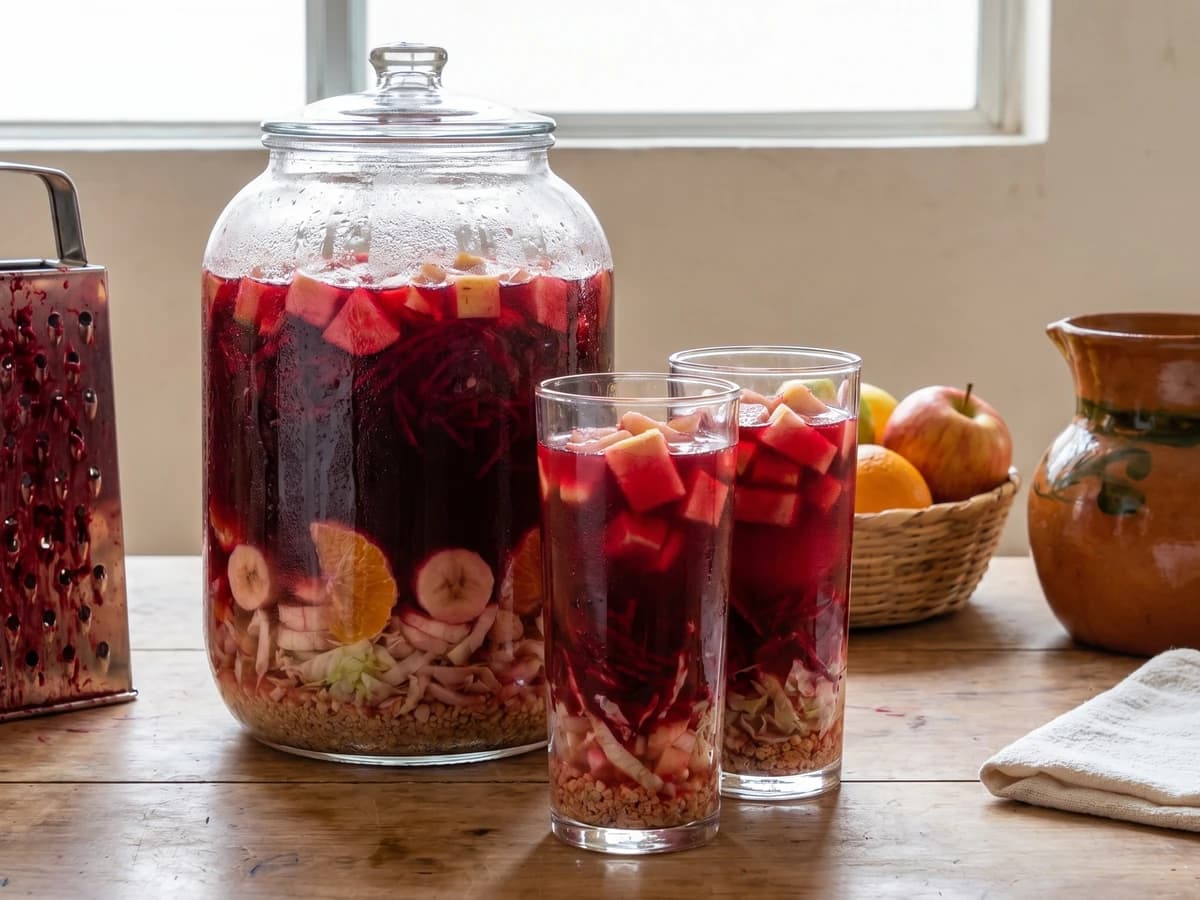
Aguascalientes' Lenten agua fresca, jewel-red from cooked beet and full of apple, banana, orange, lettuce, and ground peanuts, served cold when Holy Week meets the Feria de San Marcos.

Chef Lupita
Sonora and Sinaloa's creamy malted barley water, built on toasted cebada perla, Mexican canela, vanilla from Papantla, and evaporated milk. Pink-beige, rich, and served cold over heavy ice in a heavy glass tumbler. Liquid cookie comfort the northwest way.

Chef Lupita
Yucatán's everyday tonic of boiled chaya leaves blended with lima agria, sugar, and ice. The bright green jarra that sits on every Peninsula table from Mérida to Valladolid.