
Chef Graziella
Brutti ma Buoni
The cookies that prove beauty is the enemy of honest baking. Lumpy, cracked, and perfect, these hazelnut meringues are crisp shells hiding chewy, nutty centers.
A cooking platform built around craft, culture, and the stories behind what we eat.

Created by
The ancient spiced honey cookies of Siena, dense with walnuts and candied fruit, perfumed with anise. Medieval travelers sustained themselves with these at stable inns, and the name stuck.
These are not delicate cookies. They are travelers' provisions, meant to sustain pilgrims and merchants along the Via Francigena, the medieval road that connected Canterbury to Rome. Cavallucci were sold at the osterie where horses were stabled, and the name means 'little horses,' though the cookies contain no horsemeat. They are named for the places where they were eaten, not what they contain.
Siena guards its sweets jealously. Panforte, ricciarelli, cavallucci: these are the trinity of Sienese Christmas baking, each with origins stretching back centuries. Cavallucci are the humblest of the three, made with honey and flour and whatever spices the baker could afford. The wealthy added more candied fruit. The poor made do with anise and walnuts. Both versions sustained.
The texture confuses Americans who expect cookies to shatter. Cavallucci are dense, almost chewy, with cracks across their domed surfaces. They soften further after a day or two in a tin, which is when they reach their peak. This is not a flaw. This is the design. Food meant for travel must keep.
Cavallucci appear in Sienese records from at least the 14th century, sold at the osterie along trade routes where travelers stopped to rest and stable their horses. The name derives not from any equine ingredient but from these horse stations, 'stazioni dei cavalli,' where weary pilgrims on the Via Francigena could purchase provisions that would not spoil. The Sienese guild of speziali, the spice merchants, controlled the recipe for centuries.
Quantity
300g (2 1/3 cups)
Quantity
200g (generous 1/2 cup)
preferably chestnut or wildflower
Quantity
100g (1/2 cup)
Quantity
1/4 cup
Quantity
100g (1 cup)
coarsely chopped
Quantity
50g (1/4 cup)
finely diced
Quantity
1 teaspoon
Quantity
1/2 teaspoon
Quantity
1/2 teaspoon
Quantity
1/4 teaspoon
freshly grated
Quantity
1/2 teaspoon
Quantity
pinch
Quantity
for dusting
| Ingredient | Quantity |
|---|---|
| all-purpose flour | 300g (2 1/3 cups) |
| honeypreferably chestnut or wildflower | 200g (generous 1/2 cup) |
| granulated sugar | 100g (1/2 cup) |
| water | 1/4 cup |
| walnutscoarsely chopped | 100g (1 cup) |
| candied orange peelfinely diced | 50g (1/4 cup) |
| anise seeds | 1 teaspoon |
| ground coriander | 1/2 teaspoon |
| ground cinnamon | 1/2 teaspoon |
| nutmegfreshly grated | 1/4 teaspoon |
| baking soda | 1/2 teaspoon |
| fine sea salt | pinch |
| powdered sugar (optional) | for dusting |
Sift the flour into a large bowl. Add the baking soda, salt, coriander, cinnamon, and nutmeg. Whisk to combine. Add the anise seeds, chopped walnuts, and diced candied orange peel. Toss everything together so the additions are evenly distributed throughout the flour. Make a well in the center.
Combine the honey, sugar, and water in a small heavy saucepan. Place over medium heat and stir until the sugar dissolves completely. Bring to a simmer and let it bubble gently for two minutes. The syrup should be hot and fluid but not caramelized. Remove from heat immediately.
Pour the hot honey syrup into the well in the flour. Working quickly with a wooden spoon, stir from the center outward, incorporating the flour gradually until a rough, sticky dough forms. The dough will be quite warm. Let it cool for five minutes until you can handle it, then knead briefly on a lightly floured surface until it comes together. Do not overwork it. The dough should be soft, slightly tacky, and pliable.
Preheat your oven to 350°F (175°C). Line two baking sheets with parchment paper. Divide the dough into 24 pieces, roughly the size of a walnut in its shell. Roll each piece into a ball, then flatten slightly into a thick disc about two inches across. The tops will crack during baking, which is correct. Place them two inches apart on the prepared sheets.
Bake one sheet at a time in the center of the oven for 15 to 18 minutes. The cavallucci are done when they are pale gold on the bottom, still somewhat soft to the touch, and the tops have developed characteristic cracks. They will firm as they cool. Do not overbake them or they will become hard as stones.
Let the cookies cool on the baking sheet for five minutes, then transfer to a wire rack to cool completely. If you like, dust lightly with powdered sugar once cooled. Store in an airtight tin at room temperature. They will keep for two weeks and actually improve after the first day, becoming softer and more aromatic.
1 serving (about 31g)
Culinary guides, cultural storytelling, and the editorial depth that makes cooking meaningful.
Discover Culinary ExplorerChef Graziella
The cookies that prove beauty is the enemy of honest baking. Lumpy, cracked, and perfect, these hazelnut meringues are crisp shells hiding chewy, nutty centers.

Chef Graziella
The original twice-baked almond cookies of Tuscany, made without butter as tradition demands, hard enough to shatter between your teeth until you dip them in Vin Santo and they surrender.
Chef Graziella
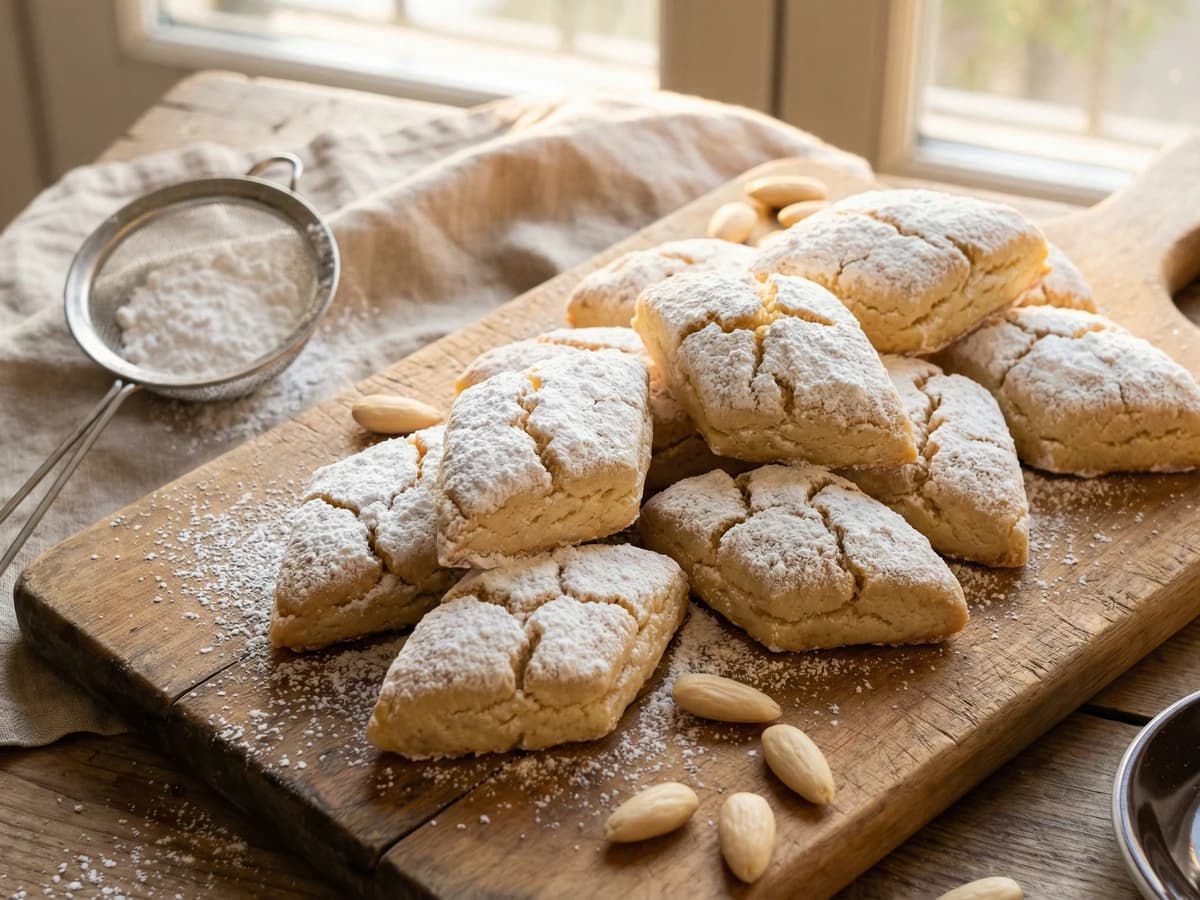
The ancient almond cookies of Siena, soft as a whisper, crackled on top, buried in powdered sugar. Eight centuries of Tuscan tradition in every bite.

Chef Juliette
A pale short-paste shell holds silken, lightly sweet carrot purée beneath neat glazed half-discs, their butter syrup catching the light: a classical tart poised between vegetable course and sweet.