
Chef Lupita
Acitrón de Cidra Conventual
Puebla's convent-style acitrón, made from cidra peel instead of endangered biznaga, built through repeated syrup soakings until the cubes turn firm, translucent, and ready for rosca or chiles en nogada.
A cooking platform built around craft, culture, and the stories behind what we eat.
Created by
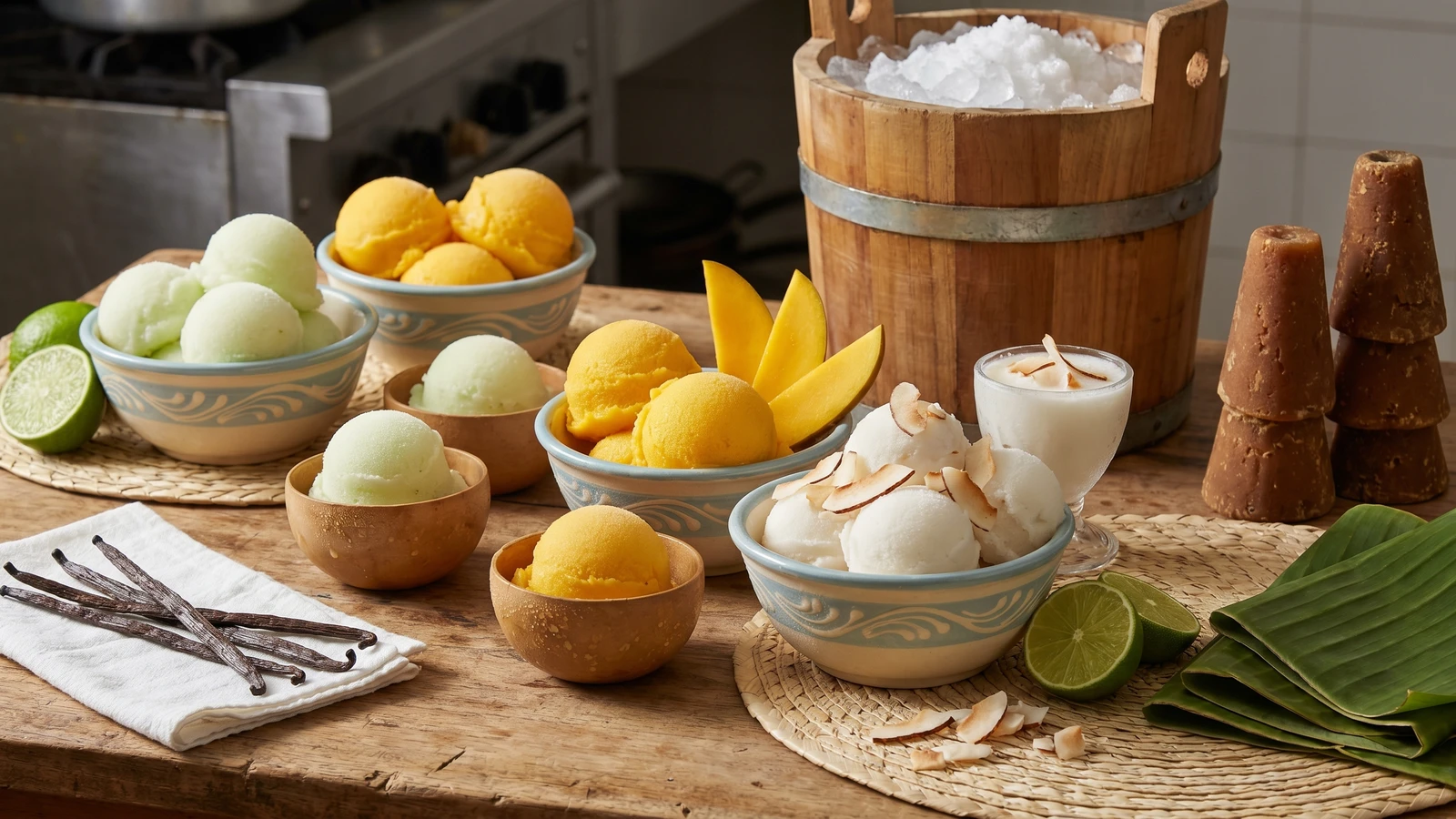
Veracruz's lake-town nieves, churned in a garrafa with ice and salt, built from limón criollo, mango, coco fresco rallado, and whatever Los Tuxtlas puts in the market that morning.
Veracruz, Los Tuxtlas, Catemaco. Start there. This is lake-town food, humid Gulf food, market food sold from metal garrafas packed in ice and salt while the afternoon sits heavy over the plaza.
The fruit decides the nieve. Limón criollo when the day is sharp and hot. Mango Manila or Ataulfo when the stalls are golden. Coco fresco rallado when someone has split the coconut that morning and the meat is still sweet and damp. If the mangoes are fibrous, don't make mango. Make limón. Pregúntale a las señoras del mercado. They know what is worth buying before you do.
The technique belongs to the women who turned fruit, syrup, and patience into a living. You pour the base into the inner canister, pack the outside with ice and rock salt, and turn by hand until the liquid thickens into fine crystals. Not hard ice cream. Not a blender slush. Nieve. The salt makes the ice colder, the turning keeps the crystals small, and the fruit stays clean on the tongue.
For Veracruz desserts, use piloncillo for the syrup. It brings a cane depth that white sugar cannot give. For coco, use coco fresco rallado, not dry bagged coconut. For vainilla, use a whole vainilla de Papantla pod when you make the coconut batch. Extract is a shortcut that tastes like a bottle. No me vengas con atajos. Cada estado, su propia cocina.
Hand-churned nieves in Mexico developed from colonial-era ice trade routes and later became plaza food, made in wooden or metal garrafas packed with ice and salt. In Veracruz, the Gulf ports connected local tropical fruit with imported freezing techniques, while Papantla's vanilla and the cane fields of the coastal plain shaped the flavor of regional sweets. Catemaco's location in Los Tuxtlas, between lake, volcanic hills, and humid fruit markets, makes its nieves practical rather than decorative: the day's fruit becomes the dessert.
Quantity
8 ounces
finely chopped or grated
Quantity
3 cups
divided
Quantity
1 small pinch
Quantity
1
split lengthwise
Quantity
1 1/2 cups
Quantity
1 tablespoon
Quantity
2 cups
pureed and strained
Quantity
2 cups
freshly grated coconut meat
Quantity
1 cup
strained
Quantity
1 cup
for the coconut nieve
Quantity
1/2 cup
for an optional market fruit batch
Quantity
8 pounds
cracked or cubed, for churning
Quantity
2 cups
for packing the churn
Quantity
for serving
Quantity
for serving
Quantity
for serving
| Ingredient | Quantity |
|---|---|
| piloncillofinely chopped or grated | 8 ounces |
| waterdivided | 3 cups |
| sea salt | 1 small pinch |
| whole vainilla de Papantla podsplit lengthwise | 1 |
| fresh lime juice from limón criollo or Mexican limes | 1 1/2 cups |
| finely grated lime zest | 1 tablespoon |
| ripe mango Manila or Ataulfo pulppureed and strained | 2 cups |
| coco fresco ralladofreshly grated coconut meat | 2 cups |
| fresh coconut waterstrained | 1 cup |
| whole milkfor the coconut nieve | 1 cup |
| guanábana pulp, mamey pulp, or ripe pineapple puree (optional)for an optional market fruit batch | 1/2 cup |
| icecracked or cubed, for churning | 8 pounds |
| rock salt or coarse saltfor packing the churn | 2 cups |
| lime halves (optional) | for serving |
| fresh mango slices (optional) | for serving |
| toasted fresh coconut flakes (optional) | for serving |
Combine the piloncillo, 1 cup water, and the pinch of sea salt in a small saucepan. Bring to a gentle simmer over medium heat, stirring until the piloncillo dissolves completely, about 6 to 8 minutes. Do not boil it hard. You want a clean cane syrup, not candy. Pour into a bowl and cool completely.
Scrape the seeds from the vainilla de Papantla pod into the cooling syrup and add the split pod. Let it steep 20 minutes, then remove the pod and save it for the coconut batch. Papantla vanilla belongs to Veracruz. Use the pod. Extract is not the same thing.
Divide the cooled syrup into three bowls. For limón, mix 1/2 cup syrup with the lime juice, lime zest, and 1 cup cold water. For mango, mix 1/2 cup syrup with the mango puree and 1/2 cup cold water. For coco, blend 1/2 cup syrup with the coco fresco rallado, coconut water, whole milk, and the reserved vanilla pod seeds until the coconut is fine but not invisible. Taste each base. It should be slightly sweeter than you want the final nieve because freezing dulls sweetness.
Cover the bowls and refrigerate until very cold, at least 2 hours. Cold base freezes faster and makes smaller crystals. This is not fussiness. This is texture. The women selling nieves in the plaza know that a warm base makes coarse ice.
Place the inner metal canister of a hand-crank ice cream maker or garrafa into its bucket. Pour in one chilled fruit base, filling the canister no more than two-thirds full. Pack the space around it with alternating layers of ice and rock salt: three parts ice to one part salt. The salt is not seasoning the dessert. It drops the temperature of the ice so the nieve can freeze.
Turn the crank steadily for 20 to 30 minutes, scraping down the sides if your machine allows it. The mixture will go from liquid to slushy to thick and scoopable. Stop when it holds soft ridges and the crank resists. If you overpack the canister or stop turning too soon, you get hard icy chunks. Nieve should be fine-grained and light.
Transfer the churned nieve to a chilled metal or ceramic container. Press parchment or a clean banana leaf directly against the surface, cover, and freeze 30 to 45 minutes. This gives it enough body to scoop without turning it into a brick. Repeat the churning process with the remaining fruit bases.
Scoop the limón, mango, and coco nieves into jícaras, copitas, or small glazed earthenware bowls from Tlacotalpan. Serve with lime halves, fresh mango slices, and toasted fresh coconut flakes if they belong to the flavor in the bowl. Do not bury the fruit under syrup, candies, or canned milk. The fruit is the point. Así se hace y punto.
1 serving (about 250g)
Culinary guides, cultural storytelling, and the editorial depth that makes cooking meaningful.
Discover Culinary ExplorerChef Lupita
Puebla's convent-style acitrón, made from cidra peel instead of endangered biznaga, built through repeated syrup soakings until the cubes turn firm, translucent, and ready for rosca or chiles en nogada.

Chef Lupita
Ciudad de México's Tulyehualco alegría is popped huautli folded into piloncillo honey, pressed with peanuts, pepitas, and raisins, then cut into the rectangular bars that built a pueblo's identity.

Chef Lupita
Oaxaca's pre-Columbian amaranth bar, popped on a hot comal and bound with piloncillo, honey, and the sacred Zapotec grain that the Spanish tried, and failed, to outlaw.

Chef Lupita
Querétaro's mercado candy of popped amaranto pressed with dark piloncillo syrup, pepitas, pecans, and cacahuate, a Bajío sweet that respects the seed before it decorates the table.