
Chef Lupita
Aguascalientes Beef Tongue Pozole (Pozole de Lengua)
Aguascalientes' Bajio pozole de lengua, built with cacahuazintle hominy, tender beef tongue, chile ancho and guajillo, with xoconostle brightness and table garnishes.
A cooking platform built around craft, culture, and the stories behind what we eat.
Created by
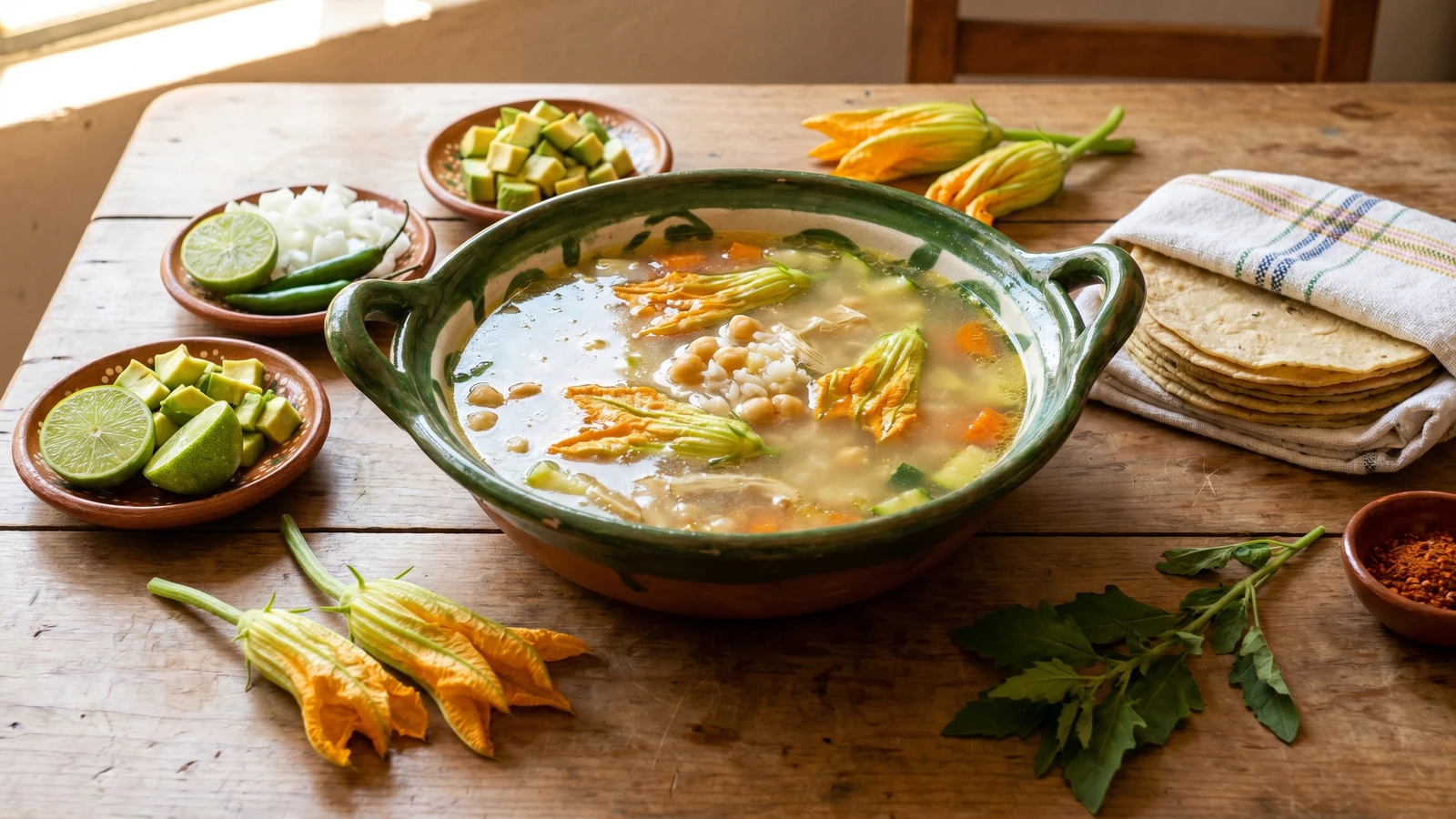
Ciudad de México's quiet wedding caldo: a clear chicken broth strewn with flor de calabaza, garbanzo, and rice, finished with aguacate and lime at the table.
Caldo Xóchitl is from Ciudad de México. Specifically from the kitchens of the central highlands, where flor de calabaza is in season from June through September and a wedding banquet is judged in part by the clarity of the first course. The name comes from the Nahuatl xóchitl, meaning flower, and the flower is the point. The squash blossoms float on a clear broth and the rest of the bowl is built around them.
This is not a showy soup. There is no chile in the broth, no fried paste, no mole. The whole composition is restraint: a clean chicken caldo, garbanzos cooked apart so they do not cloud the liquid, rice for body, calabacita and zanahoria for color, shredded chicken for substance, and the flor de calabaza added at the last moment so it wilts but does not collapse. Not all Mexican food is spicy. This dish proves it. The heat, if you want it, goes on the table in the form of sliced serrano and chile piquín.
My mother served caldo Xóchitl at her own wedding in 1979, and she made it every June after the first squash blossoms appeared in the Mercado de Medellín. Her notebook has a line underlined twice: "never boil, only simmer." She was right. You can taste a boiled caldo from across the room. The broth turns muddy and the chicken turns to fiber. Cold start, slow heat, patient skim. That is the whole technique.
The flor de calabaza dictates the calendar. If the mercado is selling them, you make this dish. If they are not in season, you wait. Mexican grandmothers cook with what the mercado is selling today. Saber cocinar es saber vivir.
Caldo Xóchitl takes its name from the Nahuatl word for flower, and the dish belongs to a family of clear ceremonial caldos that emerged in central Mexico in the colonial period, when Spanish poultry-keeping practices met the pre-Columbian tradition of cooking with squash blossoms, calabacita, and epazote. By the late 19th century it had become a fixture of capital-city wedding and baptism banquets, where the clarity of the broth was understood as a marker of the cook's skill and the host's seriousness. The Mexica had long eaten squash blossoms as a daily food, and the integration of flor de calabaza into a chicken caldo represents one of the cleanest examples of the mestizaje that defines highland Mexican cuisine: indigenous flowers and herbs floating in a broth made possible by a Spanish bird.
Quantity
1 (about 4 pounds)
cut into pieces, with the carcass and feet if you can get them
Quantity
1 medium, plus 1/2 cup
halved for the broth, finely diced for serving
Quantity
1
halved crosswise
Quantity
2 sprigs
Quantity
2
Quantity
1 tablespoon, plus more to taste
Quantity
10
Quantity
1 cup
soaked overnight in cold water (or 1 can, drained and rinsed)
Quantity
1/2 cup
Quantity
2 medium
peeled and cut into 1/2-inch rounds
Quantity
2 medium
cut into 1/2-inch half-moons
Quantity
1 large handful (about 2 cups, loosely packed)
stems trimmed
Quantity
1
sliced into thin rounds
Quantity
2
diced, for serving
Quantity
for serving
Quantity
for serving
warmed
Quantity
for the table
| Ingredient | Quantity |
|---|---|
| whole chickencut into pieces, with the carcass and feet if you can get them | 1 (about 4 pounds) |
| white onionhalved for the broth, finely diced for serving | 1 medium, plus 1/2 cup |
| head of garlichalved crosswise | 1 |
| fresh epazote | 2 sprigs |
| bay leaves | 2 |
| kosher salt | 1 tablespoon, plus more to taste |
| black peppercorns | 10 |
| dried garbanzossoaked overnight in cold water (or 1 can, drained and rinsed) | 1 cup |
| long-grain white rice | 1/2 cup |
| carrotspeeled and cut into 1/2-inch rounds | 2 medium |
| calabacitas (Mexican squash)cut into 1/2-inch half-moons | 2 medium |
| flor de calabaza (squash blossoms)stems trimmed | 1 large handful (about 2 cups, loosely packed) |
| fresh chile serrano (optional)sliced into thin rounds | 1 |
| ripe Hass avocadosdiced, for serving | 2 |
| lime wedges | for serving |
| hand-pressed corn tortillaswarmed | for serving |
| chile piquín or chile de árbol molido (optional) | for the table |
Place the chicken pieces, the carcass, and the feet if you have them in a large stockpot. Cover with cold water by three inches. Add the halved onion, the halved head of garlic, one sprig of epazote, the bay leaves, the peppercorns, and the salt. Set over medium heat and bring it up slowly. Caldo Xóchitl is a clear broth. Clarity is the whole point. You start cold so the proteins release slowly and the broth stays transparent.
As the broth approaches a simmer, a gray foam will rise to the surface. Skim it patiently with a spoon for the first fifteen minutes. Do not stir. Stirring breaks the foam and clouds the caldo. Once the foam stops rising, lower the heat until you see one lazy bubble every few seconds. Cover partially and cook for one hour and fifteen minutes. The chicken should be tender but not falling off the bone.
If you are using dried garbanzos, drain the soaking water and place them in a small saucepan with fresh cold water and a pinch of salt. Simmer for 45 minutes to an hour, until tender but still holding their shape. Drain and set aside. If you are using canned, skip this and just rinse them well. Garbanzos cooked in the chicken broth will cloud it. Cook them apart. La cocina no es decoración, es trabajo.
Lift the chicken pieces out of the pot with a slotted spoon and set them aside to cool. Strain the broth through a fine-mesh sieve lined with a damp cheesecloth or muslin cloth into a clean pot. Discard the solids. What you should see now is a pale golden liquid you can read a newspaper through. That is the Xóchitl. If it is cloudy, you stirred too much or you let it boil. Next time you will know.
Once the chicken is cool enough to handle, pull the meat off the bones in generous pieces. Discard the skin and the bones. You want shreds you can recognize, not a fine mince. Caldo Xóchitl is a soup of visible parts. Each spoonful should hold a few things at once. Set the shredded chicken aside.
Return the strained broth to a gentle simmer. Add the rice and the carrots. Cook uncovered for 12 minutes, until the rice is just tender and the carrots have a little bite left. Add the calabacitas and cook for 5 minutes more. The vegetables should be cooked through but still hold their shape. Mushy vegetables ruin the soup.
Stir in the shredded chicken and the cooked garbanzos. Tear the second sprig of epazote and drop it in. Taste for salt now. The broth will need more than you think. A bland Xóchitl is a sad Xóchitl. Pull the leaves off the squash blossoms, tear them in half if they are large, and stir them in at the very end. Turn off the heat. The blossoms wilt in thirty seconds in the hot broth. Cook them any longer and they turn to slime.
Ladle the caldo into wide bowls, making sure each one gets chicken, garbanzos, rice, calabacitas, and a generous handful of squash blossoms. Pass the diced avocado, diced raw white onion, lime wedges, sliced serrano, and warm tortillas at the table. Each diner finishes their own bowl. The avocado goes in last because it should be cool against the hot broth. Así se hace y punto.
1 serving (about 450g)
Culinary guides, cultural storytelling, and the editorial depth that makes cooking meaningful.
Discover Culinary ExplorerChef Lupita
Aguascalientes' Bajio pozole de lengua, built with cacahuazintle hominy, tender beef tongue, chile ancho and guajillo, with xoconostle brightness and table garnishes.

Chef Lupita
Veracruz's Gulf coast rice from Alvarado, built with seafood stock, tomato, chile chipotle, epazote, shrimp, fish, jaiba, and pulpo, served loose and brothy in a clay cazuela.

Chef Lupita
Costa Chica's wet salt-beef stew, built from chile costeño, guajillo, tomato, manteca, yuca, plantain, and masa dumplings, the ranching pot of Cuajinicuilapa and Pinotepa.

Chef Lupita
Michoacán's P'urhépecha atápakua is a masa-thickened sauce and stew at once, built with pork, chile guajillo, and hierbabuena added only at the end.