
Chef Lupita
Aguascalientes Beef Tongue Pozole (Pozole de Lengua)
Aguascalientes' Bajio pozole de lengua, built with cacahuazintle hominy, tender beef tongue, chile ancho and guajillo, with xoconostle brightness and table garnishes.
A cooking platform built around craft, culture, and the stories behind what we eat.
Created by
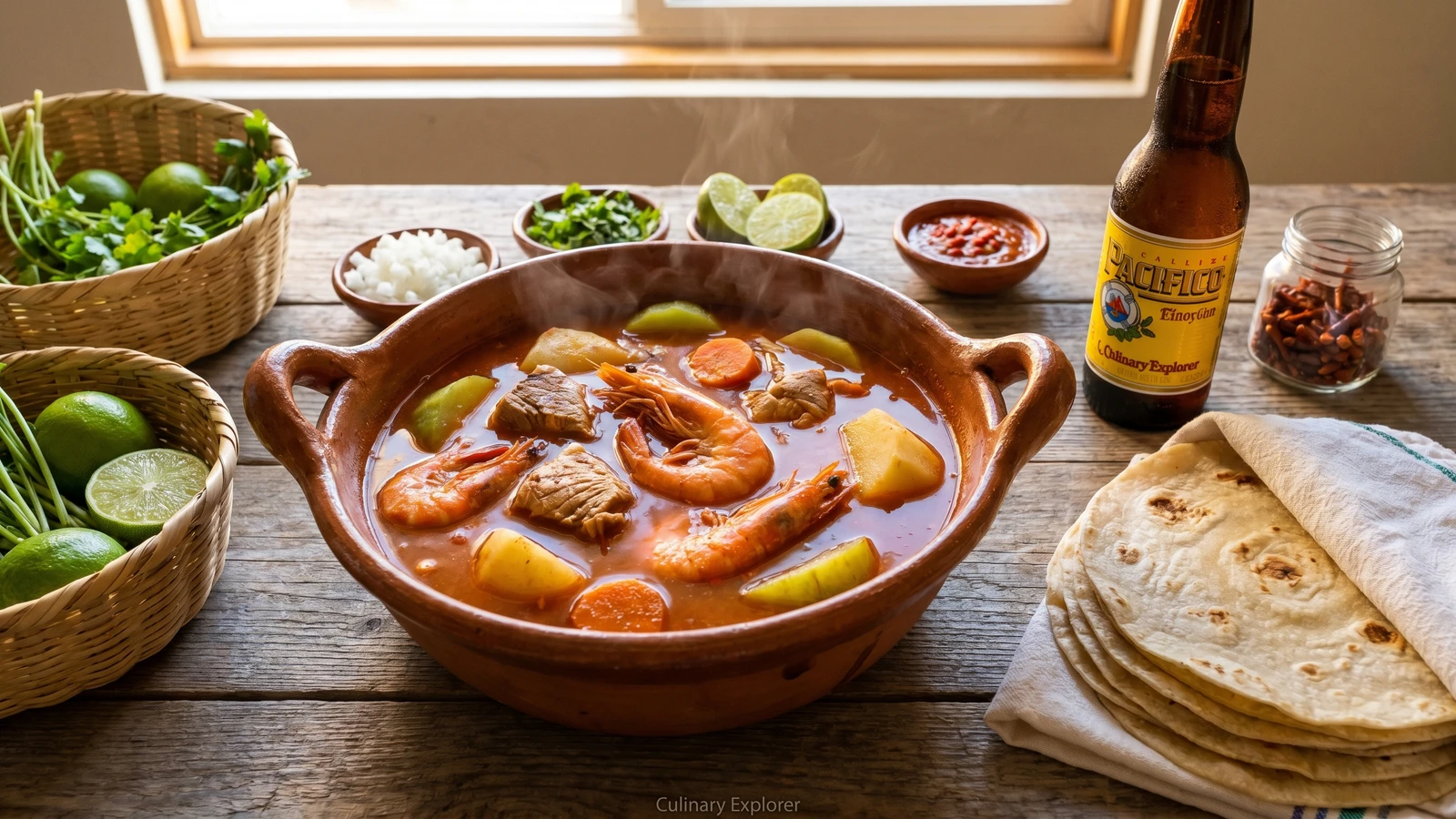
Mazatlan's dual-stock fishermen's caldo, built on shrimp shells and marlin bones, loaded with manta ray, dried pufferfish, and sea snail, finished with chiltepin and torn cilantro.
Caldo largo is from Sinaloa. Mazatlan specifically, where the Pacific meets the malecon and the fishing boats unload at dawn. This is not a generic seafood soup. This is the soup the fishermen eat when they come back to shore at noon and need something that puts them right.
The trick is in the stock, or rather the two stocks. One built from the heads and shells of Pacific shrimp, fried hard in manteca until they turn coral and the kitchen smells like the dock. Another built quietly from marlin bones, dried botete, and aromatics, simmered low so the broth stays clear and clean. You marry them at the end. One stock alone is fish soup. Two stocks together is caldo largo. Esto no es comida de un solo Mexico.
The seafood inside is what came off the boat that day. In Mazatlan that means manta ray for body, sea snail for chew, marlin chunks because there is always marlin, and dried botete because Sinaloa's fishermen learned long ago that drying the pufferfish concentrates the flavor and makes it travel. The chiltepin is the chile of the noroeste. Tiny, fierce, wild-grown across the Sierra Madre Occidental. Do not substitute it casually. If you cannot find chiltepin, dried chile de arbol will get you close, but tell yourself the truth about what you are missing.
My notebook has three versions of caldo largo collected over a week in Mazatlan, all from women whose husbands fished and whose mothers fished before them. They disagree about whether to add chayote. They agree about everything else. La cocina no es decoracion, es trabajo, and a caldo this serious is a half day of patient work for a bowl that lands like medicine.
Caldo largo, sometimes called caldo de pescado largo or caldo siete mares when more species are added, developed along Sinaloa's Pacific coast as a working-class fishermen's meal that used the parts of the catch that did not sell, including heads, bones, manta ray wings, and the dried botete that vendors prepared to extend a perishable harvest. The reputation of caldo largo as a hangover cure, locally called levantamuertos or raise-the-dead, dates to the mid-20th-century rise of Mazatlan as a Pacific port city and the bars and marisquerias that ringed the old harbor of Olas Altas. Sinaloa is Mexico's leading producer of both farmed and wild Pacific shrimp, and the state's reliance on the shellfish economy is reflected in dishes like caldo largo, aguachile, and chilorio, all of which treat the catch as the center of the table rather than a supporting player.
Quantity
2 pounds
Quantity
1 pound
ask your fishmonger
Quantity
1 pound
skinned and trimmed
Quantity
8 ounces
rinsed; substitute additional marlin steak if unavailable
Quantity
8 ounces
cleaned and tenderized; substitute octopus if needed
Quantity
8 ounces
cut into 2-inch chunks
Quantity
4
stemmed and seeded
Quantity
2
stemmed and seeded
Quantity
1
Quantity
2
charred on a comal
Quantity
1 medium
Quantity
1/2 cup
Quantity
1
halved crosswise
Quantity
4
Quantity
2
Quantity
1 tablespoon
Quantity
1 teaspoon
Quantity
3 tablespoons
Quantity
2 tablespoons
Quantity
3 quarts
Quantity
to taste
Quantity
1
sliced into thick rounds
Quantity
2
peeled and cut into 1-inch chunks
Quantity
2
peeled and cut into 1-inch chunks
Quantity
1 bunch
Quantity
for serving
Quantity
for serving
Quantity
for serving
Quantity
for serving
| Ingredient | Quantity |
|---|---|
| head-on, shell-on large shrimp from the Pacific | 2 pounds |
| marlin head and bones, or marlin collarsask your fishmonger | 1 pound |
| manta ray wingskinned and trimmed | 1 pound |
| dried botete (pufferfish)rinsed; substitute additional marlin steak if unavailable | 8 ounces |
| sea snail (caracol)cleaned and tenderized; substitute octopus if needed | 8 ounces |
| marlin steakcut into 2-inch chunks | 8 ounces |
| dried chile guajillostemmed and seeded | 4 |
| dried chile anchostemmed and seeded | 2 |
| dried chile chiltepin (or 2 dried chile de arbol) | 1 |
| medium tomatoescharred on a comal | 2 |
| white onion (halved for stock) | 1 medium |
| white onion (finely diced, for serving) | 1/2 cup |
| head of garlichalved crosswise | 1 |
| garlic cloves (for the chile base) | 4 |
| bay leaves | 2 |
| dried Mexican oregano | 1 tablespoon |
| black peppercorns | 1 teaspoon |
| manteca de cerdo (pork lard) | 3 tablespoons |
| dried-shrimp powder | 2 tablespoons |
| cold water | 3 quarts |
| kosher salt | to taste |
| large carrotsliced into thick rounds | 1 |
| medium potatoespeeled and cut into 1-inch chunks | 2 |
| chayotespeeled and cut into 1-inch chunks | 2 |
| fresh cilantro, tied with kitchen string | 1 bunch |
| chopped cilantro, for serving (optional) | for serving |
| lime halves (optional) | for serving |
| chiltepin salsa (optional) | for serving |
| flour tortillas sobaqueras, warmed (optional) | for serving |
Peel the shrimp, keeping heads and shells in one bowl and the bodies, deveined, in another. Refrigerate the bodies. The heads and shells are not garbage. They are the spine of this caldo. Without them you have fish soup, not caldo largo.
Heat 1 tablespoon of the manteca in a wide pot over medium-high. Add the shrimp heads and shells and cook, pressing and stirring, for 6 to 8 minutes until they turn deep coral and the kitchen smells like the Mazatlan dock at five in the morning. Add 6 cups of the cold water, half the halved onion, the head of garlic, the peppercorns, and 1 bay leaf. Bring to a low simmer, never a boil, and cook for 25 minutes. Strain through a fine-mesh sieve, pressing hard on the solids. Discard them. Reserve the stock.
In a separate pot, combine the marlin head and bones, the dried botete, the remaining halved onion, the second bay leaf, and the rest of the cold water. Bring to a gentle simmer. Skim the gray foam patiently for the first 10 minutes. Cook 45 minutes at the lowest possible bubble. A hard boil clouds the broth and turns the fish bitter. Strain through a fine-mesh sieve lined with cheesecloth. You should have a clear amber stock with a clean ocean smell.
Heat a dry comal over medium. Toast the guajillo, ancho, and chiltepin separately for 20 to 30 seconds per side until they puff and turn fragrant. The chiltepin is tiny and burns in a heartbeat, so watch it. Place all the toasted chiles in a heatproof bowl with the charred tomatoes and cover with hot stock from the marlin pot. Soak 15 minutes.
Transfer the soaked chiles, charred tomatoes, 4 raw garlic cloves, the dried-shrimp powder, and one cup of the soaking liquid to a blender. Blend on high until completely smooth. Strain through a fine-mesh sieve, pressing hard. Discard the skins. The puree should be deep brick red and smell like toasted chile and the sea at once.
Melt the remaining 2 tablespoons of manteca in a wide cazuela or heavy stockpot over medium heat. Add the strained chile puree. It will sputter. Cook 6 to 8 minutes, stirring constantly, until the puree darkens, the fat separates, and a slick of chile-stained oil rims the cazuela. La manteca es el sabor. Skip this step and the broth tastes raw.
Pour the shrimp stock and the marlin stock into the cazuela with the fried chile base. Add the dried oregano, crushed between your palms to release its oil. Bring to a low simmer. Taste for salt. The broth should be assertive, marine-deep, and quietly hot from the chiltepin. If it tastes shy, your salt is wrong, not your chiles. Adjust.
Add the carrot, potatoes, and chayote to the broth. Simmer 12 to 15 minutes until the potatoes are just tender at the center. The vegetables anchor the caldo. They are not garnish. The fishermen of Mazatlan eat this for dinner and walk to the boats at four in the morning, so the broth carries weight.
Lower the manta ray wing into the simmering broth and cook 6 minutes. Add the sea snail and the marlin chunks and cook 4 more minutes. Finally add the reserved shrimp bodies and the bunch of cilantro tied with string. Cook just until the shrimp curl and turn opaque, 2 to 3 minutes more. Pull the cazuela off the heat the second the shrimp are done. Overcooked shrimp in a caldo this serious is a small tragedy.
Pull out and discard the cilantro bundle. Ladle into deep bowls, making sure each one gets a piece of every kind of seafood. Set the diced raw onion, chopped cilantro, lime halves, chiltepin salsa, and warm flour tortillas sobaqueras around the table. Each person finishes their own bowl. The Pacifico goes ice-cold beside it. Asi se hace y punto.
1 serving (about 550g)
Culinary guides, cultural storytelling, and the editorial depth that makes cooking meaningful.
Discover Culinary ExplorerChef Lupita
Aguascalientes' Bajio pozole de lengua, built with cacahuazintle hominy, tender beef tongue, chile ancho and guajillo, with xoconostle brightness and table garnishes.

Chef Lupita
Veracruz's Gulf coast rice from Alvarado, built with seafood stock, tomato, chile chipotle, epazote, shrimp, fish, jaiba, and pulpo, served loose and brothy in a clay cazuela.

Chef Lupita
Costa Chica's wet salt-beef stew, built from chile costeño, guajillo, tomato, manteca, yuca, plantain, and masa dumplings, the ranching pot of Cuajinicuilapa and Pinotepa.

Chef Lupita
Michoacán's P'urhépecha atápakua is a masa-thickened sauce and stew at once, built with pork, chile guajillo, and hierbabuena added only at the end.