
Chef Lupita
Aguascalientes Beef Tongue Pozole (Pozole de Lengua)
Aguascalientes' Bajio pozole de lengua, built with cacahuazintle hominy, tender beef tongue, chile ancho and guajillo, with xoconostle brightness and table garnishes.
A cooking platform built around craft, culture, and the stories behind what we eat.
Created by
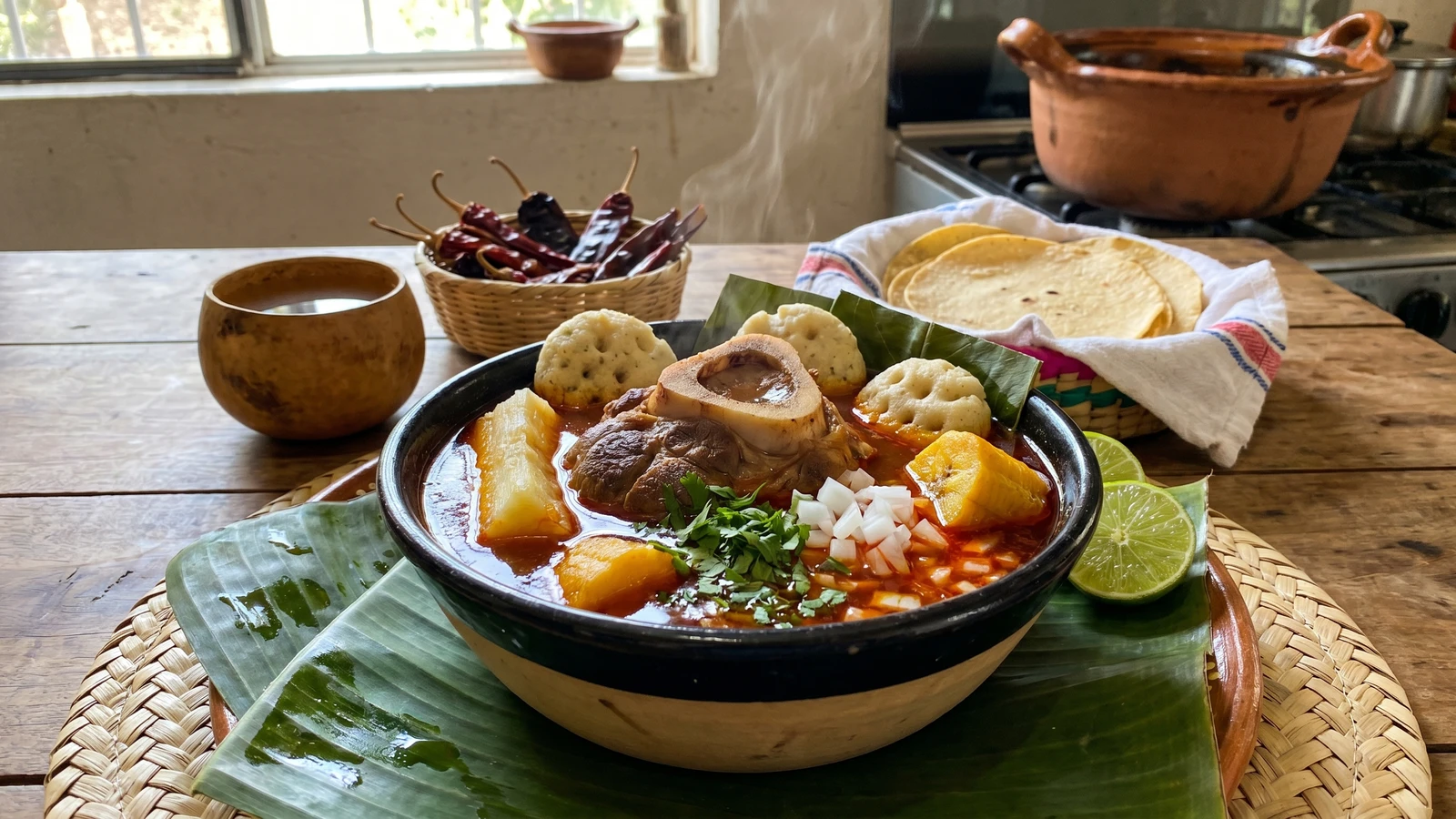
Guerrero's Costa Chica working-day caldo, beef shank simmered until tender with chile costeño, guajillo, yuca, ripe plátano macho, hoja santa, epazote, and masa chochoyotes.
Guerrero, Costa Chica, Cuajinicuilapa. Put your finger there first. This caldo belongs to the Afro-Mexican corridor that runs along the Pacific through Costa Chica Guerrero and Costa Chica Oaxaca, through towns like Cuajinicuilapa, Pinotepa, and the roads that lead toward Chacahua. Esto no es comida de un solo México. This is a 32-state cuisine, and this pot has a coast, a people, and a memory.
The beef shank gives the broth its body. The ripe plátano macho gives sweetness without turning the pot soft. The yuca comes from the humid coastal pantry, the hoja santa perfumes the caldo like anise and wet earth, and the chile rojo must taste like Guerrero: chile costeño for regional bite, guajillo for color and roundness. You toast the chiles, soak them, blend them, then fry the paste in manteca de cerdo before it enters the broth. No me vengas con atajos. Raw chile puree thrown into water tastes like laziness.
I learned versions of this kind of coastal caldo from women who cooked at noon because the day had already been working since sunrise. They did not call it fancy. They called it food. A bowl on the table, black-and-tan pottery from Cuajinicuilapa or Pinotepa if the house had it, warm tortillas in a cloth, lime at the side, and the chochoyotes half-swollen with broth. The technique is practical: build the broth from bones, wake the chiles on the comal, let the plantain sweeten the pot only at the end so it holds its shape. Así se hace y punto.
The Costa Chica of Guerrero and Oaxaca is one of Mexico's central Afro-Mexican regions, yet the Afro-Mexican third root was not constitutionally recognized until 2020, after generations of cooks had already preserved dishes built from plantain, yuca, coastal herbs, chiles, and long-simmered broths. This caldo sits beside other Afro-Mexican and coastal dishes that are often misnamed or flattened: Guerrero's chilate can mean a chicken stew, distinct from the cacao-rice-cinnamon beverage also called chilate, and Costa Chica wet barbacoa is a plated, sauced preparation, not taquería barbacoa. In the wider Afro-Mexican map, Veracruz Sotavento carries dishes like mondongo jarocho with Atlantic slave-trade lineage, while Chacahua and Corralero are known for tichindas, black-shell mangrove mussels, and chilpachole is thickened with masa, not flour.
Quantity
3 pounds
bone-in, cut into thick rounds
Quantity
1 pound
Quantity
12 cups, plus more as needed
Quantity
1 medium
halved
Quantity
1
halved crosswise
Quantity
2
Quantity
1 tablespoon, plus more to taste
Quantity
6
stemmed and seeded
Quantity
4
stemmed and seeded
Quantity
2
halved
Quantity
1/2 small
Quantity
3
unpeeled
Quantity
2 tablespoons
Quantity
1 pound
peeled, fibrous core removed, cut into 2-inch chunks
Quantity
2
peeled and cut into thick diagonal pieces
Quantity
2 large
Quantity
2 sprigs
Quantity
1 cup
Quantity
1 tablespoon
Quantity
1/2 teaspoon
Quantity
for serving
Quantity
for serving
Quantity
for serving
Quantity
for serving
| Ingredient | Quantity |
|---|---|
| beef shankbone-in, cut into thick rounds | 3 pounds |
| beef short ribs or beef neck bones | 1 pound |
| cold water | 12 cups, plus more as needed |
| white onionhalved | 1 medium |
| head of garlichalved crosswise | 1 |
| bay leaves | 2 |
| kosher salt | 1 tablespoon, plus more to taste |
| dried chile guajillostemmed and seeded | 6 |
| dried chile costeñostemmed and seeded | 4 |
| Roma tomatoeshalved | 2 |
| white onion for chile paste | 1/2 small |
| garlic cloves for chile pasteunpeeled | 3 |
| manteca de cerdo | 2 tablespoons |
| yucapeeled, fibrous core removed, cut into 2-inch chunks | 1 pound |
| ripe plátanos machospeeled and cut into thick diagonal pieces | 2 |
| hoja santa leaves | 2 large |
| fresh epazote | 2 sprigs |
| fresh masa or prepared masa harina dough | 1 cup |
| manteca de cerdo for chochoyotes | 1 tablespoon |
| kosher salt for chochoyotes | 1/2 teaspoon |
| warm corn tortillas (optional) | for serving |
| lime wedges (optional) | for serving |
| chopped cilantro (optional) | for serving |
| diced white onion (optional) | for serving |
Put the beef shank and short ribs or neck bones in a heavy pot. Cover with the cold water by about two inches. Add the halved onion, halved garlic, bay leaves, and salt. Bring slowly to a simmer over medium heat and skim the gray foam for the first 15 minutes. Do not boil hard. You want a clear, strong broth, not angry water.
Lower the heat until the broth gives small, steady bubbles. Cover partially and cook for about 2 hours, until the shank meat is tender but still holding to the bone. Add hot water if the liquid drops below the meat. The marrow and collagen are doing the work here. Let them.
Heat a dry comal over medium. Toast the guajillo and chile costeño separately, about 20 to 30 seconds per side, just until fragrant and flexible. Toast the tomatoes, onion half, and unpeeled garlic on the same comal until spotted and softened. The chile costeño burns fast, so watch it. Burned chile turns the whole pot bitter.
Put the toasted chiles in a bowl and cover with hot water, not boiling water. Let them soften for 15 minutes. Drain, then blend with the toasted tomatoes, onion, peeled garlic cloves, and 1 cup of beef broth from the pot. Blend until very smooth. Strain through a fine-mesh sieve. The skins stay behind. The flavor goes into the caldo.
Melt 2 tablespoons manteca de cerdo in a small cazuela or skillet over medium heat. Add the strained chile paste carefully because it will sputter. Cook 6 to 8 minutes, stirring, until it darkens to a deep brick red and the fat begins to shine at the edges. La manteca es el sabor. Frying the paste removes the raw edge and makes the chile taste like itself.
Remove the spent onion, garlic, and bay leaves from the beef broth. Stir in the fried chile paste. Add the yuca chunks and simmer 20 to 25 minutes, until the yuca is tender at the edges but not falling apart. If you left the fibrous core in the yuca, you will feel it now. Take the time to remove it before cooking.
Mix the masa with 1 tablespoon manteca de cerdo and 1/2 teaspoon salt until soft and smooth. Pinch off small balls, about the size of large marbles. Press your thumb into the center of each one to make a little dimple. That dimple catches broth and helps the chochoyote cook through. This is masa doing its job, not decoration.
Add the chochoyotes to the simmering pot one by one. Cook 8 minutes, then add the plátano macho, hoja santa, and epazote. Simmer 10 to 12 minutes more, until the plantain is tender but still intact and the chochoyotes float with swollen edges. Taste for salt. The broth should be red, beefy, lightly sweet from the plantain, and fragrant from the hoja santa.
Ladle beef, yuca, plantain, chochoyotes, and plenty of broth into deep bowls. Serve with warm corn tortillas, lime wedges, chopped cilantro, and diced white onion. Put it on the table in a clay bowl or cazuela if you have one. This is working-day Costa Chica food, generous and direct. Saber cocinar es saber vivir.
1 serving (about 570g)
Culinary guides, cultural storytelling, and the editorial depth that makes cooking meaningful.
Discover Culinary ExplorerChef Lupita
Aguascalientes' Bajio pozole de lengua, built with cacahuazintle hominy, tender beef tongue, chile ancho and guajillo, with xoconostle brightness and table garnishes.

Chef Lupita
Veracruz's Gulf coast rice from Alvarado, built with seafood stock, tomato, chile chipotle, epazote, shrimp, fish, jaiba, and pulpo, served loose and brothy in a clay cazuela.

Chef Lupita
Costa Chica's wet salt-beef stew, built from chile costeño, guajillo, tomato, manteca, yuca, plantain, and masa dumplings, the ranching pot of Cuajinicuilapa and Pinotepa.

Chef Lupita
Michoacán's P'urhépecha atápakua is a masa-thickened sauce and stew at once, built with pork, chile guajillo, and hierbabuena added only at the end.