
Chef Lupita
Agua de Alfalfa
Ciudad de México's highland market agua fresca, fresh alfalfa blended with pineapple and lime until bright green, strained clean, and poured cold from the vitrolero.
A cooking platform built around craft, culture, and the stories behind what we eat.
Created by
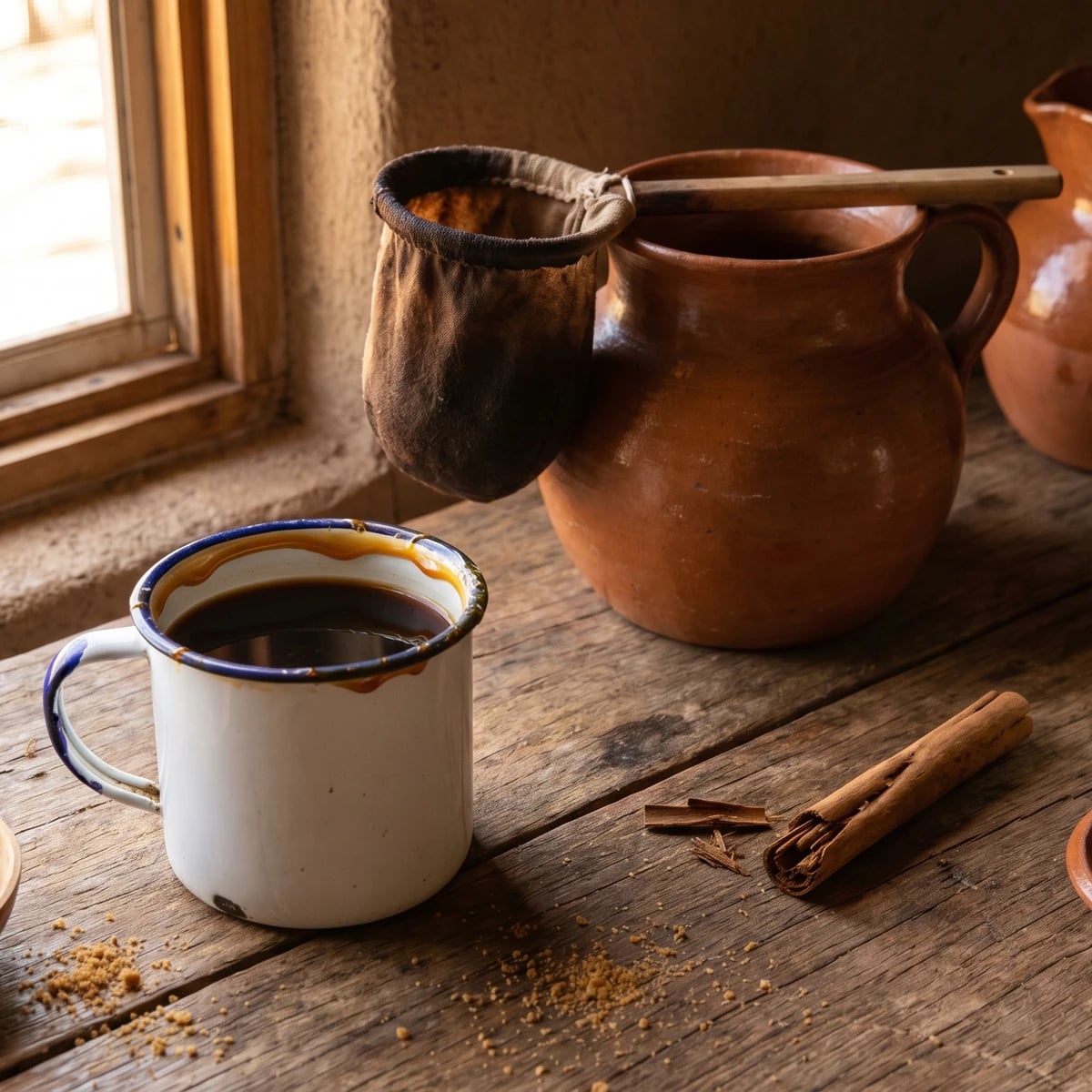
Sonora's ranchero coffee, toasted on the comal with piloncillo that caramelizes onto the bean, brewed in a clay olla with canela, and filtered through a cloth talega the way they have done it on the ranches for generations.
This is Sonora's coffee. Not Mexico City's, not Veracruz's, not Chiapas's. Sonora does not grow coffee, the climate is wrong for it, the beans come up from the south, but the way Sonora prepares it belongs to the desert and to the ranches that built the state.
Café talega is built on three things and you cannot skip any of them. The beans are toasted on a comal with piloncillo until the sugar caramelizes directly onto the bean. The water is boiled in a clay olla with a stick of canela de Ceylan, real Mexican cinnamon, not the cassia bark sold as cinnamon in supermarkets. The brewed coffee is filtered through a cotton talega, a drawstring cloth bag that holds the grounds back and lets the dark, clean liquid through. No paper. No metal mesh. Cloth. The talega is what gives the coffee its name and its texture, a body that paper filter cannot produce.
This is ranchero coffee. It is poured at four in the morning when the men are heading out to the cattle, and it is poured again at six in the evening when they come back. It takes evaporated milk and another grating of piloncillo at the cup if you want it that way, the norteño way, the way they drink it on the ranches of the sierra outside Cananea and Bavispe. No me vengas con atajos. Skip the comal toasting and you have brewed coffee with sugar in it. That is not café talega. That is a different drink with the wrong name.
Café talega traces to the ranch and mining settlements of northern Sonora in the 19th century, where coffee shipped up from the southern Mexican states arrived green and was toasted at home over mesquite fires, a practice shared across the norteño states from Chihuahua through Coahuila and into Nuevo Leon. The toasting of beans with piloncillo, rather than separately sweetening the cup, was a frugal innovation that preserved both ingredients during long storage and stretched a small amount of sugar across many pots. The cloth talega filter predates the introduction of paper coffee filters by the German Melitta Bentz in 1908 by at least a century in Latin America, where versions of the cloth sock filter appear in Costa Rica, Colombia, and across Mexico's coffee-drinking north under different regional names.
Quantity
1 cup
preferably from Chiapas or Veracruz
Quantity
1/3 cup
grated if using piloncillo
Quantity
6 cups
Quantity
1 stick, about 3 inches
Quantity
to serve
Quantity
to taste
| Ingredient | Quantity |
|---|---|
| green or lightly roasted coffee beanspreferably from Chiapas or Veracruz | 1 cup |
| piloncillo or raw cane sugar (azucar mascabado)grated if using piloncillo | 1/3 cup |
| cold water | 6 cups |
| true Mexican cinnamon (canela de Ceylan) | 1 stick, about 3 inches |
| evaporated milk (optional) | to serve |
| piloncillo to sweeten at the cup (optional) | to taste |
Set a heavy cast iron comal or a thick-bottomed skillet over medium-low heat. Let it come up slowly. A comal that is too hot will scorch the beans before the sugar has a chance to work. In a Sonoran ranch kitchen this happens over a low fire of mesquite. You do not need mesquite. You need patience.
Pour the coffee beans onto the warm comal in a single layer. Stir them with a wooden spoon for about three minutes, until they smell nutty and the color deepens a shade. Now scatter the grated piloncillo directly over the beans. Keep stirring. The sugar will melt, foam, and crystallize onto the beans within a minute or two. The beans will go dark mahogany with a glassy coating. That coating is the whole point. This is not flavored coffee. This is coffee toasted in caramel.
Slide the beans onto a metal sheet pan in a single layer and let them cool to room temperature, about 10 minutes. The sugar crust will harden. Grind them coarse, the texture of raw sugar, not espresso fine. Coarse grind is what the cloth talega is built for. Fine grind clogs the cloth and the coffee runs slow and muddy.
Pour the cold water into a clay olla or a heavy saucepan. Drop in the cinnamon stick. Bring it to a rolling boil over high heat, then cut the heat down to a low simmer for about two minutes so the canela releases. The water should smell like the inside of a Sonoran pantry.
Pull the olla off the heat. Stir in the ground coffee all at once. Cover and let it steep for four minutes. Not eight. Not three. Four. The piloncillo on the beans dissolves into the water and the coffee opens. Longer and the cup turns bitter. Shorter and the body is thin.
Set a clean cotton talega, a small drawstring cloth bag, over a heatproof pitcher or a second clean olla. If you do not have a talega, use a square of clean unbleached muslin tied over the mouth of the pitcher with kitchen string. Slowly pour the brewed coffee through the cloth. The grounds stay behind. The coffee that comes through is dark, glossy, and clean. Do not press the cloth or squeeze the grounds. That is how you get sediment in the cup. Asi se hace y punto.
Pour into the white-and-blue enamel cups or thick ceramic mugs. Set the can of evaporated milk and a small dish of piloncillo on the table. Each person doctors their own. On a Sonoran ranch this coffee is poured at four in the morning before the men go out and again at six in the evening when they come back. Saber cocinar es saber vivir.
1 serving (about 245g)
Culinary guides, cultural storytelling, and the editorial depth that makes cooking meaningful.
Discover Culinary Explorer
Chef Lupita
Ciudad de México's highland market agua fresca, fresh alfalfa blended with pineapple and lime until bright green, strained clean, and poured cold from the vitrolero.

Chef Lupita
Aguascalientes' Lenten agua fresca, jewel-red from cooked beet and full of apple, banana, orange, lettuce, and ground peanuts, served cold when Holy Week meets the Feria de San Marcos.

Chef Lupita
Sonora and Sinaloa's creamy malted barley water, built on toasted cebada perla, Mexican canela, vanilla from Papantla, and evaporated milk. Pink-beige, rich, and served cold over heavy ice in a heavy glass tumbler. Liquid cookie comfort the northwest way.

Chef Lupita
Yucatán's everyday tonic of boiled chaya leaves blended with lima agria, sugar, and ice. The bright green jarra that sits on every Peninsula table from Mérida to Valladolid.