
Chef Lupita
Almendrados Conventuales Poblanos
Puebla's convent almond cookies, made from blanched almonds, sugar syrup, egg yolks, canela, and patient hands, the kind of sweet that belongs beside coffee in talavera, not in a plastic bakery box.
A cooking platform built around craft, culture, and the stories behind what we eat.
Created by
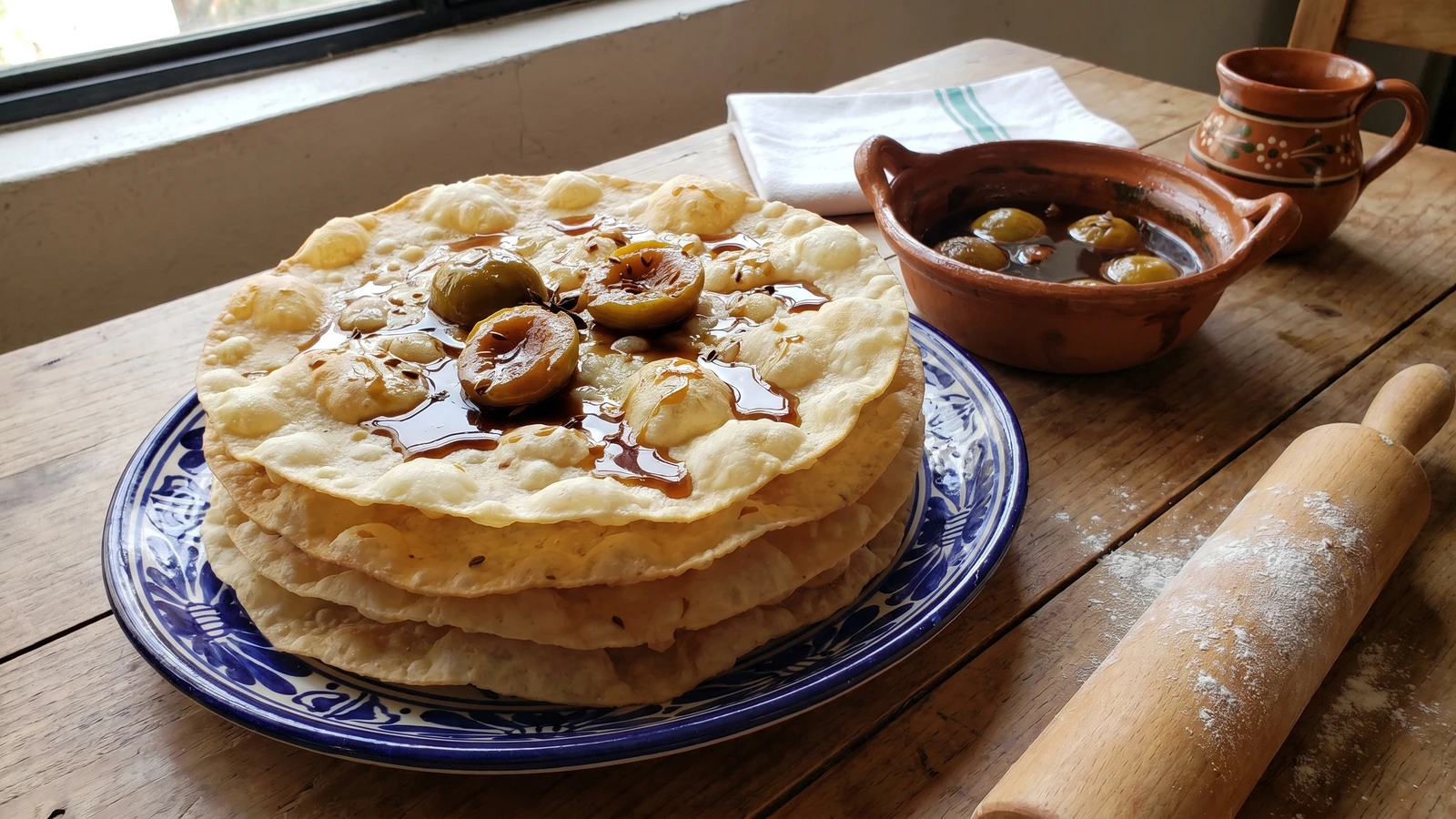
Puebla's Christmas buñuelo is a paper-thin wheat dough stretched over the knee, fried until crisp, then bathed with piloncillo syrup scented with anise, canela, and fresh guava.
Puebla owns this Christmas buñuelo, especially in the city of Puebla and the towns around the central valley where posadas fill the streets in December. This is not a doughnut. It is a thin, crisp sheet of wheat dough, stretched by hand over a cloth-covered knee, fried until it blisters, then drowned in piloncillo syrup with anise, canela, and fresh guava.
The knee matters. A rolling pin can start the circle, but it cannot finish it the same way. The rounded shape of the knee lets the dough stretch paper-thin without tearing, and that technique came from women making dozens at a time for Christmas tables, not from a bakery display case. I learned it from a señora near the Mercado de Sabores in Puebla who corrected my hands twice before she let me touch the next ball of dough.
The flavor is not chile. Not every Mexican dish needs chile to prove where it comes from. Here the geography is wheat from the colonial highlands, piloncillo from cane country, guava from the season, anise from the old sweet kitchen of central Mexico, and talavera on the table. Cada estado, su propia cocina.
My mother wrote only one line about buñuelos in her notebook: "la masa debe descansar." The dough must rest. She was right. A rushed dough tears, a rested dough obeys. Saber cocinar es saber vivir.
Buñuelos arrived in Mexico through Spanish and Moorish frying traditions during the colonial period, then changed in convent kitchens and home kitchens that used local piloncillo, guava, canela, and anise. Puebla, founded in 1531 as a Spanish colonial city between Veracruz and Ciudad de México, became one of the centers where wheat-based sweets, convent pastry, and indigenous sweeteners met. The knee-stretched buñuelo is now closely tied to Christmas posadas and Nochebuena in central Mexico, with Puebla keeping one of the most recognizable versions because of its thin size and piloncillo-guava syrup.
Quantity
4 cups, plus more for dusting
Quantity
2 tablespoons
Quantity
1 teaspoon
Quantity
1/2 teaspoon
Quantity
2
at room temperature
Quantity
3 tablespoons
melted and cooled slightly
Quantity
3/4 cup, plus more as needed
Quantity
1 teaspoon
lightly crushed
Quantity
1 teaspoon
Quantity
for frying
Quantity
2 cups
chopped or grated
Quantity
2 cups
Quantity
1
Quantity
1
Quantity
1 teaspoon
Quantity
4
halved
Quantity
1 strip
Quantity
1 pinch
| Ingredient | Quantity |
|---|---|
| all-purpose flour | 4 cups, plus more for dusting |
| granulated sugar | 2 tablespoons |
| fine sea salt | 1 teaspoon |
| baking powder | 1/2 teaspoon |
| large eggsat room temperature | 2 |
| manteca de cerdomelted and cooled slightly | 3 tablespoons |
| warm water | 3/4 cup, plus more as needed |
| anise seedlightly crushed | 1 teaspoon |
| vanilla extract | 1 teaspoon |
| neutral oil or fresh manteca de cerdo | for frying |
| piloncillochopped or grated | 2 cups |
| water | 2 cups |
| Mexican cinnamon stick (canela) | 1 |
| star anise | 1 |
| anise seed | 1 teaspoon |
| fresh guavashalved | 4 |
| orange peel | 1 strip |
| fine sea salt | 1 pinch |
Put the piloncillo, water, canela, star anise, anise seed, guavas, orange peel, and salt in a small saucepan. Bring to a steady simmer and cook 20 to 25 minutes, until the piloncillo dissolves and the syrup coats a spoon lightly. The guava should soften and perfume the syrup, not fall apart into jam. Keep it warm. In Puebla, the syrup goes on generously.
In a wide bowl, whisk the flour, sugar, salt, and baking powder. Make a well in the center and add the eggs, melted manteca, warm water, crushed anise seed, and vanilla. Mix with your hand until a rough dough forms. It should feel firm but not dry. If flour remains at the bottom, add warm water one tablespoon at a time.
Turn the dough onto a clean table and knead 10 to 12 minutes, until it becomes smooth, elastic, and slightly glossy. This dough must stretch thin later, so do the work now. La cocina no es decoración, es trabajo. If it tears immediately when pulled, knead two minutes more.
Divide the dough into 18 small balls, each about the size of a lime. Rub each one with a thin film of oil or melted manteca and set them on a tray. Cover with a clean kitchen towel and rest 45 minutes. Resting relaxes the dough so it stretches instead of fighting you. No me vengas con atajos.
Cover one knee with a clean cotton servilleta or thin kitchen towel. Roll one dough ball into a small circle, then lay it over the cloth-covered knee and stretch gently from the center outward with the backs of your fingers. Rotate as you work. The buñuelo should become almost translucent, with uneven edges. That unevenness is correct. The knee gives the dough a rounded support so it thins without tearing. This is why they are called buñuelos de rodilla.
Lay each stretched round on a clean tablecloth or floured tray while you stretch the rest. Let them air-dry 10 to 15 minutes, turning once. They should feel slightly leathery at the edges but still flexible. This short drying makes them blister and crisp in the fat.
Heat 2 inches of neutral oil or fresh manteca de cerdo in a wide heavy pot to 350F. Slide in one buñuelo at a time. Press it gently under the surface with tongs for the first few seconds so it fries evenly, then turn once or twice until pale gold with darker freckles, about 45 to 60 seconds total. It should be crisp enough to rustle when lifted.
Drain the buñuelos upright in a colander or on a rack set over a tray. Do not stack them while they are hot or they will soften. Serve whole, cracked into pieces, or briefly dipped in the warm piloncillo syrup. In many Puebla homes, the syrup sits in a clay jarro and each person bathes their own. Así se hace y punto.
1 serving (about 85g)
Culinary guides, cultural storytelling, and the editorial depth that makes cooking meaningful.
Discover Culinary ExplorerChef Lupita
Puebla's convent almond cookies, made from blanched almonds, sugar syrup, egg yolks, canela, and patient hands, the kind of sweet that belongs beside coffee in talavera, not in a plastic bakery box.

Chef Lupita
Ciudad de Mexico's panaderia banderillas are long sticks of hojaldre pressed with sugar, baked until amber, and finished with a hard glaze for coffee at the kitchen table.

Chef Lupita
Mérida's pale egg-yolk-and-vanilla kisses, tiny cookies built on eight yolks and a perfume of orange blossom, sandwiched with guava paste and dusted heavy with powdered sugar.

Chef Lupita
Hidalgo's bisquet de nata carries Pachuca's mining history into the breakfast table: a Cornish-style bread softened by Mexican nata, split warm and eaten with café de olla.