
Chef Lupita
Almendrados Conventuales Poblanos
Puebla's convent almond cookies, made from blanched almonds, sugar syrup, egg yolks, canela, and patient hands, the kind of sweet that belongs beside coffee in talavera, not in a plastic bakery box.
A cooking platform built around craft, culture, and the stories behind what we eat.
Created by
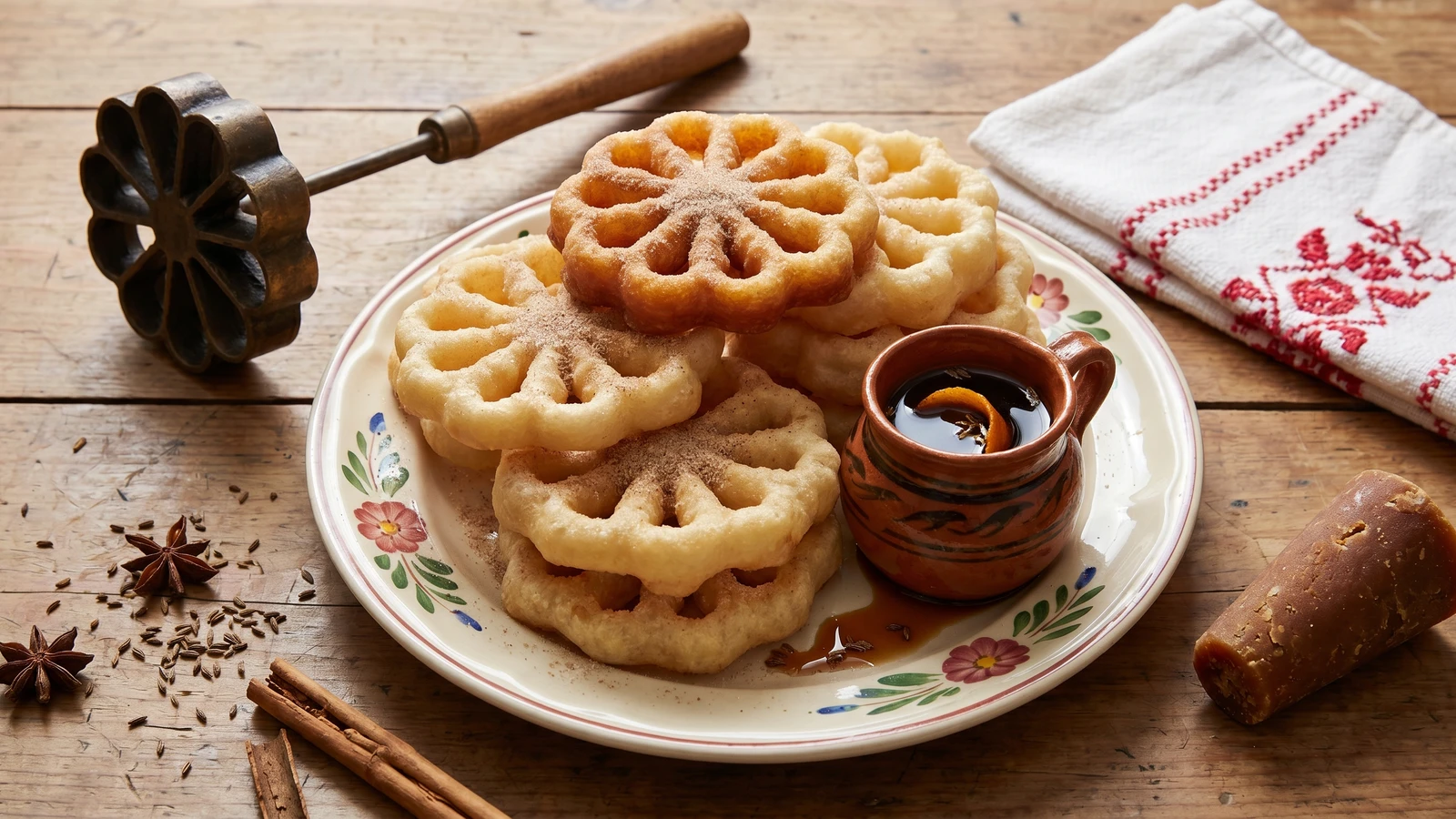
Yucatán's rosette-iron buñuelos, thin floral disks fried crisp on a hot bronze mold, dusted in cinnamon sugar, and drizzled at the table with a dark miel of piloncillo, canela, and anís.
This is a Yucatán buñuelo. Not the puffed disk of dough you stretch by hand and fry flat, that one belongs to the center and the north of the country. This is the buñuelo de molde: thin, floral, crisp, made by dipping a hot bronze iron in batter and lowering it back into the lard until the lace of dough releases on its own. Two different dishes, same name, and Mexico is full of those arguments.
The mold matters. In Mérida and in the small towns of the peninsula, the molde de bronce is passed from mother to daughter. The good ones are heavy, hand-cast, with floral or star-shaped patterns that hold the batter just right. A flimsy aluminum mold will not work. The iron has to be hot enough to grab the batter and seasoned enough to let it go. Saber cocinar es saber vivir, and saber cocinar buñuelos yucatecos means understanding the iron before you understand the batter.
The miel is the other half of the dish. Piloncillo, canela, anís, a piece of orange peel. That anise is the yucateco signature. Other states drown their buñuelos in a thinner syrup of brown sugar and water. The peninsula reaches for anise the way it reaches for achiote: as a regional fingerprint. My mother never made these. Jalisco is buñuelo country in a different language. But I learned this version from a señora named Doña Lucila in Valladolid who has been frying buñuelos every December since 1962, and she watched me until I got it right. Cada estado, su propia cocina.
The buñuelo arrived in the Americas with Spanish and Sephardic culinary tradition in the 16th century, where fried sweet doughs already marked Christmas, Hanukkah, and Carnival celebrations across the Mediterranean. In Yucatán, the rosette-iron version, known throughout the Hispanic world as buñuelos de viento or buñuelos de molde, took hold particularly strongly because the peninsula's strong Spanish-colonial Catholic calendar made Christmas and Nochebuena central food occasions, and the molde itself became a household heirloom. The use of anise in the syrup is a distinctly southeastern Mexican adaptation; central Mexican buñuelo syrups typically rely on canela and guava, while the peninsula's preference for anise reflects both Andalusian and Lebanese-Maya influences accumulated over four centuries of cooking on the same land.
Quantity
2
at room temperature
Quantity
1 cup
at room temperature
Quantity
1/2 cup
Quantity
1 tablespoon
Quantity
1/2 teaspoon
Quantity
1 teaspoon extract or seeds of 1/2 bean
Quantity
1 1/2 cups
Quantity
2 tablespoons
Quantity
4 cups
for frying
Quantity
1 cone (8 ounces)
chopped
Quantity
2 cups
Quantity
1
broken in two
Quantity
1 tablespoon
Quantity
1 strip
no white pith
Quantity
1/2 cup
Quantity
1 tablespoon
| Ingredient | Quantity |
|---|---|
| large eggsat room temperature | 2 |
| whole milkat room temperature | 1 cup |
| water | 1/2 cup |
| granulated sugar | 1 tablespoon |
| fine sea salt | 1/2 teaspoon |
| pure vanilla extract or vanilla bean from Papantla | 1 teaspoon extract or seeds of 1/2 bean |
| all-purpose flour | 1 1/2 cups |
| cornstarch | 2 tablespoons |
| manteca de cerdo (pork lard)for frying | 4 cups |
| piloncillochopped | 1 cone (8 ounces) |
| water for the miel | 2 cups |
| true Mexican canela (Ceylon cinnamon) stickbroken in two | 1 |
| anise seed | 1 tablespoon |
| orange peelno white pith | 1 strip |
| granulated sugar for dusting | 1/2 cup |
| ground Mexican canela for dusting | 1 tablespoon |
In a medium bowl, whisk the eggs until pale. Add the milk, water, sugar, salt, and vanilla. Sift the flour and cornstarch over the top and whisk until completely smooth. The batter should coat the back of a spoon like heavy cream and run off in a steady ribbon. Lumps will keep the iron from releasing the buñuelo clean. Strain through a fine-mesh sieve if you doubt it.
While the batter rests, combine the chopped piloncillo, 2 cups water, the canela stick, anise seed, and orange peel in a small saucepan. Bring to a gentle simmer over medium heat and cook for 20 to 25 minutes, stirring now and then, until the syrup coats the back of a spoon and a drop pulled between your fingers stretches into a short thread. It will thicken more as it cools. Strain into a jug and keep warm. This miel is what makes a yucateco buñuelo yucateco. No me vengas con atajos: do not use corn syrup, do not skip the anise.
Pour the lard into a deep heavy pot, at least three inches deep, and clip a thermometer to the side. Submerge the rosette mold in the cold lard and bring everything to 365°F over medium heat. The mold has to be in the fat from the start. A cold iron sheds the batter. A properly heated iron grabs the batter, holds it for the dunk, and lets it go when the buñuelo is crisp. This is the secret of every yucateca who owns a molde de bronce inherited from her mother.
Lift the hot mold out of the lard, tap off the excess on the rim of the pot, and dip it into the batter. The batter must come up the sides of the mold but not over the top. If it goes over the top, the buñuelo will not release. Hold it in the batter for one second, lift, and lower the dressed mold back into the hot lard. Count to three. The buñuelo should slide off the iron on its own as it cooks. If it sticks, give it a gentle shake.
Once the buñuelo releases, fry for 45 to 60 seconds, flipping once with a slotted spoon, until the disk is pale gold with darker tips at the petals. Do not let it darken to caramel. The buñuelo yucateco is delicate, almost ivory, with the floral pattern crisp and intact. Drain on paper or on a wire rack set over a sheet pan. Return the mold to the lard between buñuelos to keep it hot.
Combine the 1/2 cup of granulated sugar and the tablespoon of ground canela on a wide plate. While each buñuelo is still warm, lay it in the cinnamon sugar and tap it gently so the sugar catches on the ridges. The warmth makes the sugar cling. A cold buñuelo refuses it.
Stack the buñuelos on a wide clay plate, the kind they sell in the Mercado Lucas de Gálvez in Mérida, and pour the warm miel de piloncillo into a small jarrito on the side. Each person drizzles their own. A buñuelo soaked from the kitchen turns soggy by the time it reaches the table. Así se hace y punto.
1 serving (about 40g)
Culinary guides, cultural storytelling, and the editorial depth that makes cooking meaningful.
Discover Culinary ExplorerChef Lupita
Puebla's convent almond cookies, made from blanched almonds, sugar syrup, egg yolks, canela, and patient hands, the kind of sweet that belongs beside coffee in talavera, not in a plastic bakery box.

Chef Lupita
Ciudad de Mexico's panaderia banderillas are long sticks of hojaldre pressed with sugar, baked until amber, and finished with a hard glaze for coffee at the kitchen table.

Chef Lupita
Mérida's pale egg-yolk-and-vanilla kisses, tiny cookies built on eight yolks and a perfume of orange blossom, sandwiched with guava paste and dusted heavy with powdered sugar.

Chef Lupita
Hidalgo's bisquet de nata carries Pachuca's mining history into the breakfast table: a Cornish-style bread softened by Mexican nata, split warm and eaten with café de olla.