
Chef Lupita
Aporreadillo Michoacano con Huevo
Michoacán's Tierra Caliente almuerzo, where salted beef is softened, pounded, fried in lard, folded with egg and chile perón salsa, then served beside morisqueta like a proper working table.
A cooking platform built around craft, culture, and the stories behind what we eat.
Created by
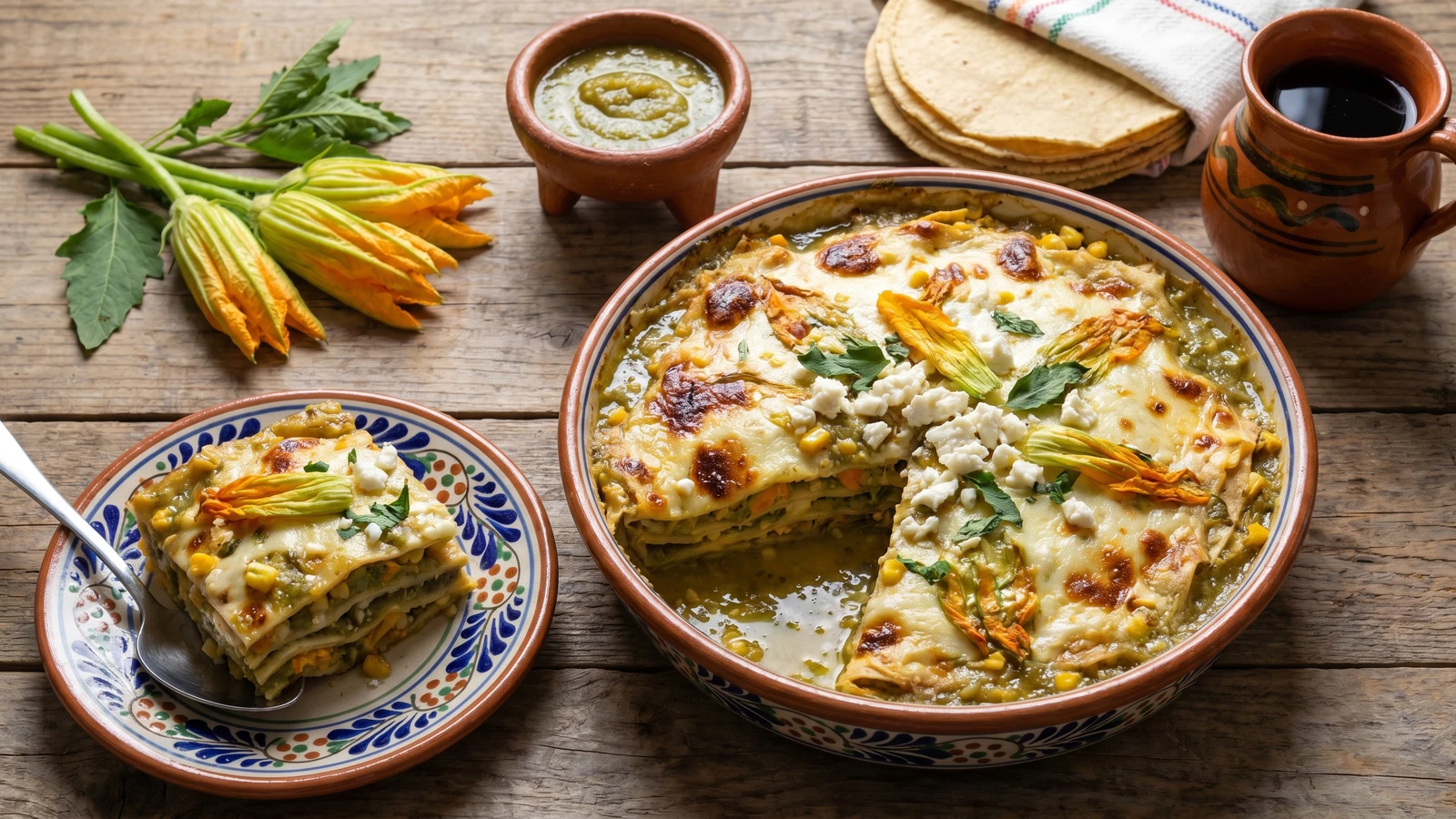
A layered vegetarian budín from Puebla and Ciudad de México built on the milpa trinity, calabacita, flor de calabaza, and elote, bound with salsa verde, crema, and melting queso Oaxaca.
This is a central highlands dish. Puebla claims it. So does Ciudad de México. The truth is that the budín lives wherever the milpa lives, and the milpa, corn, squash, beans, planted together as the Mesoamericans have done for thousands of years, is the agricultural foundation of central Mexico. When the calabacitas and the flor de calabaza and the elotes are all in the mercado at the same time, late summer through early fall, this is the dish you make.
The flor de calabaza is not a garnish. It is the headliner. Squash blossoms have been eaten in Mexico since long before the Spanish arrived, and they show up in every kitchen from Xochimilco to Cholula during their short season. If you cannot find them, do not make a substitute. Make something else, then make this dish when the flowers come back. Mexican grandmothers cook with what the mercado is selling today.
The epazote is the other non-negotiable. It is the herb that makes central Mexican food taste like central Mexican food, slightly medicinal, slightly minty, with no real translation into any other cuisine. Skip it and you have a vegetable lasagna. Use it and you have a budín. My mother used to say more epazote than you think. She was right.
The queso Oaxaca melts into ribbons under the salsa verde and the crema, and the whole thing comes out of the oven the color of an autumn afternoon in the Valle de Puebla. Cada estado, su propia cocina, and the milpa belongs to all of them.
The milpa system, a polyculture of corn, squash, and beans known as the Three Sisters in English, is one of the oldest documented agricultural practices in the Americas, dating back at least 6,000 years in the Tehuacán Valley of Puebla. Flor de calabaza appears in Aztec tribute records from the Codex Mendoza and was sold in the great market of Tlatelolco described by Bernal Díaz del Castillo in 1519, evidence that squash blossoms have been a commercial crop in central Mexico for at least five centuries. The budín itself, as a layered tortilla casserole, is a 19th-century innovation that emerged from convent and hacienda kitchens in Puebla, where the technique of layering and baking, borrowed from European casserole traditions, was applied to native ingredients to produce a dish that is now considered a defining example of mestizo cuisine.
Quantity
18
day-old preferred
Quantity
1/4 cup
for frying the tortillas
Quantity
2 pounds
husked and rinsed
Quantity
4
stemmed (use 3 for less heat)
Quantity
1
stemmed and seeded
Quantity
1/2 medium, plus 1 cup finely diced for the filling
Quantity
3, plus 2 minced for the filling
Quantity
1 cup, packed
Quantity
2 tablespoons, divided
Quantity
1 large bunch (about 4 cups loosely packed)
stems and pistils removed
Quantity
3 medium
diced small
Quantity
3 ears (about 2 1/2 cups kernels)
kernels cut off
Quantity
1 large sprig
leaves stripped and chopped
Quantity
1 teaspoon, plus more to taste
Quantity
1 1/2 cups
Quantity
1 pound
shredded
Quantity
1/2 cup
crumbled, for finishing
| Ingredient | Quantity |
|---|---|
| corn tortillasday-old preferred | 18 |
| vegetable oil or melted lardfor frying the tortillas | 1/4 cup |
| tomatilloshusked and rinsed | 2 pounds |
| fresh chile serranostemmed (use 3 for less heat) | 4 |
| fresh chile poblanostemmed and seeded | 1 |
| white onion | 1/2 medium, plus 1 cup finely diced for the filling |
| garlic cloves | 3, plus 2 minced for the filling |
| fresh cilantro leaves and tender stems | 1 cup, packed |
| lard (manteca de cerdo) | 2 tablespoons, divided |
| flor de calabaza (squash blossoms)stems and pistils removed | 1 large bunch (about 4 cups loosely packed) |
| calabacitas (Mexican grey squash or zucchini)diced small | 3 medium |
| fresh elote (white or yellow corn)kernels cut off | 3 ears (about 2 1/2 cups kernels) |
| fresh epazoteleaves stripped and chopped | 1 large sprig |
| kosher salt | 1 teaspoon, plus more to taste |
| Mexican crema | 1 1/2 cups |
| queso Oaxacashredded | 1 pound |
| queso frescocrumbled, for finishing | 1/2 cup |
Heat a comal or heavy skillet over medium-high. Place the tomatillos, serranos, poblano, the half white onion, and the three whole garlic cloves directly on the dry surface. Turn them with tongs as they blacken. The tomatillos should collapse and weep their juices. The chiles should blister in dark patches. The garlic stays in its skin until it softens. This takes about ten to twelve minutes. Charring on the comal is what gives a salsa verde its smoke and depth. Boiled tomatillos make a flat salsa. Así se hace y punto.
Transfer the charred vegetables to a blender, peeling the garlic first. Add the cup of cilantro and a teaspoon of salt. Blend until smooth but not aerated. The salsa should be the color of a chile poblano leaf, deep green with darker flecks from the char. Taste it. It should be sharp and a little smoky. Adjust salt now.
The milpa is the pre-Columbian planting system: corn, squash, beans, growing together. The filling honors that. In a wide skillet, melt one tablespoon of lard over medium heat. Add the diced white onion and the minced garlic. Cook for three minutes until soft and translucent. Add the diced calabacita and the corn kernels. Season with half a teaspoon of salt. Cook for five to seven minutes, stirring occasionally. The calabacita should be tender but still hold its shape. Watery calabacita means the budín will be soupy. Cook until the moisture has cooked off.
Add the squash blossoms and the chopped epazote to the skillet. Stir gently. The blossoms collapse in less than a minute and turn from bright orange to a softer ochre. Pull the pan off the heat the moment they wilt. Overcooked flor de calabaza turns to mush. The epazote should be unmistakable. If you cannot smell it, add more. Epazote is not optional in this dish. It is what makes it taste like central Mexico and not like a generic vegetable gratin.
Heat the remaining tablespoon of lard with the quarter cup of oil in a small skillet over medium heat. Pass each tortilla through the hot fat for three to five seconds per side, just to soften and waterproof it. Do not fry them crisp. A crisp tortilla cracks in the budín and pulls apart when you serve it. Stack the softened tortillas on paper towels as you work. This is the same technique used for enchiladas and the budín fails without it.
Heat the oven to 375F. Lightly grease a 9x13 baking dish or a 12-inch clay cazuela. Spread half a cup of salsa verde across the bottom. Arrange six softened tortillas to cover the surface, overlapping them where needed. Spoon a third of the milpa filling over the tortillas. Drizzle a third of a cup of crema across, then scatter a third of the queso Oaxaca. Ladle a generous cup of salsa verde over everything.
Repeat the layering: six more tortillas, another third of the filling, a third of the crema, a third of the cheese, another cup of salsa verde. Then the final layer: six tortillas, the last of the filling, the rest of the crema, and the remaining queso Oaxaca on top. Pour any remaining salsa verde around the edges so the tortillas at the rim do not dry out. This is a three-layer budín. It should stand tall and confident when you pull it out of the oven.
Bake uncovered for 35 to 45 minutes. The top should be golden in patches where the queso Oaxaca has melted and browned, and the salsa around the edges should bubble. If the cheese is melting but not coloring, run the budín under the broiler for two or three minutes. Watch it. The line between golden and burned is short. Pull it out and let it rest for ten minutes before cutting. A budín that goes straight from oven to plate falls apart on the spoon.
Scatter the crumbled queso fresco across the top. Bring the whole baking dish to the table and serve generous spoonfuls onto plates. The layers should hold together but yield easily to a spoon, with the salsa verde and crema running between them. This is dinner-party food in Puebla and CDMX. La cocina no es decoración, es trabajo.
1 serving (about 425g)
Culinary guides, cultural storytelling, and the editorial depth that makes cooking meaningful.
Discover Culinary ExplorerChef Lupita
Michoacán's Tierra Caliente almuerzo, where salted beef is softened, pounded, fried in lard, folded with egg and chile perón salsa, then served beside morisqueta like a proper working table.

Chef Lupita
Guerrero's Costa Grande aporreado is salted cecina pounded soft, scrambled with egg, and finished in a red guajillo and chile de árbol salsa loud with garlic and cilantro.

Chef Lupita
Los Altos de Chiapas turns two-night fermented white corn into a tart-sweet atole, cooked with canela and piloncillo, then poured hot into jícaras for desayuno.

Chef Lupita
Oaxaca's Mixteca region ferments nixtamalized masa for days until it turns tart and alive, then simmers it with piloncillo and canela into a thick, warm atole served at first light in clay.