
Chef Freja
Aebleflaesk
The Fyn autumn supper where thick pork belly renders slowly into its own fat, then meets apples and onions that cook down into a deep amber tangle. Sweet, salt, and the oldest pairing in the Danish larder.
A cooking platform built around craft, culture, and the stories behind what we eat.
Created by Chef Freja
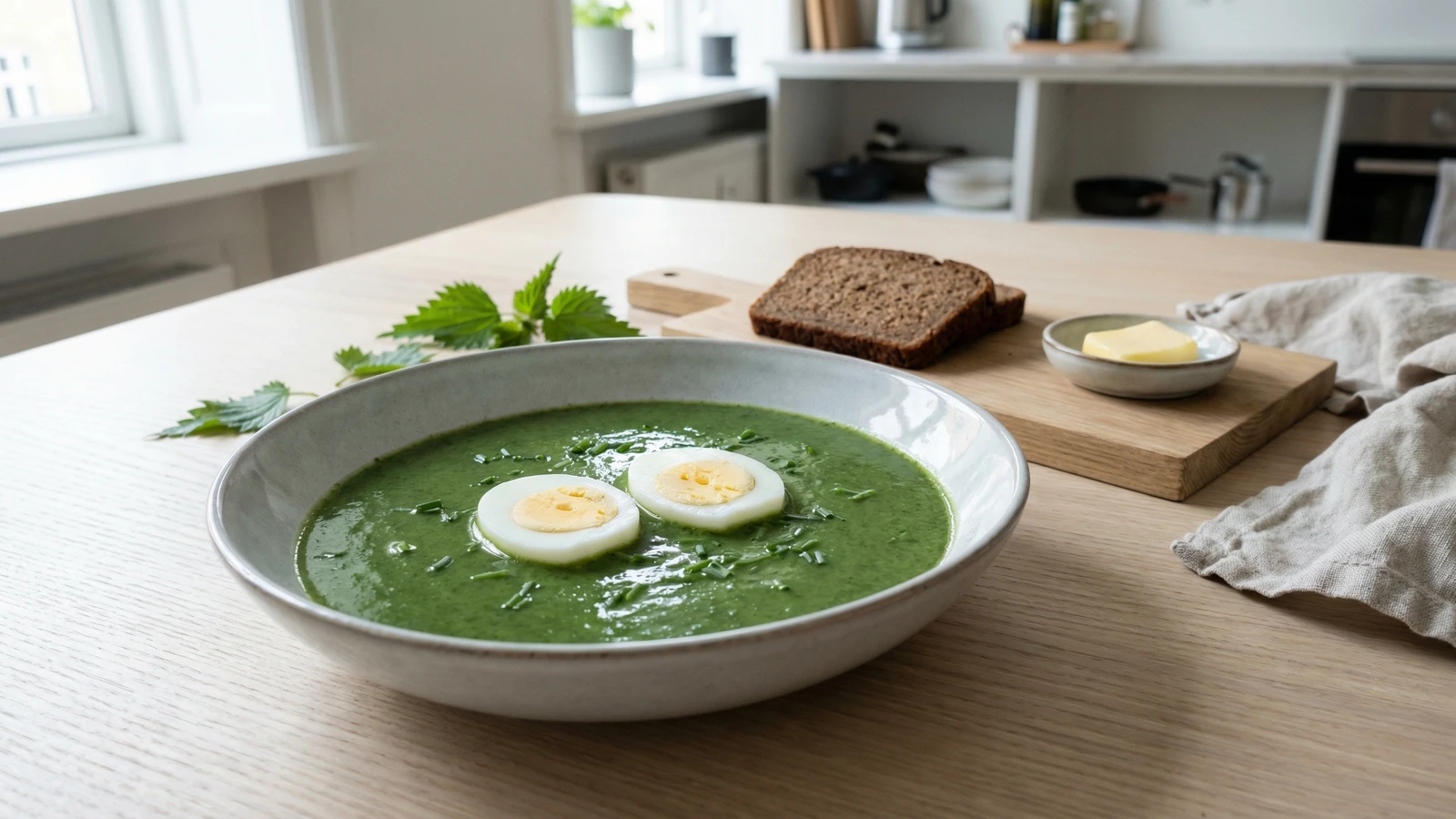
The Danish spring soup made from the first green thing to push through the cold ground. Young nettle tops, potato, cream, and halved hard-boiled eggs floating on top. The taste of late March in a bowl.
There's a week in late March when the verges around Copenhagen turn. You walk past a hedge you've seen grey and empty all winter and suddenly there are nettles pushing up, bright and urgent, the first green thing to announce that the cold has let go. This is the week braendenaeldesuppe comes back to the kitchen.
Nettle soup is spring tonic food, the kind Danes have been making for as long as anyone can remember. When the cellar was empty of root vegetables and the garden hadn't started, nettles were already there: wild, free, and full of everything a body needed after a long winter of salted pork and preserved cabbage. We still make the soup, not because we need the vitamins the way our grandparents did, but because the body remembers. The first spoonful of nettle soup tastes like the year turning.
What you want are the top four or five leaves of young plants, no more. Older leaves go stringy and bitter. Wear gloves when you gather them and a long sleeve, and trust the sting: it disappears the moment the leaves hit hot water. I'll walk you through the blanch that saves your mouth, the off-the-heat blend that saves the color, and the eggs that turn the whole thing from a puree into a proper bowl. The season decides when you make this one. Late March, into April, while the leaves are still small and the light is still new. You'll know when it's right.
Nettle soup belongs to the oldest layer of Scandinavian cooking, older than potatoes, older than written recipes. For centuries it was spring tonic food across the Nordic countries, eaten in the lean weeks between the emptying of the winter larder and the arrival of the first garden greens. Danish farm cookbooks of the 1800s recommended a weekly bowl throughout April as a blood cleanser after winter, and the pairing with halved hard-boiled eggs, a Copenhagen refinement that turned peasant soup into a proper course, dates from the same era. The habit of foraging nettles in Denmark nearly disappeared in the twentieth century and has come back slowly in recent decades, carried home by cooks who rediscovered what a spring kitchen can still find at the edge of a field.
Quantity
200g
the top four or five leaves only, gloves on
Quantity
4 large
Quantity
50g
Quantity
2 small
finely sliced
Quantity
1
white and pale green parts only, sliced
Quantity
300g
peeled and roughly chopped
Quantity
1 litre
Quantity
150ml
Quantity
to taste
Quantity
freshly ground, to taste
Quantity
a small grating
Quantity
small bunch
snipped, to finish
Quantity
thick slices, to serve
| Ingredient | Quantity |
|---|---|
| young nettle topsthe top four or five leaves only, gloves on | 200g |
| eggs | 4 large |
| unsalted butter | 50g |
| shallotsfinely sliced | 2 small |
| leekwhite and pale green parts only, sliced | 1 |
| floury potatoespeeled and roughly chopped | 300g |
| chicken or vegetable stock | 1 litre |
| double cream | 150ml |
| fine sea salt | to taste |
| white pepper | freshly ground, to taste |
| fresh nutmeg | a small grating |
| chivessnipped, to finish | small bunch |
| dark rugbrod and butter (optional) | thick slices, to serve |
Put the eggs into a small pan, cover with cold water, and bring to the boil. The moment the water reaches a rolling boil, set a timer for eight minutes. Eight minutes gives you a fully set white and a yolk that is cooked through but still bright yellow and soft at the center, not the chalky grey of an overcooked egg. Drain and plunge straight into cold water. The cold stops the cooking and loosens the shell from the white, which matters because the eggs are the thing you see first in the bowl.
Wearing kitchen gloves, pick the top four or five leaves from each nettle stem and discard the thicker stems below. You want young growth only. Older leaves go stringy and bitter and carry a harsher taste. Two hundred grams of leaves looks like a surprising amount when you carry it home, and cooks down to almost nothing. Wash the leaves in a large bowl of cold water, lifting them out rather than pouring through a colander so any grit stays behind.
Bring a large pan of salted water to a rolling boil and have a bowl of ice water ready next to the stove. Drop the nettles in and push them under with a slotted spoon. Thirty seconds is all they need. The sting comes from formic acid in the tiny hairs on the leaf, and the heat destroys it instantly. The moment the leaves go dark and limp, lift them straight into the ice water. This sets the bright green color and stops the cooking. Drain well and squeeze out as much water as you can between your hands. You can take your gloves off now. The nettles are harmless.
Melt the butter in a heavy pot over a gentle heat. Add the sliced shallots and leek and a good pinch of salt. Stir them through the butter, put the lid on, and let them sweat for about eight minutes until completely soft and translucent. You don't want any color. Browning pulls the whole soup toward caramel and away from green, and green is the entire point of this bowl.
Add the chopped potatoes and the stock to the pot. Bring to a gentle simmer and cook uncovered for about fifteen minutes, until the potatoes collapse when you press them against the side of the pot with the back of a spoon. Floury potatoes give the soup its body without any flour or thickener. If there is any resistance left in the potato, wait another few minutes. Undercooked potato makes a grainy soup.
Take the pot off the heat. This matters. Add the squeezed blanched nettles and blend the soup until completely smooth. The color should be deep, almost startling green. If you blend while the soup is still over direct heat, the nettles turn khaki within a minute and you lose that first-day-of-spring color that makes this soup what it is. Off the heat, they stay vivid.
Stir in the cream and return the pot to a low heat. Warm it through until just below a simmer, never boiling. Boiling cream breaks and the soup goes grainy. Season generously with salt, white pepper, and the smallest grating of nutmeg. Taste, and taste again. The soup should be rounded and green, with the cream softening the wild edge of the nettles without covering it. Only by tasting do you really understand it.
Peel the eggs and halve them lengthwise with a sharp knife wiped between cuts so the yolks stay clean. Ladle the soup into warm shallow bowls. Lay two egg halves, yolk side up, on the surface of each bowl so they float in the green. Scatter with snipped chives. Serve at once, with rugbrod and good butter on the side. The eggs are not decoration. They are the cold against the hot, the pale yolk against the green, the piece that makes this a proper bowl and not just a puree. Tak for mad.
1 serving (about 500g)
Culinary guides, cultural storytelling, and the editorial depth that makes cooking meaningful.
Discover Culinary ExplorerChef Freja
The Fyn autumn supper where thick pork belly renders slowly into its own fat, then meets apples and onions that cook down into a deep amber tangle. Sweet, salt, and the oldest pairing in the Danish larder.

Chef Freja
Warm Danish apple soup for the first cool evenings of autumn. Tart apples simmered with cinnamon and lemon peel, thickened to a soft gloss, and served with cold cream and buttery toasted oats.

Chef Freja
Danish white asparagus velouté with tiny veal meatballs, flour dumplings, and bright green tips scattered on the surface. The Easter soup of Copenhagen, built from five small pans of spring.

Chef Freja
Thin beef slices rolled around bacon and onion, tied with string, and braised slowly in a dark glossy gravy finished with cream and redcurrant jelly. Danish Sunday dinner at its most comforting.