
Chef Klaus
Apfelschorle
Cloudy apple juice, sharp mineral water, and no sugar bowl: the German Schorle that belongs in school bags, beer gardens, picnic baskets, and the table when supper is quick.
A cooking platform built around craft, culture, and the stories behind what we eat.
Created by
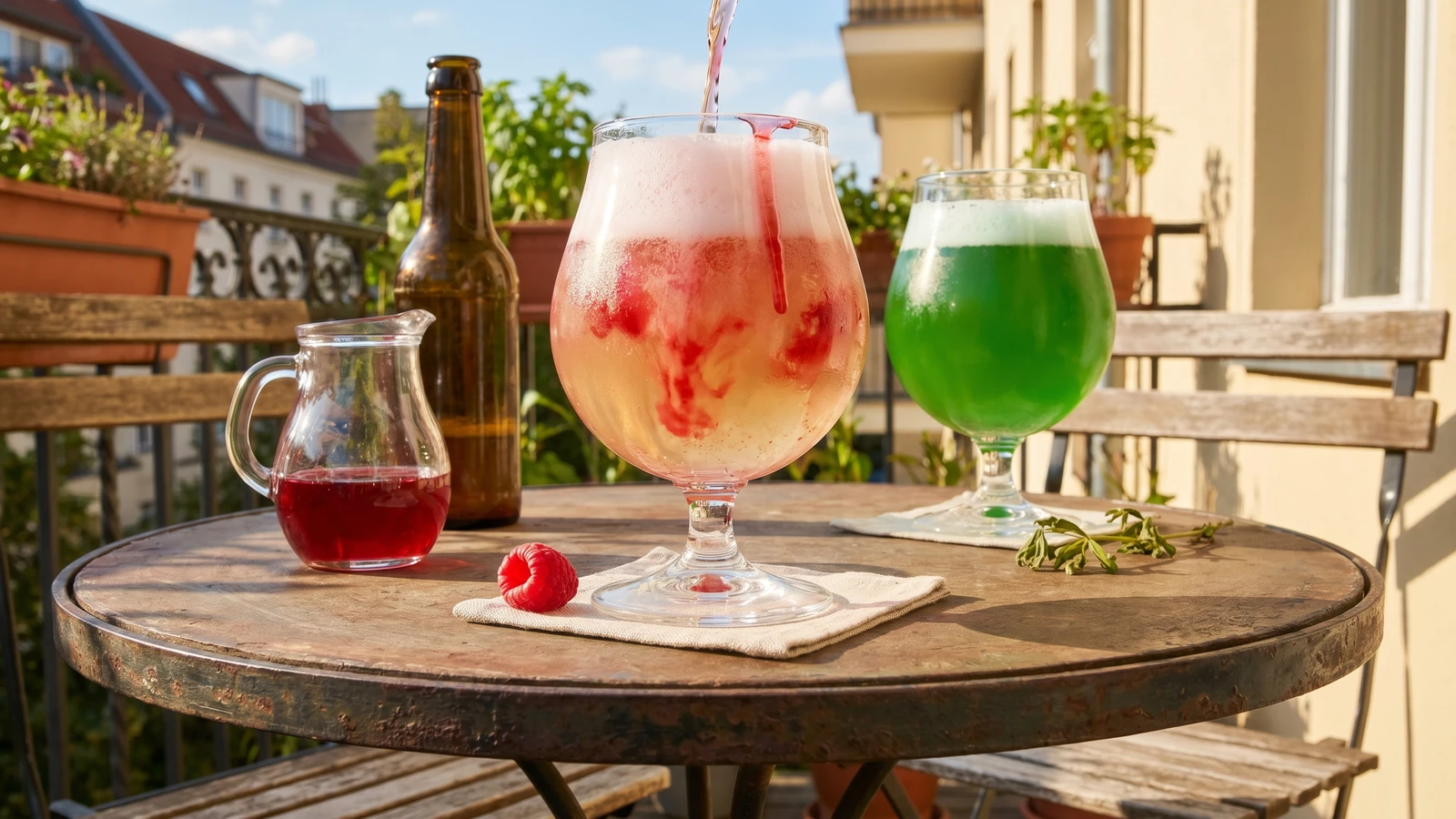
Berlin's summer glass: sharp, pale Berliner Weisse softened with a red raspberry or green woodruff Schuss, cold enough to bead the glass and never from bottled syrup.
Berliner Weisse mit Schuss belongs to Berlin in summer, to beer gardens, outdoor tables, and afternoons when a sour wheat beer alone would make some drinkers blink. The beer is pale, spritzy, and tart from lactic fermentation; the Schuss, the shot of syrup, rounds the edge without burying it. Red is raspberry. Green is Waldmeister, woodruff, the herb that smells of hay, vanilla, and forest floor once it has wilted.
Germany doesn't agree on beer mixed with sweetness. Berlin has this sour wheat beer in a wide goblet, the north drinks Alsterwasser, beer cut with clear lemonade, and the south says Radler. Im Norden anders, im Süden anders. This is Berlin's answer, and it is not a beer-tent stein with something green tipped into it. Das ist kein Bierzelt.
The technique is simple and strict: syrup cold, beer colder, and pour the beer gently down the inside of the glass. Warm syrup kills the chill, warm beer foams wild and tastes flat, and a hard pour knocks out the lively edge that makes Berliner Weisse worth drinking. Make the syrup yourself. Nicht aus dem Glas. A bought green bottle tastes mostly of colour.
For woodruff, wilt the sprigs first and keep the steep short. Fresh Waldmeister gives very little scent until it droops, then the coumarin perfume wakes up; oversteep it and the syrup turns bitter. Raspberry is easier: heat just until the fruit gives up its juice, strain without squeezing hard, and keep the colour clean. Schön ist, was schmeckt.
Berliner Weisse was already closely tied to Berlin by the late 18th century, and Napoleon's troops are often credited with calling it the Champagne of the North during their occupation of the city in 1806, a nickname that points to its pale colour, acidity, and lively carbonation. The sweet Schuss became strongly associated with Berlin serving culture in the 19th and 20th centuries, most commonly raspberry red or woodruff green, poured into the wide bowl-shaped Berliner Weisse glass. Traditional Berliner Weisse is a low-alcohol, top-fermented wheat beer soured by lactic bacteria, closer to a regional sour beer than to the stronger Bavarian wheat beers that carry the word Weisse further south.
Quantity
4 x 330ml bottles
well chilled
Quantity
120ml
chilled
Quantity
250g
fresh or frozen
Quantity
150g
for raspberry syrup
Quantity
120ml
for raspberry syrup
Quantity
1 teaspoon
Quantity
12g
wilted 8 to 12 hours
Quantity
250g
for woodruff syrup
Quantity
250ml
for woodruff syrup
Quantity
1 strip
for woodruff syrup
| Ingredient | Quantity |
|---|---|
| Berliner Weissewell chilled | 4 x 330ml bottles |
| homemade raspberry syrup or homemade woodruff syrupchilled | 120ml |
| raspberriesfresh or frozen | 250g |
| sugarfor raspberry syrup | 150g |
| waterfor raspberry syrup | 120ml |
| lemon juice | 1 teaspoon |
| fresh food-grade woodruff sprigswilted 8 to 12 hours | 12g |
| sugarfor woodruff syrup | 250g |
| waterfor woodruff syrup | 250ml |
| lemon peelfor woodruff syrup | 1 strip |
Put the Berliner Weisse and the glasses in the refrigerator until properly cold. This drink lives from cold acidity and fine foam; if the beer is warm, it throws coarse bubbles and tastes dull before the syrup even arrives.
For the red Schuss, bring the raspberries, sugar, and water just to a low bubble, then cook 5 minutes until the berries collapse and the liquid turns deep red. Keep the heat gentle because hard boiling muddies the fruit and cooks away the clean tartness. Strain through a fine sieve without pressing hard, stir in the lemon juice, and chill the syrup.
For the green Schuss, wilt the woodruff sprigs in a cool place for 8 to 12 hours until the scent comes up. Bring the sugar and water to a boil, take it off the heat, let it cool 10 minutes, then add the wilted woodruff and lemon peel for 20 minutes only. The wilt wakes the aroma; the short steep keeps bitterness and too much coumarin out of the glass. Strain and chill.
Pour 30ml chilled syrup into each chilled Berliner Weisse goblet. Syrup first gives you the red or green base and lets the beer lift it slowly through the glass; syrup dumped on top sinks in streaks and leaves the first mouthful wrong.
Tilt the glass and pour 330ml cold Berliner Weisse gently down the inside, then let the foam settle into a pale cap. Do not stir hard. The carbonation does the mixing, and if you beat it with a spoon you've spent the beer before you drink it.
Serve immediately, red or green, with a straw if you want the old Berlin habit. The drink waits for nobody; once the foam falls and the chill goes, it's just sweet sour beer in a pretty glass.
1 serving (about 365g)
Culinary guides, cultural storytelling, and the editorial depth that makes cooking meaningful.
Discover Culinary ExplorerChef Klaus
Cloudy apple juice, sharp mineral water, and no sugar bowl: the German Schorle that belongs in school bags, beer gardens, picnic baskets, and the table when supper is quick.

Chef Klaus
Frankfurt's long drink for a warm table: dry Apfelwein, cold mineral water, and the ribbed Geripptes glass that tells you where you are.
Chef Klaus
The Easter bottle from yolks, sugar, cream, and good spirit, beaten warm just enough to thicken, then cooled into a yellow liqueur for cake, coffee, and small glasses.

Chef Klaus
The Advent mug that works only if you keep the heat gentle: egg yolks, sugar, and white wine whisked thick before the pot ever thinks about boiling.