
Chef Makoa
Butter Mochi (Hawaiʻi Local Mochiko Coconut Cake)
A chewy, golden Hawaiʻi Local square from mochiko, butter, and coconut milk, baked in one pan until the edges pull crisp and the middle stays tender.
A cooking platform built around craft, culture, and the stories behind what we eat.
Created by
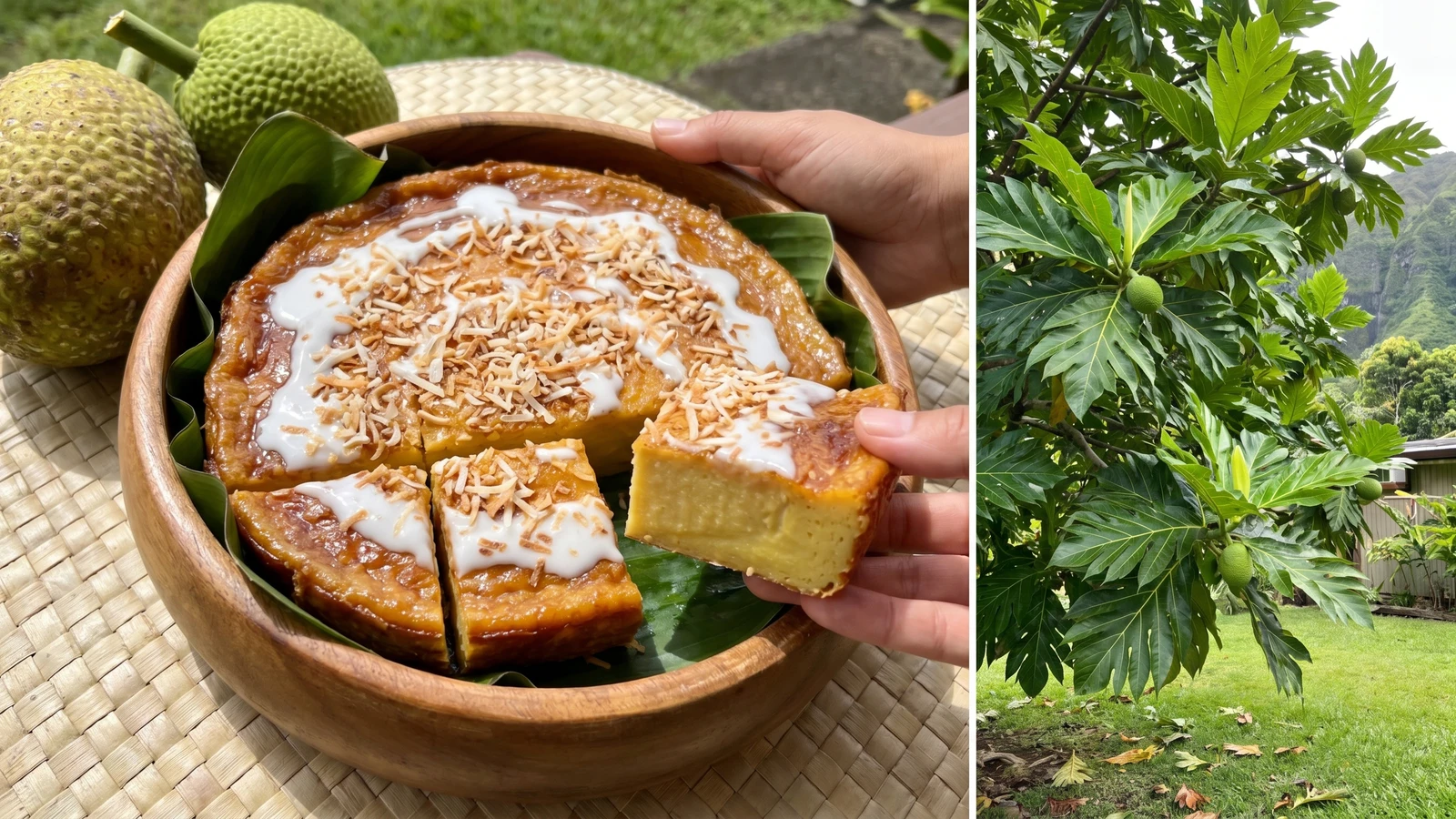
Very ripe Hawaiian ʻulu, the canoe-crop breadfruit, mashed soft with coconut milk and sugar, then baked until the middle sets like a quiet custard.
The canoe carried ʻulu before any of us knew these islands by name. Back home in Hawaiʻi, when the breadfruit tree gives heavy and the fruit turns soft, sweet, and yellow inside, the old people don't look at it like it's past its time. They see dessert. Eat what you have. The tree is telling you what it wants to become.
This is Hawaiian food from the fresh-and-cooked table: ripe ʻulu mashed with coconut milk, a little sugar, eggs for the modern custard set, and a pinch of salt so the sweetness stands up. It isn't the fermented breadfruit keeping traditions of the Marquesas, Tahiti, or the atolls, the popoi and masi that carried families through lean seasons. This one is the soft, baked, home-kitchen way, the ʻulu going golden and fragrant, the coconut making it rich without making it fussy.
Across the Triangle the cousins know this same breadfruit under their own tongues: ʻuru in Tahiti, mei in the Marquesas, kuru in parts of the Cook Islands, and ʻulu here in Hawaiʻi. One ocean, one canoe, one root. When it ripens until your thumb leaves a dent in the skin, don't throw it away. No blame the ʻulu for getting sweet. Sit down with it and let it feed the table one more way.
Breadfruit is one of the great canoe crops, carried by Polynesian voyagers and planted from island to island as a staple tree that could feed whole communities for generations. In Hawaiʻi, ʻulu held an important place beside kalo, ʻuala, niu, and other canoe plants, while elsewhere in the Triangle ripe, cooked, pounded, and fermented breadfruit became long-keeping food for chiefs, families, and atoll communities. This baked coconut pudding is a contemporary Hawaiian home form of an older rule: when the starch crop ripens sweet, it moves from staple to dessert without losing its kuleana.
Quantity
2 cups
mashed smooth
Quantity
1 cup
Quantity
1/2 cup plus 2 tablespoons
divided
Quantity
1/2 cup
packed, or less if the ʻulu is very sweet
Quantity
3
Quantity
3 tablespoons
plus more for the baking dish
Quantity
1 teaspoon
Quantity
1/2 teaspoon
Quantity
1/4 teaspoon
Quantity
2 tablespoons
| Ingredient | Quantity |
|---|---|
| very ripe cooked ʻulu (breadfruit) fleshmashed smooth | 2 cups |
| full-fat coconut milk | 1 cup |
| thick coconut creamdivided | 1/2 cup plus 2 tablespoons |
| brown sugarpacked, or less if the ʻulu is very sweet | 1/2 cup |
| large eggs | 3 |
| melted butter or coconut oilplus more for the baking dish | 3 tablespoons |
| vanilla extract | 1 teaspoon |
| ground cinnamon | 1/2 teaspoon |
| fine sea salt | 1/4 teaspoon |
| unsweetened shredded coconut (optional) | 2 tablespoons |
Use ʻulu so ripe the skin has dark patches and the fruit gives under your thumb, with flesh that smells sweet and a little honeyed. If it is firm and green, cook it as a starch for another meal. This pudding wants the soft one, the fruit everybody thinks went too far.
Set the oven to 350F. Butter or oil an 8-inch square baking dish or a 9-inch round dish. If you have banana leaf, lay a softened piece in the bottom for fragrance, then grease it lightly.
Mash the cooked ripe ʻulu until it is mostly smooth, with a few small soft bits left if you like texture. It should look thick, golden, and sticky, not dry or crumbly. If it fights you, it needed more cooking. No blame the ʻulu.
Whisk the coconut milk, 1/2 cup coconut cream, brown sugar, eggs, melted butter or coconut oil, vanilla, cinnamon, and salt until the sugar loosens. Fold in the mashed ʻulu and work it together until the mixture is thick and pourable, like a heavy batter.
Scrape the mixture into the prepared dish and smooth the top. Spoon the remaining 2 tablespoons coconut cream over the surface and swirl it lightly so it bakes into pale glossy streaks. Scatter shredded coconut over the top if you are using it.
Bake 45 to 55 minutes, until the edges are deep golden, the center barely trembles when you nudge the dish, and a knife near the center comes out mostly clean. The top should have a soft sheen, not a dry crust.
Let the pudding rest at least 25 minutes before cutting, so the ʻulu and coconut settle into each other. Serve warm, room temperature, or chilled the next day, in generous squares with a small spoon of coconut cream if you like. This is comfort food. No need make it precious.
1 serving (about 135g)
Culinary guides, cultural storytelling, and the editorial depth that makes cooking meaningful.
Discover Culinary ExplorerChef Makoa
A chewy, golden Hawaiʻi Local square from mochiko, butter, and coconut milk, baked in one pan until the edges pull crisp and the middle stays tender.

Chef Makoa
Soft squares of Hawaiʻi Local chichi dango, pale pink and white from the mochi-shop counter, baked with mochiko, milk, and coconut milk, then dusted until every sticky edge turns friendly.

Chef Makoa
A Hawaiʻi Local chocolate-on-chocolate birthday cake: soft chiffon, cooked pudding icing, and cake crumbs pressed around the sides like the bakery case knew you were coming.

Chef Makoa
A Hawaiʻi Local Chinese New Year cake, dark with brown sugar and steamed until sticky, glossy, and sliceable. Gau holds the family close, one sweet square at a time.