
Chef Lupita
Agua de Alfalfa
Ciudad de México's highland market agua fresca, fresh alfalfa blended with pineapple and lime until bright green, strained clean, and poured cold from the vitrolero.
A cooking platform built around craft, culture, and the stories behind what we eat.

Created by
Northern Mexico's mesquite-pod atole, built from pechitas simmered until the water runs the color of coffee, thickened with masa, and finished with piloncillo and milk. Desert food, indigenous food, the kind of drink that has been keeping people warm in the sierra for a thousand years.
This is a drink of the Mexican north. Sonora, Chihuahua, Coahuila, and the upper edge of the Bajio where mesquite trees grow wild on the ranchero land and the pods, pechitas, drop in late summer to be gathered and dried for winter. You will not find this atole in Oaxaca. You will not find it in Yucatán. It is desert food, and the desert pours into the cup.
The pechita is the dried pod of the mesquite tree, Prosopis velutina or Prosopis glandulosa depending on which side of the Sierra Madre you are standing on. The Comcáac on the Sonoran coast, the Tohono O'odham of the border desert, the Yaqui along the Rio Yaqui, all of them have eaten mesquite for thousands of years. They ground the pods into harina de mezquite, a sweet flour that fed entire communities through the lean months. The atole is one of the oldest preparations: pods boiled in water, the dark sweet liquid strained off, thickened with corn, drunk hot. Everything else here, the piloncillo, the milk, the cinnamon, came later with the Spaniards. The bones of the drink are pre-Columbian.
The flavor is unlike anything else in Mexican cooking. Caramel. Molasses. A whisper of smoke from the wood the pod grew on. A natural sweetness that does not taste like cane. I collected this recipe from a senora in Ures, Sonora, who learned it from her grandmother, who learned it from a Yaqui woman who worked in her family's kitchen. The senora told me, "La pechita no se cocina, se respeta." The pechita is not cooked, it is respected. She meant: do not boil it to death. Do not bury the flavor under sugar. Let the desert speak.
Cada estado, su propia cocina. This one belongs to the north.
Mesquite (mezquite) has been a staple food across the Sonoran and Chihuahuan deserts for at least 8,000 years, and archaeological evidence from caves in the Tehuacán Valley and northern Sonora shows continuous human use of the pods as both food and medicine across pre-Columbian Mesoamerica. The Comcáac (Seri) name for the mesquite, haas, refers specifically to the tree's central role in their traditional food calendar, and harina de mezquite, the flour ground from the dried pods, was historically traded across northwest Mexico and into what is now the U.S. Southwest. The shift from mesquite as a daily staple to a seasonal specialty followed the 19th-century expansion of wheat agriculture in Sonora and the displacement of indigenous foodways under Porfirio Díaz's land reforms, but the atole survived in ranchero kitchens and in indigenous communities, where it is still prepared every winter from pods gathered the previous summer.
Quantity
8 ounces
whole and clean, broken into 2-inch pieces
Quantity
10 cups
divided
Quantity
1 stick, about 3 inches
Quantity
1/2 cup
Quantity
2 cups
Quantity
1/3 cup (about 2 ounces)
grated or chopped
Quantity
1/4 teaspoon
Quantity
1 teaspoon
Quantity
for serving
| Ingredient | Quantity |
|---|---|
| dried mesquite pods (pechitas)whole and clean, broken into 2-inch pieces | 8 ounces |
| waterdivided | 10 cups |
| Mexican cinnamon stick (canela de Ceylán) | 1 stick, about 3 inches |
| masa harina nixtamalizada | 1/2 cup |
| whole milk or evaporated milk | 2 cups |
| piloncillograted or chopped | 1/3 cup (about 2 ounces) |
| kosher salt | 1/4 teaspoon |
| Mexican vanilla extract | 1 teaspoon |
| ground Mexican cinnamon (optional) | for serving |
Look over each pod. Discard any that are blackened, mildewed, or full of holes from weevils. The good ones are dry, golden-amber to dark brown, and snap with a clean sound when you bend them. Break them into 2-inch pieces with your hands so the water can reach the sweet pulp inside. Pechitas are mesquite pods, the dried beans of the mesquite tree that grows wild across Sonora, Chihuahua, Coahuila, and the northern Bajio. The Comcáac, the Tohono O'odham, and the Yaqui have been eating them for thousands of years. You are not inventing anything here. You are inheriting it.
Place the broken pechitas in a heavy 4-quart olla or stockpot. Add 8 cups of water and the cinnamon stick. Bring to a boil over high heat, then reduce to a steady low simmer. Cook uncovered for 60 to 75 minutes, until the water turns the color of strong coffee with a red-amber edge and the pods have softened and given up their sugar. The kitchen will smell like molasses, burnt sugar, and something woodsy. That smell is the desert.
Turn off the heat. Use a wooden spoon or a potato masher to press the softened pods against the side of the pot, breaking them up further so any remaining pulp releases into the liquid. Let it sit ten minutes. Strain the liquid through a fine-mesh sieve into a clean pot, pressing hard on the solids with the back of a ladle. The pods contain woody fibers and seeds that you do not want in the finished atole. Discard the spent solids. You should have about 5 to 6 cups of dark mesquite extract.
In a small bowl, whisk the masa harina with the remaining 2 cups of cool water until completely smooth. No lumps. Lumps in atole are unforgivable. The masa is what makes this an atole and not a tea. It carries the body, the cling, the way the drink coats the cup. Pre-Hispanic atoles were thickened with corn long before any sugar reached the north.
Return the strained mesquite liquid to medium heat. Whisk in the masa slurry in a slow stream, stirring constantly with a wooden spoon so the bottom does not catch. Add the piloncillo and the salt. Keep stirring as the atole comes back to a gentle simmer. After 8 to 10 minutes, it will thicken visibly and coat the back of the spoon. The piloncillo will dissolve into the dark liquid and deepen the color almost to black-brown. Taste it. Pechitas are sweet on their own, so the piloncillo is a supporting note, not the lead.
Lower the heat. Pour in the milk in a slow stream, stirring the whole time. Warm it through without letting the atole come back to a boil. Boiling milk in atole curdles the surface and gives you a skin you do not want. Stir in the vanilla. Taste once more for salt and sweetness. The finished atole should be the color of cajeta, thick enough to coat a spoon, with a flavor that runs from caramel to molasses to something faintly smoky from the mesquite itself.
Ladle into clay jarritos or heavy enamel cups. Dust the top with a pinch of ground Mexican cinnamon. Drink it slowly. This is a winter drink in the sierras of Sonora and Chihuahua, where the nights drop cold and the mesquite trees stand bare. It is breakfast, supper, and medicine, depending on the household. Saber cocinar es saber vivir.
1 serving (about 350g)
Culinary guides, cultural storytelling, and the editorial depth that makes cooking meaningful.
Discover Culinary ExplorerChef Lupita
Ciudad de México's highland market agua fresca, fresh alfalfa blended with pineapple and lime until bright green, strained clean, and poured cold from the vitrolero.
Chef Lupita
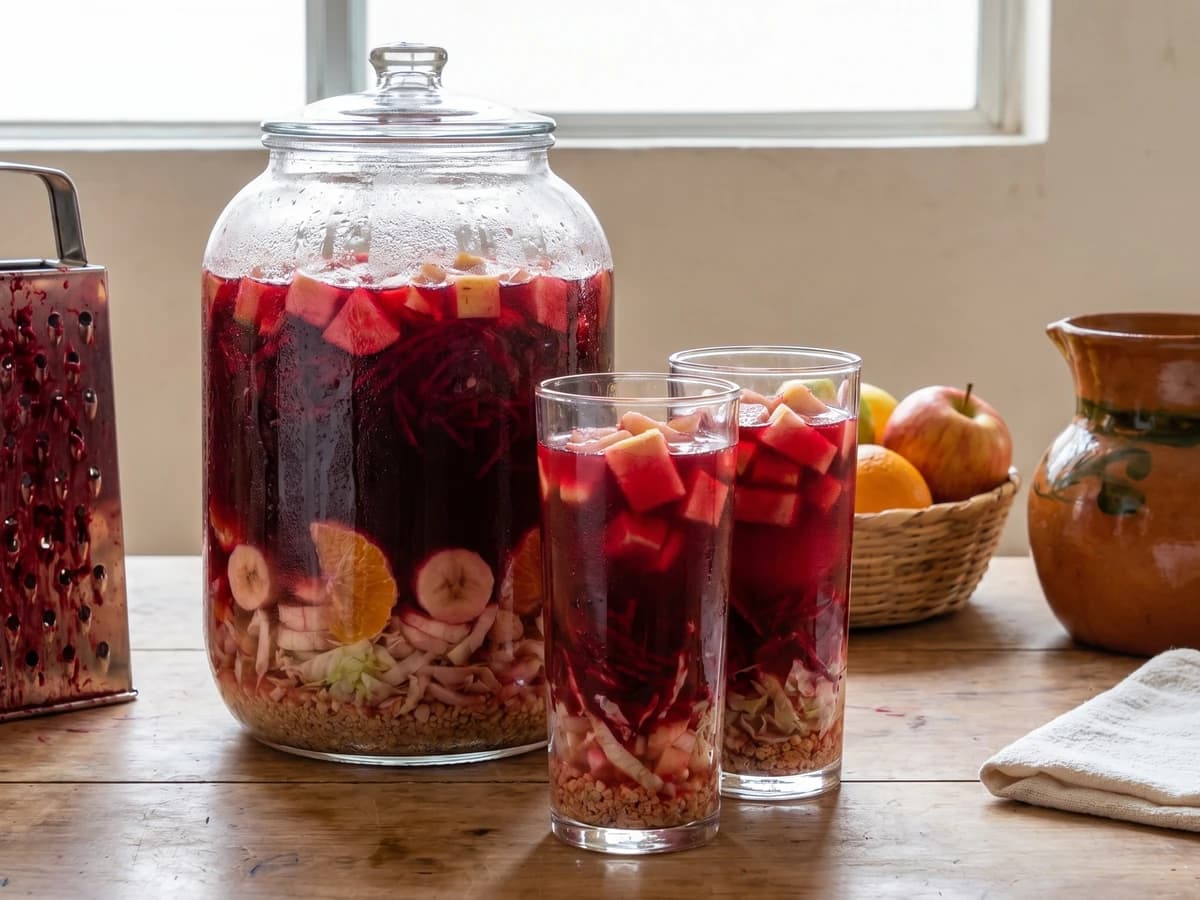
Aguascalientes' Lenten agua fresca, jewel-red from cooked beet and full of apple, banana, orange, lettuce, and ground peanuts, served cold when Holy Week meets the Feria de San Marcos.

Chef Lupita
Sonora and Sinaloa's creamy malted barley water, built on toasted cebada perla, Mexican canela, vanilla from Papantla, and evaporated milk. Pink-beige, rich, and served cold over heavy ice in a heavy glass tumbler. Liquid cookie comfort the northwest way.

Chef Lupita
Yucatán's everyday tonic of boiled chaya leaves blended with lima agria, sugar, and ice. The bright green jarra that sits on every Peninsula table from Mérida to Valladolid.