
Chef Lupita
Acitrón de Cidra Conventual
Puebla's convent-style acitrón, made from cidra peel instead of endangered biznaga, built through repeated syrup soakings until the cubes turn firm, translucent, and ready for rosca or chiles en nogada.
A cooking platform built around craft, culture, and the stories behind what we eat.
Created by
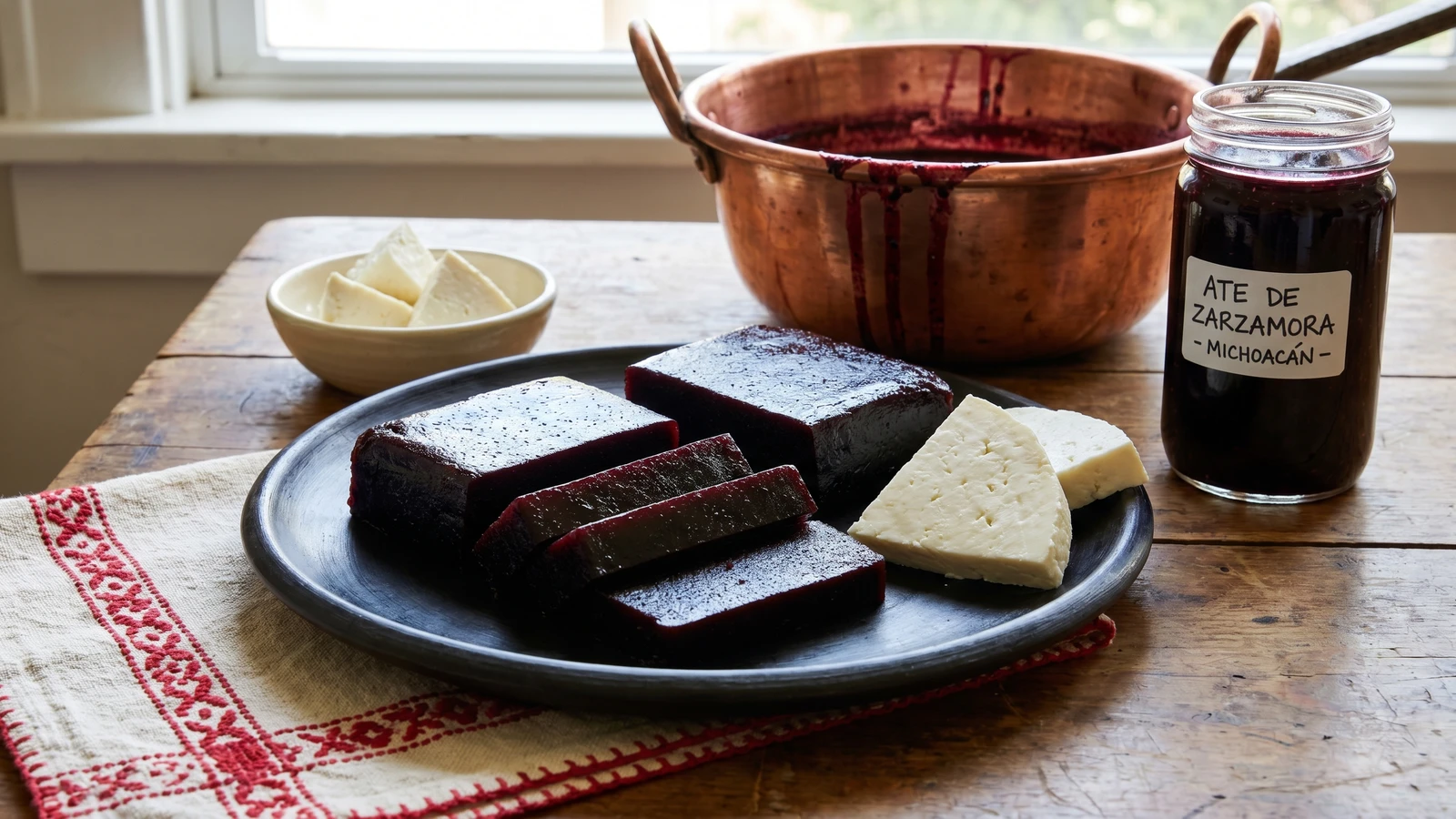
Morelia's ate de zarzamora turns Michoacán blackberries and piloncillo into a dark, sliceable fruit paste, cooked slowly in a copper cazo and served with queso fresco.
Michoacán owns this ate through Morelia, but the fruit speaks from the berry country around Los Reyes, Peribán, and Uruapan, where the blackberries come in dark, soft, and staining your fingers before they reach the basket. This is not chile and lime food. Not all Mexican food is that. This is dulce p'urhépecha territory: fruta del huerto, piloncillo, copper, and time.
Ate de zarzamora is the darker cousin of Morelia's famous ate de membrillo and ate de guayaba. The technique belongs to the women who stood over copper cazos and learned by sight, not by thermometer, when fruit and sugar had become something sliceable. The paste must pull from the bottom in heavy folds. It must set firm enough to cut and soft enough to bite without fighting you. That's the work.
Use piloncillo claro, not refined white sugar. Use a copper cazo if you have one. The cazo de cobre is not decoration, it gives even heat and the slow concentration that makes Michoacán sweets taste like themselves. An enameled pot will work, but don't pretend it is the same. Si no conoces el mercado, no conoces la cocina.
Serve it with queso fresco or a young Cotija, on a Capula black-burnished clay plate or a Tzintzuntzan cream-glazed dish if you have one. Sweet against salty, dark berry against milk. Cada estado, su propia cocina.
Ate is Mexico's descendant of Iberian fruit pastes such as dulce de membrillo, adapted in colonial convent and household kitchens to local fruits including guava, tejocote, pear, peach, and later blackberry. Morelia became especially associated with ate in the 19th and 20th centuries, when Michoacán fruit preserves were sold as durable travel sweets that could keep without refrigeration. Modern Michoacán is Mexico's leading blackberry-producing state, and the fruit-growing belt around Los Reyes and Peribán gave this older Morelia confection a dark berry version that now belongs fully to the region.
Quantity
2 pounds
rinsed and picked over
Quantity
1 pound
grated or chopped small
Quantity
1 cup
Quantity
1
unpeeled, cored, and chopped
Quantity
2 tablespoons
Quantity
1/4 teaspoon
Quantity
for greasing the mold
Quantity
for serving
| Ingredient | Quantity |
|---|---|
| ripe Michoacán blackberriesrinsed and picked over | 2 pounds |
| piloncillo clarograted or chopped small | 1 pound |
| water | 1 cup |
| large tart appleunpeeled, cored, and chopped | 1 |
| fresh Mexican lime juice | 2 tablespoons |
| fine sea salt | 1/4 teaspoon |
| neutral oil | for greasing the mold |
| queso fresco or queso Cotija joven (optional) | for serving |
Lightly oil an 8-inch square mold, then line it with parchment with overhang on two sides. Ate sets firmly, and you need to lift it out cleanly. Do this before the fruit goes on the fire. Once the paste is ready, it waits for nobody.
Put the blackberries, chopped apple, water, and salt in a copper cazo or heavy enameled pot. Cook over medium heat, stirring often, until the berries collapse and the apple softens, about 20 minutes. The apple is not there for flavor. It brings pectin, the quiet structure that lets the ate slice instead of slump.
Pass the hot fruit through a food mill or press it through a fine-mesh sieve with a sturdy spoon. Work patiently and scrape the underside of the sieve. Discard the blackberry seeds and apple skins. You want a smooth, dark purple pulp with body. If you leave the seeds in, you made a preserve with grit, not ate.
Return the strained pulp to the copper cazo. Add the chopped piloncillo and cook over medium-low heat, stirring until fully dissolved. Piloncillo gives this ate its deep mineral sweetness. Refined sugar makes it flatter and brighter, like candy from nowhere. This is Michoacán. Use piloncillo.
Cook the mixture over low heat, stirring constantly with a wooden paddle, until it thickens into a glossy paste, 55 to 75 minutes. Scrape the bottom and corners every time. It is ready when the paddle leaves a clean path across the bottom of the cazo for two seconds and the paste falls from the spoon in heavy folds, not drops.
Stir in the lime juice during the last five minutes of cooking. The lime sharpens the blackberry and helps the pectin finish its work. Do not add it early. Long cooking dulls the acidity, and this paste needs that edge against the piloncillo.
Scrape the hot paste into the prepared mold and smooth the top with an oiled spatula. Let it cool uncovered until firm, then cover loosely and rest at room temperature for 12 hours. The block should pull away from the sides and hold a clean cut. If it bends but does not flow, you did it right.
Lift the ate from the mold and cut into small rectangles or diamonds. Serve with queso fresco or a young Cotija, the way Michoacán sweets belong on the table: fruit, milk, piloncillo, and patience. Recetas probadas y garantizadas.
1 serving (about 55g)
Culinary guides, cultural storytelling, and the editorial depth that makes cooking meaningful.
Discover Culinary ExplorerChef Lupita
Puebla's convent-style acitrón, made from cidra peel instead of endangered biznaga, built through repeated syrup soakings until the cubes turn firm, translucent, and ready for rosca or chiles en nogada.

Chef Lupita
Ciudad de México's Tulyehualco alegría is popped huautli folded into piloncillo honey, pressed with peanuts, pepitas, and raisins, then cut into the rectangular bars that built a pueblo's identity.

Chef Lupita
Oaxaca's pre-Columbian amaranth bar, popped on a hot comal and bound with piloncillo, honey, and the sacred Zapotec grain that the Spanish tried, and failed, to outlaw.

Chef Lupita
Querétaro's mercado candy of popped amaranto pressed with dark piloncillo syrup, pepitas, pecans, and cacahuate, a Bajío sweet that respects the seed before it decorates the table.