
Chef Lupita
Agua de Alfalfa
Ciudad de México's highland market agua fresca, fresh alfalfa blended with pineapple and lime until bright green, strained clean, and poured cold from the vitrolero.
A cooking platform built around craft, culture, and the stories behind what we eat.

Created by
Sonora's magenta refresher from the desert organ pipe cactus, mashed by hand with limon and a pinch of sea salt from Bahia de Kino. The color of the Sonoran summer in a heavy glass tumbler.
This is from Sonora. Specifically from the Sonoran desert, from the Comcaac people of the coast around Bahia de Kino and Punta Chueca, and from the home cooks of Hermosillo and Caborca who serve this agua on the hottest days of the year. The fruit is pitahaya dulce, the fruit of the pitayo, the organ pipe cactus that grows nowhere else in this form. This is not the Asian dragon fruit on the supermarket shelf. This is desert fruit, harvested with long wooden poles by hands that know the spines.
For the Comcaac Seri, the pitahaya harvest marks the new year. The first ripe fruit of the season is a calendar, a celebration, a confirmation that the desert is still alive. When the magenta runs down your hand as you scoop the flesh out of the rind, you understand why this fruit anchors a culture. The color is the brightest natural pigment I have seen in any Mexican market, and I have walked through every state.
The technique is simple and unforgiving. Do not blend. The seeds are tiny and they crack open in a blender, turning the agua gray and bitter within minutes. You mash by hand, you strain, you dilute, you drink the same day. The pigment is fragile. The perfume is fragile. The fruit gives you a window of a few hours to honor it. Cada estado, su propia cocina, and this one belongs to Sonora.
My mother never knew this fruit. She was from Jalisco. When I tasted it for the first time in a mercado in Hermosillo at age twenty-nine, I wrote in my own notebook: 'esto no es comida de un solo Mexico.' This is not food from a single Mexico. The northwest is its own country of flavor, and pitahaya is its summer flag.
Pitahaya dulce is the fruit of Stenocereus thurberi, the organ pipe cactus, and it has been a staple of the Comcaac (Seri) people of coastal Sonora for at least 2,000 years. The Comcaac traditional calendar marks the pitahaya harvest, known as Iimt Iquiisax, as the beginning of the year, and the fruit was historically eaten fresh, dried into cakes for storage, and fermented into a ceremonial wine for community gatherings. Spanish missionaries in the 17th and 18th centuries noted the Sonoran indigenous reliance on pitahaya in their journals, and the Pimas Altos, the Yaqui, and the Mayo all developed parallel uses of the fruit. The modern agua de pitahaya, prepared in northwestern Mexican homes during the brief late-June through July harvest, preserves the indigenous understanding of the fruit as both food and seasonal marker.
Quantity
6 (about 2 pounds)
spines brushed off, halved and flesh scooped
Quantity
8 cups, divided
Quantity
1/2 cup, plus more to taste
Quantity
2
juiced
Quantity
1 pinch
Quantity
for serving
Quantity
for serving
Quantity
for garnish
| Ingredient | Quantity |
|---|---|
| ripe pitahayas (organ pipe cactus fruit, pitahaya dulce)spines brushed off, halved and flesh scooped | 6 (about 2 pounds) |
| cold filtered water | 8 cups, divided |
| sugar | 1/2 cup, plus more to taste |
| limones (Mexican key limes)juiced | 2 |
| sea salt from Bahia de Kino | 1 pinch |
| ice (optional) | for serving |
| lime wedges (optional) | for serving |
| extra pitahaya seeds (optional) | for garnish |
The pitahaya you want is the desert pitahaya, the fruit of the pitayo organ pipe cactus that grows in the Sonoran desert, not the pink-skinned dragon fruit from a supermarket bin. The ripe ones are the size of a small fist, magenta to deep red inside, with tiny black seeds suspended in the flesh. If the fruit still has spines on the skin, brush them off with a stiff vegetable brush under running water. The Comcaac harvest these in late June and July with long poles. Asi se hace y punto.
Halve each pitahaya with a paring knife. Scoop the flesh, seeds and all, into a wide bowl. You should have about three cups of pulp. The seeds stay. They are part of the texture and part of the tradition. Do not strain them out at this stage.
Add the sugar and the juice of the two limones to the pulp. Stir gently with a wooden spoon and let it sit for ten minutes. The sugar pulls the juice out of the flesh and the lime brightens the color. You will see the magenta turn electric. That is the pigment, called betalain, the same compound that gives beets and prickly pear their color. Sonora's desert pours out of this fruit in a way nothing else does.
Mash the pulp with the back of a wooden spoon or a potato masher. You want the flesh broken up but not pulverized. A blender will crack the seeds and turn the agua bitter and gray. No me vengas con atajos. The mercado women in Hermosillo do this by hand and so do you.
Pour the mashed pulp into a fine-mesh strainer set over a large pitcher or jarra. Press gently with the wooden spoon to push the juice and the small seeds through. Discard the fibrous solids left in the strainer. Add six cups of the cold water and the pinch of sea salt. Stir. Taste. Add the last two cups of water if you want it lighter, more sugar if the fruit was not fully ripe.
Refrigerate for at least thirty minutes so the flavors settle and the agua gets properly cold. Serve in heavy glass vasos jarochos over a single large ice cube. A lime wedge on the rim. A few extra seeds floating on top if you saved them. Drink it the same day. Pitahaya agua does not keep. The pigment dulls by morning and the perfume is gone. Drink it now. Saber cocinar es saber vivir.
1 serving (about 250g)
Culinary guides, cultural storytelling, and the editorial depth that makes cooking meaningful.
Discover Culinary ExplorerChef Lupita
Ciudad de México's highland market agua fresca, fresh alfalfa blended with pineapple and lime until bright green, strained clean, and poured cold from the vitrolero.
Chef Lupita
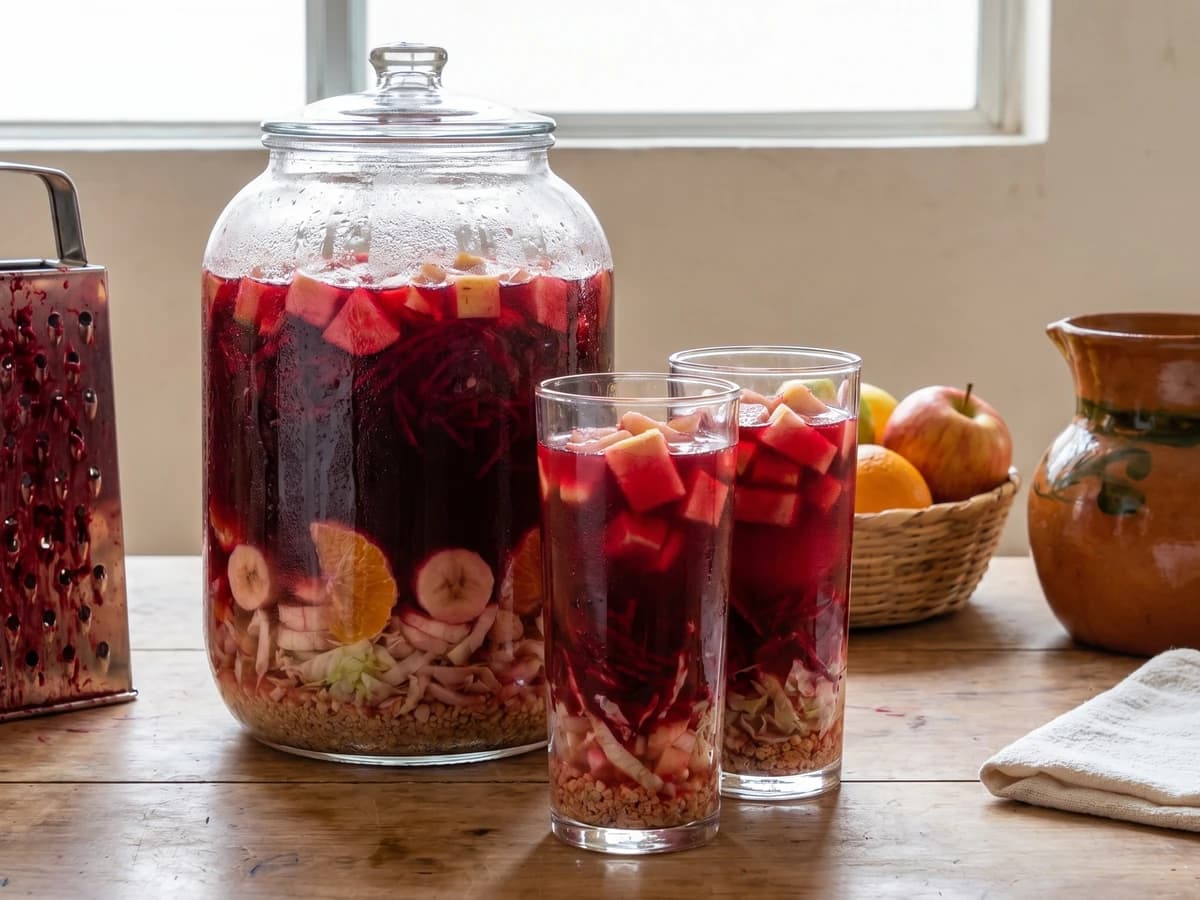
Aguascalientes' Lenten agua fresca, jewel-red from cooked beet and full of apple, banana, orange, lettuce, and ground peanuts, served cold when Holy Week meets the Feria de San Marcos.

Chef Lupita
Sonora and Sinaloa's creamy malted barley water, built on toasted cebada perla, Mexican canela, vanilla from Papantla, and evaporated milk. Pink-beige, rich, and served cold over heavy ice in a heavy glass tumbler. Liquid cookie comfort the northwest way.

Chef Lupita
Yucatán's everyday tonic of boiled chaya leaves blended with lima agria, sugar, and ice. The bright green jarra that sits on every Peninsula table from Mérida to Valladolid.