
Chef Lupita
Agua de Alfalfa
Ciudad de México's highland market agua fresca, fresh alfalfa blended with pineapple and lime until bright green, strained clean, and poured cold from the vitrolero.
A cooking platform built around craft, culture, and the stories behind what we eat.
Created by
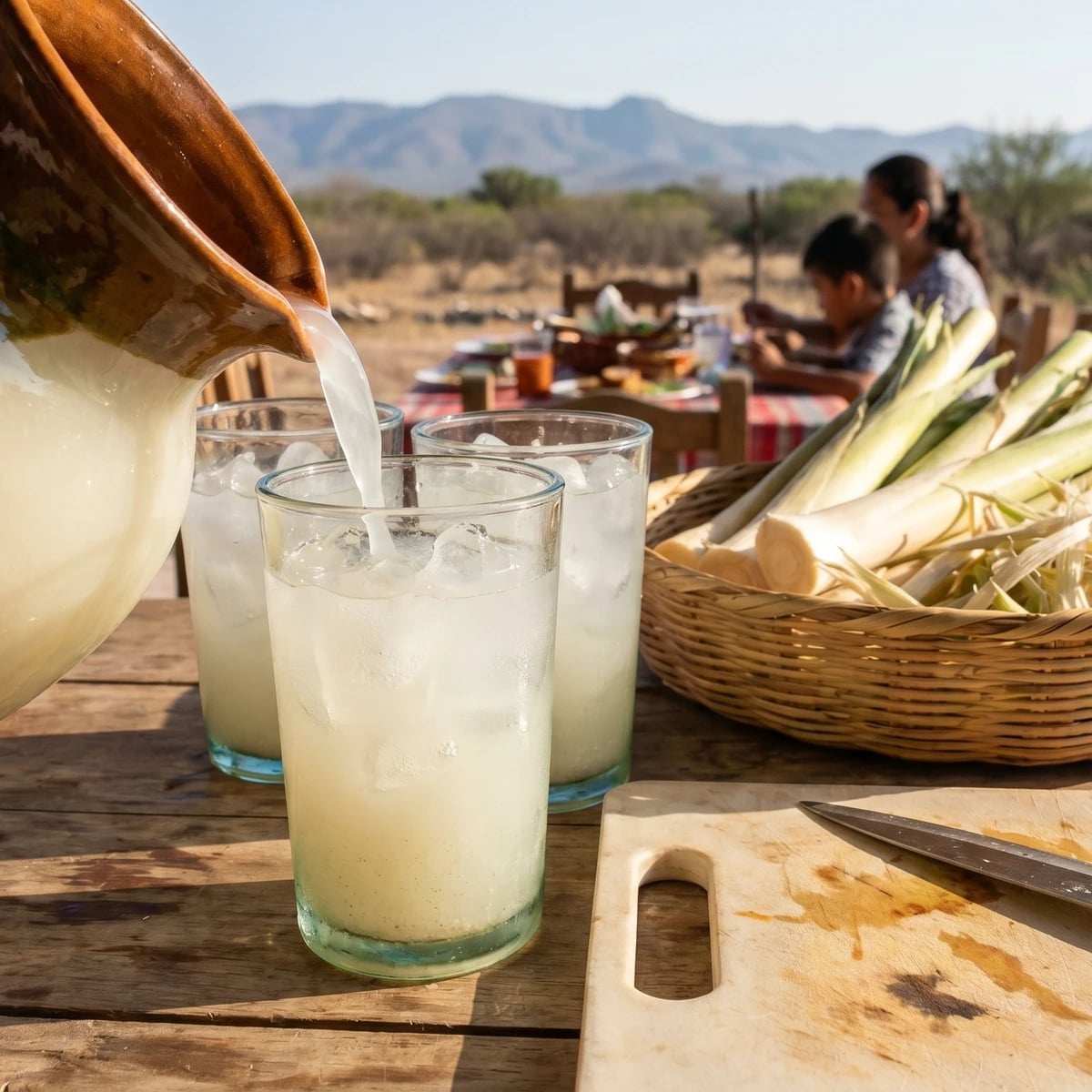
San Luis Potosí's Altiplano drink for May, pale palmito de yuca blended with cold water and cane sugar, served icy in clay jarritos when the semidesert heat stops pretending.
San Luis Potosí, the Altiplano potosino, is where this agua lives: the dry country north of the capital, around Matehuala, Charcas, and Venado, where May heat turns the road white and the market tables fill with plants that know how to survive without much water.
Agua de palmito is not a limeade wearing a regional name. It is the tender heart of yuca del semidesierto, peeled down to the pale core, blended with cold water and cane sugar until the drink turns ivory and faintly green. No chile. No herb. Not every Mexican drink has to shout. The Altiplano speaks in dryness, mineral sweetness, and restraint.
I first wrote this down from a señora near Mercado Hidalgo in San Luis Potosí, but she sent me back to ask the women from Matehuala because, she said, ellas sí saben cortar el palmito. She was right. The trick is the knife work before the blender: remove every fibrous outside layer, keep only the clean heart, and strain without making the drink thin.
This is picnic water for May, poured from a clay jarra into thick glasses with ice. The drink is pale, humble, and serious. Saber cocinar es saber vivir, even when all you're doing is choosing the right piece of palmito and knowing when to stop adding sugar.
San Luis Potosí is split between the humid Huasteca and the dry Altiplano, and agua de palmito belongs to the northern semidesert around Matehuala, Charcas, and Venado. During the late 19th and early 20th centuries, the Altiplano's ixtle economy made desert plants such as lechuguilla, maguey, and yuca central to household work; the same landscape supplied edible seasonal shoots, flowers, and hearts for home kitchens. Palmito de yuca is the tender core of a desert yucca or izote, not the Caribbean cassava root and not the canned palm heart sold for salads.
Quantity
12 ounces trimmed heart
pale tender core only, outer fibrous layers removed, cut into 1/2-inch pieces
Quantity
8 cups
divided
Quantity
1/2 to 3/4 cup
to taste
Quantity
1/4 teaspoon
Quantity
for serving
| Ingredient | Quantity |
|---|---|
| fresh edible palmito de yucapale tender core only, outer fibrous layers removed, cut into 1/2-inch pieces | 12 ounces trimmed heart |
| cold filtered waterdivided | 8 cups |
| cane sugarto taste | 1/2 to 3/4 cup |
| fine sea salt | 1/4 teaspoon |
| ice (optional) | for serving |
Buy fresh edible palmito de yuca from a vendor who knows the Altiplano product. It should be ivory to pale green, damp, firm, and clean-smelling. If it smells sour, looks gray, or feels woody, leave it there. Pregúntale a las señoras del mercado. They know which pieces were cut young enough for agua.
Peel away every tough, fibrous, green outside layer until only the pale tender heart remains. Cut it into 1/2-inch pieces and rinse under cold water. Taste one thin shaving. It should be earthy, faintly sweet, and green in the mouth. If it tastes lightly bitter, soak the pieces in cold water for 10 minutes and drain. If it tastes soapy or harsh, the palmito is wrong for this drink.
Put half the palmito in the blender with 3 cups cold water. Blend on high for 60 to 90 seconds, until the liquid turns pale ivory and the pieces are fully broken down. Repeat with the remaining palmito and 3 more cups cold water. Cold water keeps the flavor clean. Warm water makes the plant taste tired.
Pour the blended palmito through a medium-mesh strainer into a large pitcher or vitrolero, pressing gently with a spoon. Discard the stringy fiber left behind. Do not strain through cloth unless your palmito is unusually fibrous. This agua should have a little body, not the thinness of bottled water.
Stir the cane sugar and salt into 1 cup cold water until dissolved, then add it to the pitcher with the remaining 1 cup cold water. Start with 1/2 cup sugar, taste, then add more only if the palmito needs it. Chill for at least 30 minutes. The flavor settles as it rests, and the fine sediment at the bottom is correct.
Stir hard before serving. Pour over ice into thick glasses or small clay jarritos. No lime, no mint, no chile. This is San Luis Potosí's semidesert in a glass, and restraint is part of the flavor. Cada estado, su propia cocina.
1 serving (about 250g)
Culinary guides, cultural storytelling, and the editorial depth that makes cooking meaningful.
Discover Culinary Explorer
Chef Lupita
Ciudad de México's highland market agua fresca, fresh alfalfa blended with pineapple and lime until bright green, strained clean, and poured cold from the vitrolero.

Chef Lupita
Aguascalientes' Lenten agua fresca, jewel-red from cooked beet and full of apple, banana, orange, lettuce, and ground peanuts, served cold when Holy Week meets the Feria de San Marcos.

Chef Lupita
Sonora and Sinaloa's creamy malted barley water, built on toasted cebada perla, Mexican canela, vanilla from Papantla, and evaporated milk. Pink-beige, rich, and served cold over heavy ice in a heavy glass tumbler. Liquid cookie comfort the northwest way.

Chef Lupita
Yucatán's everyday tonic of boiled chaya leaves blended with lima agria, sugar, and ice. The bright green jarra that sits on every Peninsula table from Mérida to Valladolid.