Culinary Explorer

A cooking platform built around craft, culture, and the stories behind what we eat.
Discover Culinary Explorer
Mousselines d’Écrevisses

Mousselines d’Écrevisses

Created by Chef Juliette

Based on No. 970, Mousselines d’Écrevisses, from Le Guide Culinaire (1907) by Auguste Escoffier

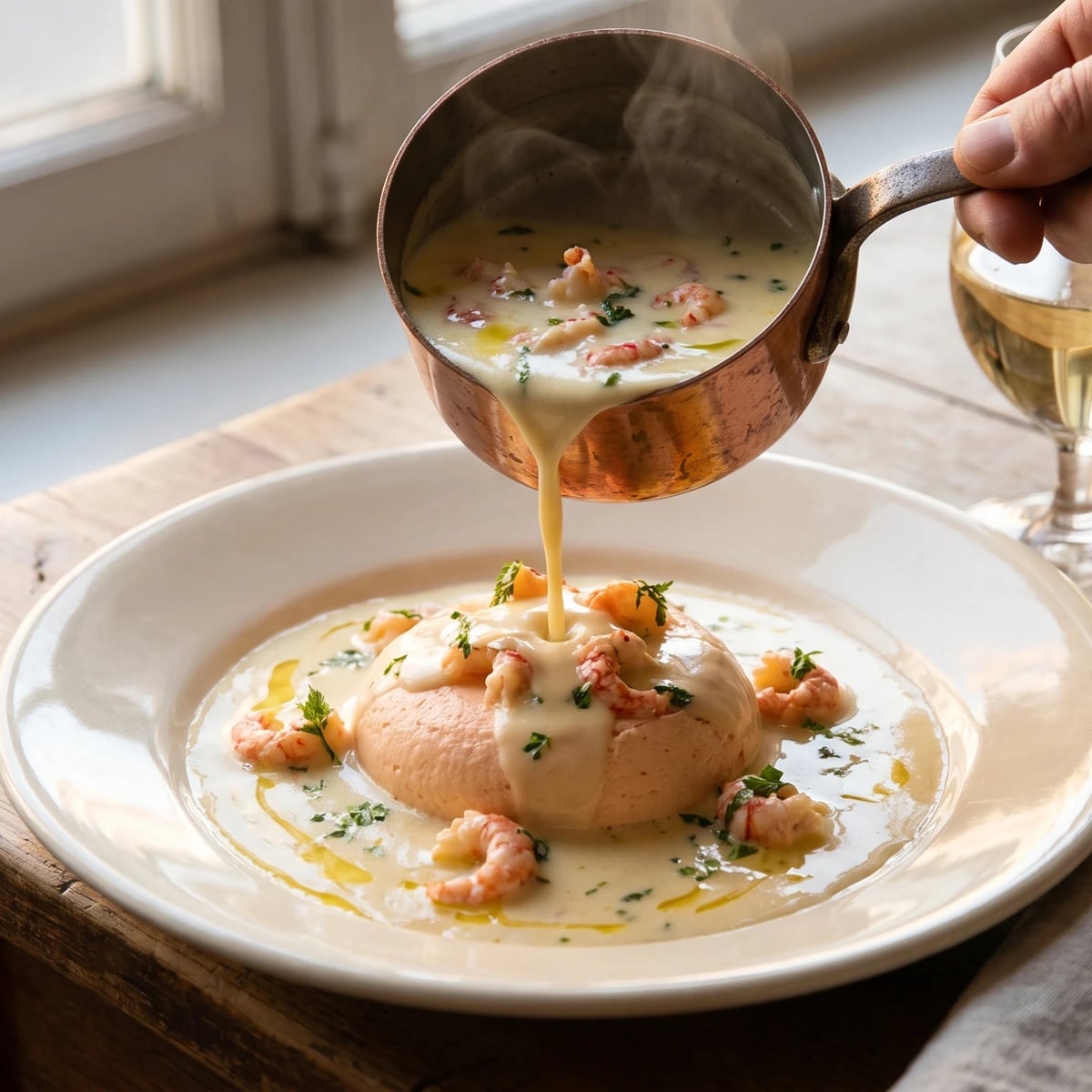
Mousselines d’Écrevisses turn raw crayfish, egg white, and cream into warm, silken moulds, poached under cover and served in glossy shellfish sauce. Keep the forcemeat cold, and the rest is gentle heat.

Main Dishes
French
Dinner Party
Special Occasion
45 min
Active Time
40 min cook1 hr 25 min total
Yield4 servings

Mousselines d’Écrevisses (warm crayfish mousselines) teach one uncompromising principle: a forcemeat is an emulsion, and an emulsion must stay cold. Raw crayfish, egg white, and cream become something lighter than any one of them, but let the mixture warm under the blade and the texture turns grainy. Cold ingredients, cold tools, gentle hands. That is the grammar.

The entry points directly to Mousselines de Homard (No. 951), because raw lobster and crayfish forcemeats behave in the same delicate way. The classical kitchen assumed a saucier, crustacean stock never off the fire, repeated pounding through sieves, and ranks of dariole moulds; its salamander had no work here, because mousselines are covered and poached rather than browned. A chilled food processor, one careful pass through a fine sieve, four buttered ramekins, and good unsalted shellfish stock give one cook the honest equivalent. The repeated pounding was brigade scaffolding and can go. Raw crayfish, real cream, the moulds, and the covered bain-marie are the dish and must stay.

When they are right, the mousselines leave their moulds as pale coral domes, trembling but whole, with a fine, moist crumb under the spoon and a shellfish sauce pooling around them. The forcemeat will be too soft to shape between spoons, exactly as the source warns, so don't stiffen it with crumbs or flour. If it begins to look oily while you mix, stop and chill it; ça se rattrape. The critical step comes before heat: keep the forcemeat cold while the cream goes in.

Mousselines d’Écrevisses belong to Parisian grande cuisine, which drew freshwater crayfish from river and lake districts and translated their delicate flesh into a warm moulded forcemeat. In classical usage, a crustacean mousse is generally cold, while mousseline names a warm preparation; the soft raw crayfish mixture went into buttered dariole moulds because it could not hold a spoon-shaped quenelle. The method passed readily into bourgeois dining rooms, where ramekins and a covered water bath perform precisely the same work.

The technique, the tradition, and the story behind every dish.

Discover Culinary Explorer

Ingredients

referenced raw-crustacean mousseline preparation

Quantity

1 home-scaled batch Mousselines de Homard (No. 951)

made here with crayfish using the ingredients below

raw peeled crayfish tail meat

Quantity

3 cups (720 ml / 450 g)

kept very cold; 3/4 cup reserved for the sauce

unsalted butter

Quantity

6 tablespoons (90 ml / 85 g)

divided; 2 tablespoons softened for the moulds and 3 tablespoons cold and cubed for finishing

large egg whites

Quantity

2, about 1/4 cup (60 ml / 60 g)

very cold

heavy cream

Quantity

2 cups (480 ml / 480 g)

very cold and divided

fine sea salt

Quantity

1 1/4 teaspoons (6 ml / 7 g)

divided

ground white pepper

Quantity

1/4 teaspoon (1.25 ml / 0.5 g)

cayenne

Quantity

1/16 teaspoon (0.3 ml / 0.1 g)

freshly grated nutmeg

Quantity

1/16 teaspoon (0.3 ml / 0.1 g)

small shallots

Quantity

2, about 1/2 cup (120 ml / 60 g)

thinly sliced

tomato paste

Quantity

1 teaspoon (5 ml / 6 g)

Cognac

Quantity

1 tablespoon (15 ml / 14 g)

dry white wine

Quantity

1/2 cup (120 ml / 120 g)

unsalted shellfish stock

Quantity

1 cup (240 ml / 240 g)

fresh lemon juice

Quantity

2 teaspoons (10 ml / 10 g)

chervil

Quantity

2 tablespoons (30 ml / 4 g)

finely chopped and divided

Equipment Needed

  • Food processor with at least a 7-cup (1.7 litre) bowl
  • Fine-mesh sieve or tamis
  • Four 6-ounce (175 ml) dariole moulds or straight-sided ramekins
  • Deep roasting tin for the bain-marie
  • Small heavy saucier or saucepan
  • Instant-read thermometer
  • Aluminium foil

Instructions

  1. 1

    Prepare the cold chain

    Heat the oven to 325°F (165°C). Chill the food-processor bowl, blade, a mixing bowl, and the fine sieve for 15 minutes. Coat four 6-ounce (175 ml) dariole moulds or straight-sided ramekins generously with 2 tablespoons of the softened butter, reaching every corner and the rims. Set a kettle of water to heat for the bain-marie. Keep the crayfish, egg whites, and cream refrigerated until the moment each is needed.

    The cold equipment isn't ceremony. Friction from the processor warms the crayfish quickly, and warmth is what separates the fat and liquid before the forcemeat has formed.
  2. 2

    Build the sauce base

    Melt 1 tablespoon of the butter in a small saucier over medium-low heat. Add the shallots and soften them without colouring, about 3 minutes. Stir in the tomato paste for 30 seconds, then add the Cognac and wine. Reduce until only about 1/4 cup (60 ml) remains and the raw smell of alcohol has disappeared. Add the shellfish stock and simmer gently until reduced to about 3/4 cup (180 ml), 10 to 12 minutes. Strain into a clean pan, pressing the shallots lightly, then set the concentrated base aside. This wine, stock, and shallot reduction is the home stove's answer to the crustacean stockpot and its attending saucier.

  3. 3

    Make the cold forcemeat

    Reserve 3/4 cup (110 g) of the best whole crayfish tails for the sauce. Pat the remaining 2 1/4 cups (340 g) thoroughly dry and place them in the chilled processor with 1 teaspoon of the salt, the white pepper, cayenne, and nutmeg. Following the raw-crustacean method of Mousselines de Homard (No. 951), process in short pulses until the crayfish becomes a smooth, sticky paste. Add the cold egg whites and pulse only until absorbed. Force the paste once through the chilled fine sieve into a bowl set over ice, then reserve 2 tablespoons of this uncreamed paste in a separate chilled cup. Stir 1 1/4 cups (300 ml) of the cold cream into the remaining paste, 1/4 cup at a time, using a firm spatula and folding until each addition disappears before adding the next. The finished forcemeat should be satin-smooth, glossy without looking oily, and too soft to spoon-shape. If it begins to separate, stop. Ça se rattrape: chill everything for 10 minutes, place the reserved paste in a clean cold bowl, and work the broken mixture into it one spoonful at a time. If no rescue is needed, fold the reserved paste back in at the end.

    Poach a teaspoon of forcemeat in barely trembling water for 2 minutes. It should be tender, moist, and evenly set. A grainy test means the mixture grew too warm; chill it before filling the moulds.
  4. 4

    Mould and poach

    Divide the forcemeat among the buttered moulds, filling them within 1/4 inch (6 mm) of the rims. Tap each mould once against a folded towel to release large air pockets, then smooth the tops. Stand the moulds in a deep roasting tin and pour very hot, not boiling, water around them to reach halfway up their sides. Cover the entire tin tightly with foil and bake for 22 to 28 minutes, until the mousselines feel softly resilient at the centre and register 145°F (63°C). The bain-marie should never boil. If it does, ladle out some water, replace it with cool water, and lower the oven to 300°F (150°C); gentle the heat before the mousselines contract and turn coarse.

  5. 5

    Finish the sauce

    While the mousselines poach, return the sauce base to a bare simmer and add the remaining 3/4 cup (180 ml) cream. Reduce gently until the sauce coats the back of a spoon without becoming heavy. Add the reserved crayfish tails and poach them in the sauce for 1 to 2 minutes, just until opaque and curled, then lift them out. Remove the pan from the heat and whisk in the 3 tablespoons cold butter, one cube at a time, to form a glossy emulsion. Add the lemon juice, the remaining 1/4 teaspoon salt, and 1 tablespoon chervil. If the butter floats in greasy beads, don't discard the sauce. Ça se rattrape: whisk 1 teaspoon of cold water in a clean pan, then whisk the sauce into it gradually over the gentlest heat.

  6. 6

    Unmould and serve

    Let the mousselines rest in their moulds for 2 minutes. Run a thin knife around each rim, place a warmed shallow plate over the mould, and invert decisively. If one refuses to release, dip the base of its mould in hot water for 5 seconds and try again; don't pry at the delicate sides. Pool the shellfish cream sauce generously around each mousseline, arrange the warm crayfish tails in the sauce, and finish with the remaining chervil. Serve immediately. À table!

Chef Tips

  • Most packaged crayfish tails are already cooked, even when sold refrigerated or frozen. They cannot form this forcemeat. Ask specifically for raw peeled tail meat; if it isn't available, raw lobster tail is the honest substitute, but the dish then becomes Mousselines de Homard (No. 951).
  • Dry the crayfish thoroughly after thawing. Surface water dilutes the proteins that bind the emulsion, and no quantity of extra cream can repair a watery foundation.
  • Straight-sided metal dariole moulds release most cleanly, but ordinary 6-ounce ramekins work. Avoid large, deep cups, which leave the centre raw while the outside grows firm.
  • Serve with buttered young leeks, spinach, or a restrained rice pilaf. A dry Mâconnais Chardonnay or an Alsace Pinot Blanc has enough freshness for the cream without trampling the crayfish.

Advance Preparation

  • The wine and shellfish-stock reduction can be prepared up to 1 day ahead and refrigerated. Reheat it gently, then add the cream, crayfish tails, butter, lemon, and chervil shortly before serving.
  • The moulds may be buttered and the equipment chilled several hours ahead. The forcemeat can be mixed, moulded, covered, and refrigerated for up to 3 hours, but it should go directly from the refrigerator into the prepared bain-marie.
  • Poach the mousselines close to serving. Reheating firms their delicate texture, so use the make-ahead time on the sauce base and table rather than on the final poach.

Frequently Asked Questions

Nutrition Information

1 serving (about 285g)

Calories
680 calories
Total Fat
62 g
Saturated Fat
39 g
Trans Fat
2 g
Unsaturated Fat
20 g
Cholesterol
310 mg
Sodium
860 mg
Total Carbohydrates
8 g
Dietary Fiber
1 g
Sugars
5 g
Protein
23 g

Note: Chef personas and recipes are created with AI assistance. Cook with care: follow safe food-handling practices, check doneness with a thermometer when needed, and adapt for allergies and your kitchen.

Where cooking meets culture.

Culinary guides, cultural storytelling, and the editorial depth that makes cooking meaningful.

Discover Culinary Explorer

More from Fish - Lobster (Homard)

Browse the full collection