
Chef Juliette
Ordinary or White Consommé
Beef shin, lean beef, and fowl begin in cold water and rise slowly toward a tremble. Skim before the boil, and you learn the quiet discipline that gives every clear French broth its backbone.
A cooking platform built around craft, culture, and the stories behind what we eat.
Created by Chef Juliette
Based on No. 90, Marinière Sauce, from Le Guide Culinaire (1907) by Auguste Escoffier
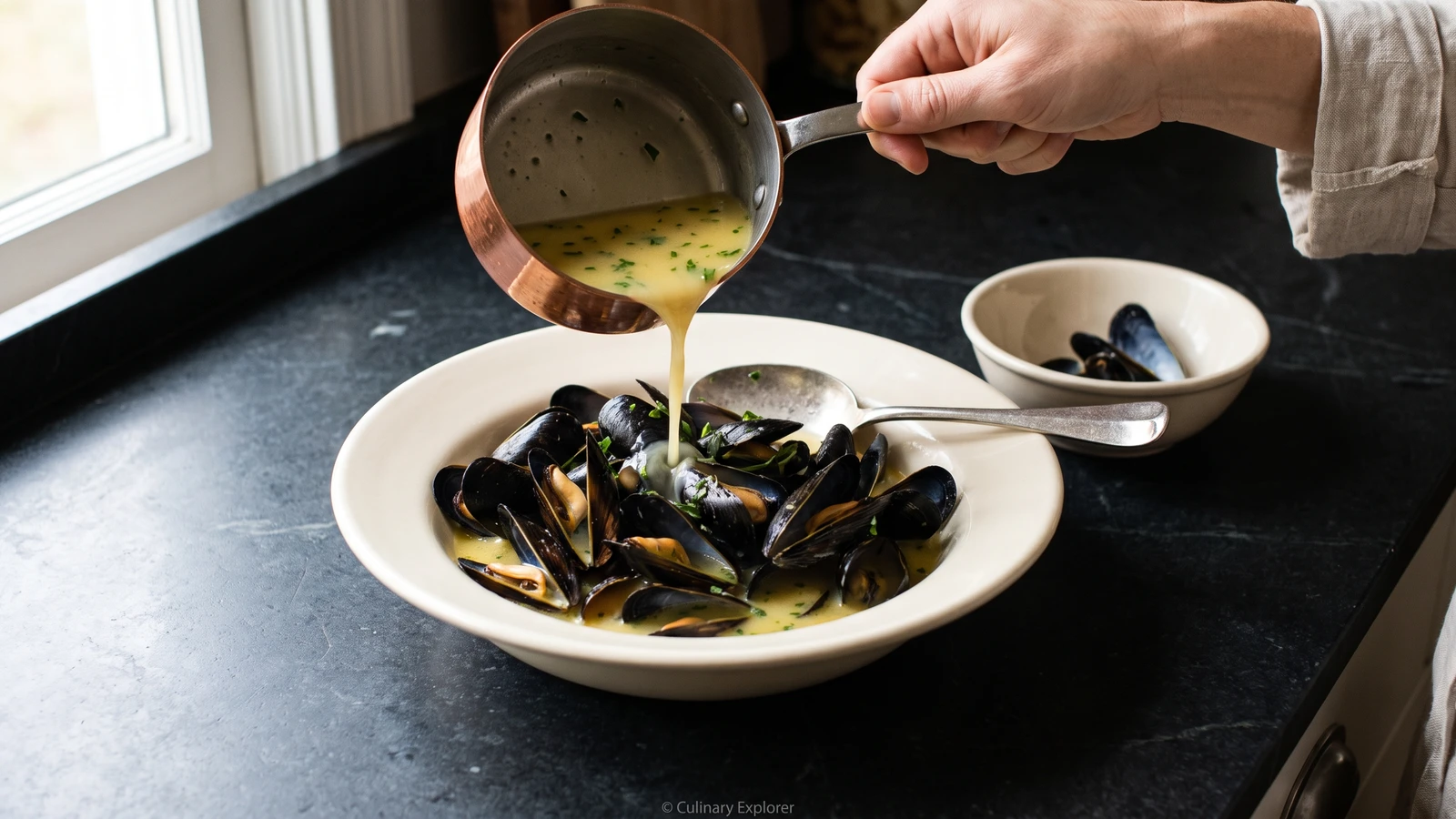
Sauce Marinière turns a wine-shallot fish sauce into satin with mussel liquor and an egg-yolk liaison, a precise off-heat finish for mussels and small poached fish that rewards a calm whisk.
Sauce Marinière (sailor-style sauce) teaches the discipline of a liaison, a binding of egg yolks into a hot sauce. Heat builds the base, then restraint finishes it. Know this before you touch the pan: once the yolks enter, the sauce must never boil.
The original assumed a saucier on staff, fish fumet never off the fire, and Sauce Bercy (No. 65) waiting by the pint. At home, prepare that referenced sauce separately, then let one broad saucepan and a whisk handle this derivative. Keeping several base sauces hot through service was brigade scaffolding and can go; the book's proportions and the off-heat liaison are the dish, and both stay. The exact ratio is multiplied by three here, giving six cups of Sauce Bercy (No. 65), one and a half cups of mussel liquor, and nine yolks. It finishes at about two quarts. One cook, one stove, one evening.
The finished Marinière should be pale butter-gold, glossy enough to cling lightly to a mussel shell, and alive with the saline depth of the cooking liquor without becoming heavy. Strain that liquor meticulously, then pull the saucepan completely off the heat before tempering the yolks. That pause is the step that decides the sauce.
Sauce Bercy (No. 65) carries the name of Bercy, Paris's wine-trading quarter, and belongs to the city's classical family of sauces for poached fish. Marinière folds the practice of the Channel and Atlantic mussel pot into that Parisian grammar, using the shellfish liquor to deepen the finished sauce before a yolk liaison binds it. It is often mistaken for the broth of moules marinière, but this codified Marinière is a derivative sauce served with small poached fish and, above all, mussels.
Quantity
1½ cups (355 ml / approximately 355 g)
very finely strained
Quantity
9 large yolks (about ½ cup plus 1 tablespoon / 135 ml / 150 g)
| Ingredient | Quantity |
|---|---|
| Sauce Bercyprepared and warm | 6 cups (1.42 L / approximately 1.45 kg) Sauce Bercy (No. 65) |
| mussel cooking liquorvery finely strained | 1½ cups (355 ml / approximately 355 g) |
| large egg yolks | 9 large yolks (about ½ cup plus 1 tablespoon / 135 ml / 150 g) |
Pass the mussel liquor through a fine-mesh sieve lined with damp muslin or a damp coffee filter, leaving every grain of sand behind. Reserve 2 tablespoons of the measured liquor in the cold for loosening or rescue. Do not add salt; mussel liquor carries its own, and its strength becomes clear only after it meets the sauce.
Put the warm Sauce Bercy (No. 65) in a heavy 3 to 4-quart saucepan over medium-low heat. Whisk in the remaining mussel liquor gradually so the sauce stays smooth, then bring it just to a bare simmer for 2 to 3 minutes. It should become unified and lightly coat the back of a spoon, not reduce into heaviness.
Whisk the yolks in a large heatproof bowl until fluid. Take the saucepan completely off the heat and let the sauce fall to about 180°F (82°C), then whisk roughly 2 cups of it into the yolks, one small ladle at a time. Slow tempering brings the yolks up to heat without making scrambled eggs. Pour this liaison back into the saucepan in a thin stream while whisking continuously.
Keep the saucepan off direct heat and whisk until the Marinière reaches 160 to 170°F (71 to 77°C) and naps the back of a spoon in a thin, satiny coat. If it needs a little more heat, set the pan over barely hot water and keep whisking. Never let it simmer. If yellow threads or grainy flecks appear, transfer it immediately to a cool bowl, whisk in the reserved cold liquor, and pass it through a fine sieve. Ça se rattrape when caught early; fully scrambled yolks cannot be restored.
Taste without adding salt automatically. The sauce should carry white wine and shallot from its foundation, then mussel depth, with the yolks supplying body rather than an eggy flavour. If it is too tight, whisk in the remaining reserved liquor by teaspoons. Spoon it immediately over opened mussels or small poached fish. À table!
1 serving (about 60g)
Culinary guides, cultural storytelling, and the editorial depth that makes cooking meaningful.
Discover Culinary ExplorerChef Juliette
Beef shin, lean beef, and fowl begin in cold water and rise slowly toward a tremble. Skim before the boil, and you learn the quiet discipline that gives every clear French broth its backbone.

Chef Juliette
Break the veal bones small, then give them eight hours at a bare tremble. This pale, gelatinous fond becomes the quiet foundation beneath velouté, blanquette, and every sauce that must stay light.

Chef Juliette
Sauce Orientale concentrates lobster-rich American Sauce with curry, then folds in cream away from the fire: a glossy, gently spiced derivative made for lobster, crayfish, and firm fish.

Chef Juliette
An old lesson in sauce families: Sauce Allemande takes mushroom liquor, then butter, lemon, and parsley, becoming a glossy Poulette for sheep's trotters, leeks, cauliflower, and anything needing gentle richness with a bright edge.