Culinary Explorer
A cooking platform built around craft, culture, and the stories behind what we eat.
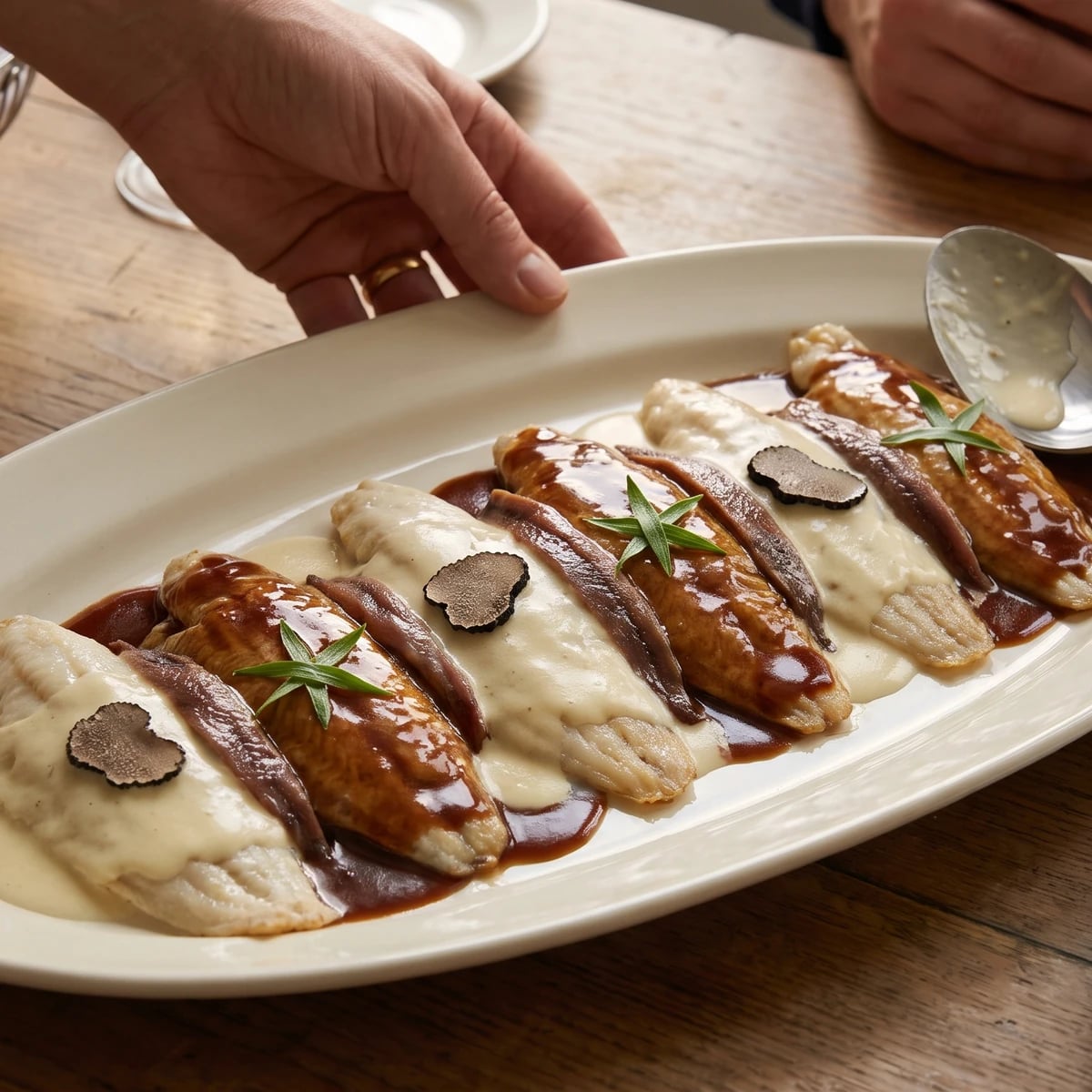
Filets de Soles Mirabeau
Created by Chef Juliette
Two sauces, one delicate fish, and no place to hide: flat-poached sole arranged white against brown, sharpened by anchovy and marked with truffle and tarragon for the dinner table.
Filets de Soles Mirabeau (sole fillets in alternating white and brown sauces) teaches orchestration. Both sauces must be finished, warm, and ready to coat before the sole enters its fumet, the concentrated fish stock used for poaching. Sole waits for no saucier.
The original assumed a poissonnier handling whole fish, a saucier on staff, and fumet never off the fire. Your kitchen offers eight market-cut fillets, two small saucepans, and one shallow roasting pan. We keep the finished White Wine Sauce and Genevoise Sauce as separate canonical preparations, then poach and dress the fish in one pass. What changed is the portion and choreography, not the flavor or sequence. The brigade's coordinated hands were scaffolding; white against brown, anchovy between the fillets, truffle on white, and tarragon on brown are the dish, so every one stays. One cook, one stove, one evening.
When it lands correctly, the platter reads at once: ivory sauce beside glossy mahogany, black truffle against the pale fillets, green tarragon against the dark, with anchovy drawing a savory line between them. Have both sauces at nappant consistency, thick enough to coat a spoon, and the platter warm before the fish meets the fumet. That preparation is the step that decides the dish.
Ingredients
skinless sole fillets
Quantity
8 fillets, about 1¼ pounds / 560 g total
pin bones removed
fine sea salt
Quantity
¾ teaspoon (3.75 ml / 4.5 g)
finely ground white pepper
Quantity
⅛ teaspoon (0.6 ml / 0.3 g)
| Ingredient | Quantity |
|---|---|
| skinless sole filletspin bones removed | 8 fillets, about 1¼ pounds / 560 g total |
| fine sea salt | ¾ teaspoon (3.75 ml / 4.5 g) |
| finely ground white pepper | ⅛ teaspoon (0.6 ml / 0.3 g) |
Where cooking meets culture.
Culinary guides, cultural storytelling, and the editorial depth that makes cooking meaningful.
Discover Culinary Explorer