
Chef Juliette
John Dory (St. Pierre)
John Dory has the delicacy of sole and the firmness of turbot. A light flouring, a quick butter sauté, and nut-brown beurre noisette show exactly why looks never mattered.
A cooking platform built around craft, culture, and the stories behind what we eat.
Created by Chef Juliette
Based on No. 863, Sole Parisienne, from Le Guide Culinaire (1907) by Auguste Escoffier
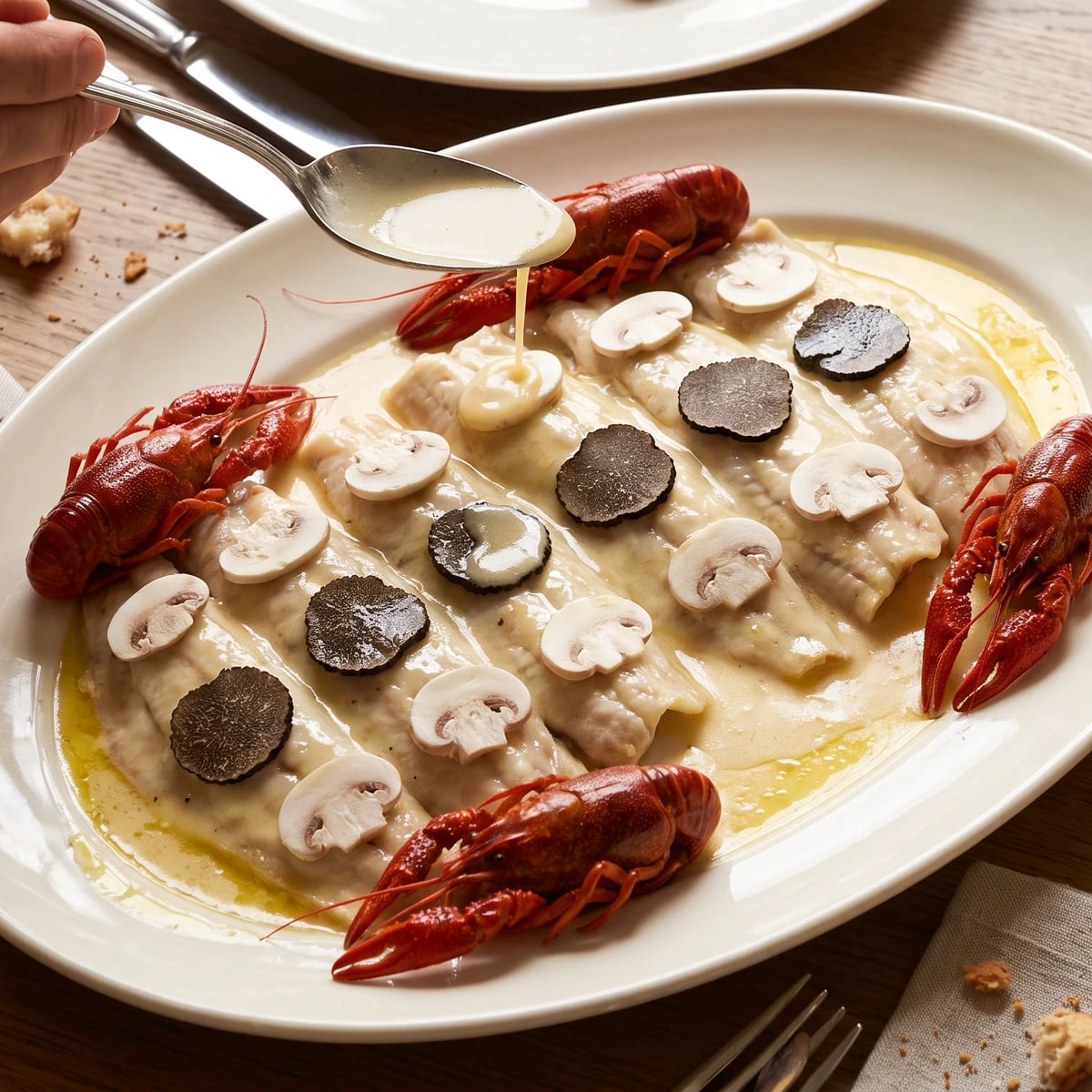
Sole Parisienne teaches the marriage of poaching liquor and finished sauce: tender sole under an ivory gloss, with black truffle, white mushrooms, and red crayfish making a proper occasion platter.
Sole Parisienne (sole with truffle, mushroom, and crayfish) teaches nappage, the even coating of a finished sauce over something delicate. Know this before touching the pan: the poaching liquor is not waste. It is the sole's contribution to the sauce, reduced alone until wine, mushroom, and fish speak clearly, then joined to the White Wine Sauce.
The original entry assumed a saucier beside you, fish stock never off the fire, a fish kettle holding a service-sized whole sole, and live crayfish already trussed. Your home equivalent is eight fillets in a covered sauté pan, a prepared White Wine Sauce from its own recipe, and four cooked whole crayfish whose naturally curled tails need no string. A salamander has no place here because the sauce stays ivory and is never browned. Separate hands, hot silver service, and live-crayfish trussing are brigade scaffolding; the mushroom liquor, white-wine poach, reduction, finished sauce, and exact truffle, mushroom, and crayfish garniture are the dish. One cook, one stove, one evening.
Have the sauce warm and the platter ready before the sole enters the pan. Sole waits badly. The liquid must barely tremble, because a boil contracts the fish before the sauce has a chance to honor it; that gentle poach is the step that decides the whole platter.
Sole Parisienne belongs to the grand Paris kitchen, where Parisienne names a composed garnish rather than a coastal place of origin. Its logic is classical and exact: the sole's cooking liquor is reduced into White Wine Sauce, then black truffle, white mushroom roundels, and red crayfish turn pale fish into a formal city platter. The dish passed naturally to bourgeois occasion tables because its ceremony is visible, while its flavor still rests on the thrifty practice of returning every drop of cooking liquor to the sauce.
Quantity
8 fillets (about 1½ lb / 680 g), each 3 to 3½ oz (85 to 100 g)
pin bones removed
Quantity
About 3 cups whole (710 ml / 225 g)
wiped clean
Quantity
1 cup plus up to 2 tablespoons (240 to 270 ml / 240 to 270 g)
divided, with the extra reserved for sauce rescue
Quantity
1 tablespoon (15 ml / 15 g)
Quantity
3 tablespoons (45 ml / 42 g)
divided
Quantity
1¼ teaspoons (6 ml / 7 g)
divided
Quantity
¼ teaspoon (1 ml / 0.5 g)
Quantity
1 cup (240 ml / 240 g)
Quantity
1½ cups (360 ml / about 375 g)
held warm
Quantity
1 small truffle (about ¾ oz / 20 g)
cut into exactly 6 thin rounds
Quantity
4 (about 6 oz / 170 g total)
shells and claws intact
| Ingredient | Quantity |
|---|---|
| skinless sole filletspin bones removed | 8 fillets (about 1½ lb / 680 g), each 3 to 3½ oz (85 to 100 g) |
| small white button mushroomswiped clean | About 3 cups whole (710 ml / 225 g) |
| waterdivided, with the extra reserved for sauce rescue | 1 cup plus up to 2 tablespoons (240 to 270 ml / 240 to 270 g) |
| fresh lemon juice | 1 tablespoon (15 ml / 15 g) |
| unsalted butterdivided | 3 tablespoons (45 ml / 42 g) |
| fine saltdivided | 1¼ teaspoons (6 ml / 7 g) |
| finely ground white pepper | ¼ teaspoon (1 ml / 0.5 g) |
| dry white wine | 1 cup (240 ml / 240 g) |
| prepared White Wine Sauceheld warm | 1½ cups (360 ml / about 375 g) |
| black truffle, fresh or whole preservedcut into exactly 6 thin rounds | 1 small truffle (about ¾ oz / 20 g) |
| medium whole cooked crayfishshells and claws intact | 4 (about 6 oz / 170 g total) |
Choose two broad mushroom caps and cut three fine roundels from each, giving you the six the source requires. Halve the remaining mushrooms. Put all the mushrooms into a small saucepan with 1 cup (240 ml) water, the lemon juice, 1 tablespoon butter, and ¼ teaspoon salt. Cover and cook at a gentle simmer for 5 to 6 minutes, just until the mushrooms yield their liquor but remain very white. Lift out the six roundels and keep them moist beneath a piece of parchment. Strain the cooking liquor through a fine sieve and reserve every drop; the remaining mushroom pieces have done their work here, so save them for an omelette or soup. Bring the prepared White Wine Sauce near a bare simmer, cover its surface, and hold it warm.
Set a rack in the center of the oven and heat it to 325°F (165°C). Butter a 12-inch (30 cm) shallow sauté pan with 1 tablespoon butter. Fold each fillet once with the former skin side inward, then arrange them snugly in one layer. Season with the remaining salt and white pepper. Pour the wine and strained mushroom liquor around the fish, then dot the tops with the final tablespoon of butter. Cover the surface directly with parchment and put on the lid. Warm over medium-low heat only until the liquid quivers at the edge, then transfer the pan to the oven for 7 to 10 minutes. The poach must barely tremble; if it begins boiling, lift the pan out at once, uncover it for thirty seconds, and finish at a lower oven temperature. Ça se rattrape, provided you stop the boiling promptly. The sole is ready when it is pearly and opaque at the thickest fold, yet still yields in moist flakes under gentle pressure.
Warm an oval serving platter. Lift each folded fillet with a broad fish spatula, pause over the pan so excess liquor falls back, and arrange the sole on the platter. Tilt the platter slightly and wick away any pooling liquid at its edge with a clean towel without touching the fish. Cover loosely with parchment and hold near the stove for no more than 8 minutes. Strain the poaching liquor into a clean 2-quart (2-liter) saucepan. Draining thoroughly matters because stray liquid beneath the fish would thin the nappage the moment it reaches the platter.
Boil the strained poaching liquor briskly and uncovered until about ½ cup (120 ml) remains, usually 8 to 12 minutes. Taste as it approaches ¾ cup (180 ml): reduction should intensify the sole, wine, and mushroom, not turn them saline. If it slips too far and tastes harsh, add the reserved warm water a tablespoon at a time until balance returns. Ça se rattrape. This reduction is not brigade decoration or an optional flourish; it is the bridge between the poached fish and the prepared sauce.
Whisk the reduced liquor gradually into the warm White Wine Sauce, letting each addition disappear before the next. Hold the combined sauce at a bare simmer for 1 to 2 minutes, never a hard boil, until it naps the back of a spoon in an even ivory coat. If it tightens too far, whisk in a teaspoon of warm water; if it remains thin, simmer it gently for another minute. Should an oily edge appear, take the pan off the heat and whisk in a teaspoon of cold water until the sauce comes together again. Keep it covered while you dress the platter.
Set the cooked crayfish beside the warm platter for a few minutes to lose their chill. Spoon the sauce generously over every fillet, coating rather than drowning the fish. Arrange the six black truffle rounds in one precise row and the six white mushroom roundels in a parallel row. Set the four whole crayfish around the sole with their curled tails facing inward and their red shells fully visible. No parsley, no lemon wedges, no extra ornament. The black truffle, white mushrooms, ivory sauce, and red crayfish complete the dish exactly as intended. Serve immediately. À table!
1 serving (about 325g)
Culinary guides, cultural storytelling, and the editorial depth that makes cooking meaningful.
Discover Culinary Explorer
Chef Juliette
John Dory has the delicacy of sole and the firmness of turbot. A light flouring, a quick butter sauté, and nut-brown beurre noisette show exactly why looks never mattered.

Chef Juliette
Fresh haddock proves its delicacy in the meunière pan: a fine flour crust, moist pearly flakes, and beurre noisette sharpened with lemon and parsley, ready from one skillet in half an hour.

Chef Juliette
Éperlans à l’Anglaise turns small fish into a lesson in disciplined coating: boned smelts under a close, crisp crumb, pan-fried in clarified butter and finished with bright, half-melted maître d’hôtel butter.

Chef Juliette
Tiny smelts, shallot, mushrooms, white wine, gratin sauce, and fine bread raspings meet a fierce oven, where the fish must turn tender in the same breath the buttered crust bronzes.