
Chef Juliette
Bouillabaisse à la Marseillaise
Marseille's great fish stew, saffron-gold and garlic-scented, proves that a hard boil can be the careful choice: it binds olive oil into broth before the whole pot meets bread.
A cooking platform built around craft, culture, and the stories behind what we eat.
Created by Chef Juliette
Based on No. 715, Potage à l’Aurore, from Le Guide Culinaire (1907) by Auguste Escoffier
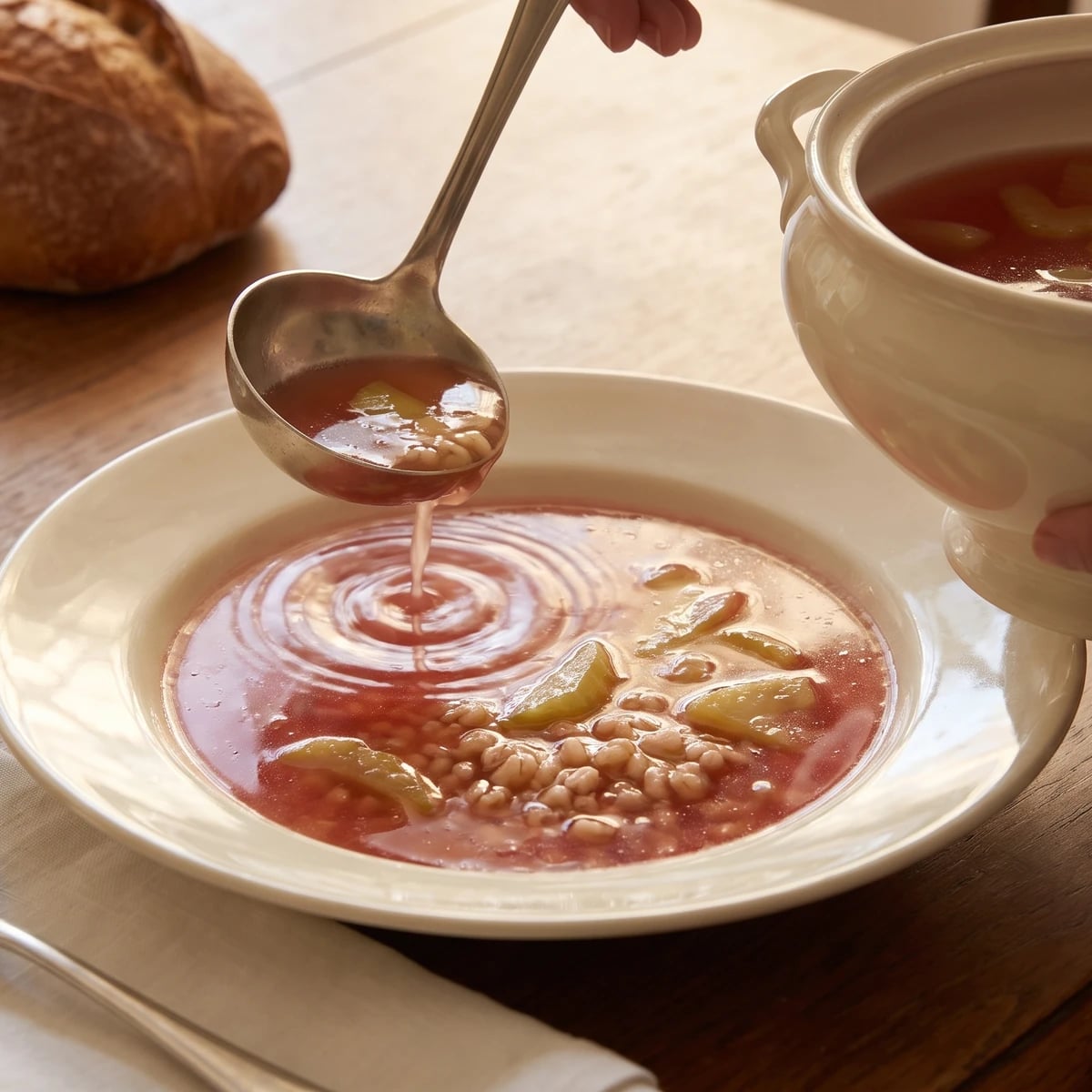
Potage à l’Aurore turns pearl barley and consommé into a lucid, dawn-red soup, its five-hour simmer kept gentle and its buttery paysanne celery folded in only at the finish.
Potage à l’Aurore (dawn-tinted pearl barley soup) teaches quiet heat. Its pearl barley must become perfectly tender while the surrounding liquor stays lucid, ready to take the rosy color of tomato without turning muddy. The one true thing to know before touching the pan is this: five hours are for softening the grain, not boiling it into submission. Barely simmer, skim every skin, and resist unnecessary stirring.
The original assumed a saucier watching the surface, a consommé stockpot never off the fire, and muslin waiting beside a succession of clean stewpans. A salamander has no work here; all the heat comes gently from below. Your honest equivalent is a heavy saucepan on the smallest burner, measured consommé, a fine-mesh sieve, and a shallow spoon kept beside the stove. The source’s quarter-pound of barley and two quarts of initial liquid already make the right home pot, so I have kept that ratio and measured only the finishing consommé the original left to the cook’s judgment. One cook, one stove, one evening.
Muslin and the separate stock station are brigade scaffolding, so they can go. Washing the barley, skimming its surface, transferring it away from the residue, and cooking the celery separately in butter are the dish and must stay. Wash until the runoff is only faintly cloudy, then set your smallest flame; clarity is won before the tomato ever enters the pot.
Potage à l’Aurore belongs to the formal Parisian repertoire, where a poetic name often described a dish’s appearance rather than its birthplace. Aurore means dawn, and here it names the rosy light made by passing vivid tomato purée into clear barley liquor, not a Provençal origin or a regional tomato soup. The method carries a household grain pot into the grand kitchen through consommé, patient skimming, and celery cut paysanne.
Quantity
½ cup plus 1 tablespoon (135 ml / 113 g)
Quantity
4 cups (946 ml / 950 g)
Quantity
4 cups (946 ml / 946 g)
Quantity
1 bundle
6 flat-leaf parsley stems, 1 small leafy celery top, and 6 chervil sprigs tied together
Quantity
¼ cup (60 ml / 65 g)
pressed through a fine-mesh sieve
Quantity
2 tablespoons (30 ml / 18 g)
cut paysanne into very small thin triangles
Quantity
2 teaspoons (10 ml / 9 g)
Quantity
½ cup (120 ml / 120 g)
for cooking the celery
Quantity
Up to 2 cups (475 ml / 475 g)
to replace evaporation
Quantity
as needed
| Ingredient | Quantity |
|---|---|
| fine pearl barley | ½ cup plus 1 tablespoon (135 ml / 113 g) |
| prepared clear consommé | 4 cups (946 ml / 950 g) |
| cold water | 4 cups (946 ml / 946 g) |
| parsley, celery, and chervil herb bundle6 flat-leaf parsley stems, 1 small leafy celery top, and 6 chervil sprigs tied together | 1 bundle |
| thick, vivid red tomato puréepressed through a fine-mesh sieve | ¼ cup (60 ml / 65 g) |
| celerycut paysanne into very small thin triangles | 2 tablespoons (30 ml / 18 g) |
| unsalted butter | 2 teaspoons (10 ml / 9 g) |
| additional clear consomméfor cooking the celery | ½ cup (120 ml / 120 g) |
| boiling water (optional)to replace evaporation | Up to 2 cups (475 ml / 475 g) |
| fine sea salt (optional) | as needed |
Put the pearl barley in a large bowl and cover it generously with cold water. Swirl it with your fingers, drain it through a fine-mesh sieve, and repeat with fresh water until the runoff is only faintly cloudy, usually four or five changes. This washing removes loose surface starch that would otherwise thicken and dull the liquor. Drain well, but do not soak.
Combine the washed barley, 4 cups of consommé, 4 cups of cold water, and the herb bundle in a heavy 4-quart saucepan. Note the liquid level against a wooden spoon or the side of the pan so you can replace only what evaporates. Bring it slowly to the first tremble over medium-low heat, then immediately reduce the burner to its gentlest setting. A few lazy bubbles are enough; a rolling boil releases starch and breaks the clarity you are building.
Cook the barley for five hours at the barest simmer, partially uncovered. As a pale skin gathers on the surface, slide a shallow spoon beneath it and lift it away without churning the pot. Skim whenever it reforms, and once each hour pass a heatproof spatula gently under the barley so nothing catches. Add boiling water as needed to restore the starting level, never flooding the pan with cold water. If the soup boils and clouds, pull it off the heat for ten minutes, lift out the barley with a slotted spoon, and pass the settled liquor through dampened double cheesecloth into a clean pan before returning the grain. Ça se rattrape.
During the final twenty minutes, cut the celery paysanne, here meaning very small, thin triangles, no larger than 1 cm across. Melt the butter in a small covered saucepan over low heat, add the celery, and let it étuver, or stew gently in its own moisture and butter, for five minutes without taking color. Add the remaining ½ cup of consommé and cook at a bare simmer until the triangles are tender but still distinct, about ten minutes. Keep them in their cooking liquor.
Remove and discard the herb bundle. Ladle the tender barley and its clear cooking liquor into a clean saucepan, leaving the last cloudy spoonful and any residue behind rather than pouring the original pan out. Press the thick tomato purée through a fine-mesh sieve directly into the soup and stir only enough to distribute it. The color should be a clear rosy red around the swollen grains, not an opaque brick.
Fold in the butter-stewed celery and its consommé, then warm the potage for five minutes at the gentlest simmer. It should flow freely from the ladle, with barley suspended in ample liquor rather than standing like porridge. If it has tightened, loosen it a little at a time with hot consommé or boiling water. Do not reach for flour, roux, or cream; the source is plain that this excellent soup must not be too thick. Taste before adding salt, since consommé carries its own seasoning.
Warm the soup bowls, then stir once from the bottom and ladle the Potage à l’Aurore so every serving receives pearl barley, clear rosy liquor, and a few celery triangles. Bring it to the table while its surface still holds a fine butter sheen. No extra herb garnish is needed; the parsley and chervil have already given what they came to give. À table!
1 serving (about 240g)
Culinary guides, cultural storytelling, and the editorial depth that makes cooking meaningful.
Discover Culinary Explorer
Chef Juliette
Marseille's great fish stew, saffron-gold and garlic-scented, proves that a hard boil can be the careful choice: it binds olive oil into broth before the whole pot meets bread.

Chef Juliette
Waterzoi asks fresh, bone-in river fish to thicken its own buttery broth, with parsley root and pepper for company. No flour, no stockpot, just a brisk simmer watched closely.

Chef Juliette
Queue de Bœuf en Hochepot gathers oxtail, pig's trotter and ear, cabbage, roots, and grilled chipolatas around a clear, gelatin-rich broth whose quiet simmer keeps every piece tender and distinct.

Chef Juliette
Beef shoulder larded with bacon, sharpened by red wine and vinegar, then sealed with garlic, vegetables, and dry lemon peel until the low oven turns it yielding and the gravy darkly glossy.