Culinary Explorer
A cooking platform built around craft, culture, and the stories behind what we eat.
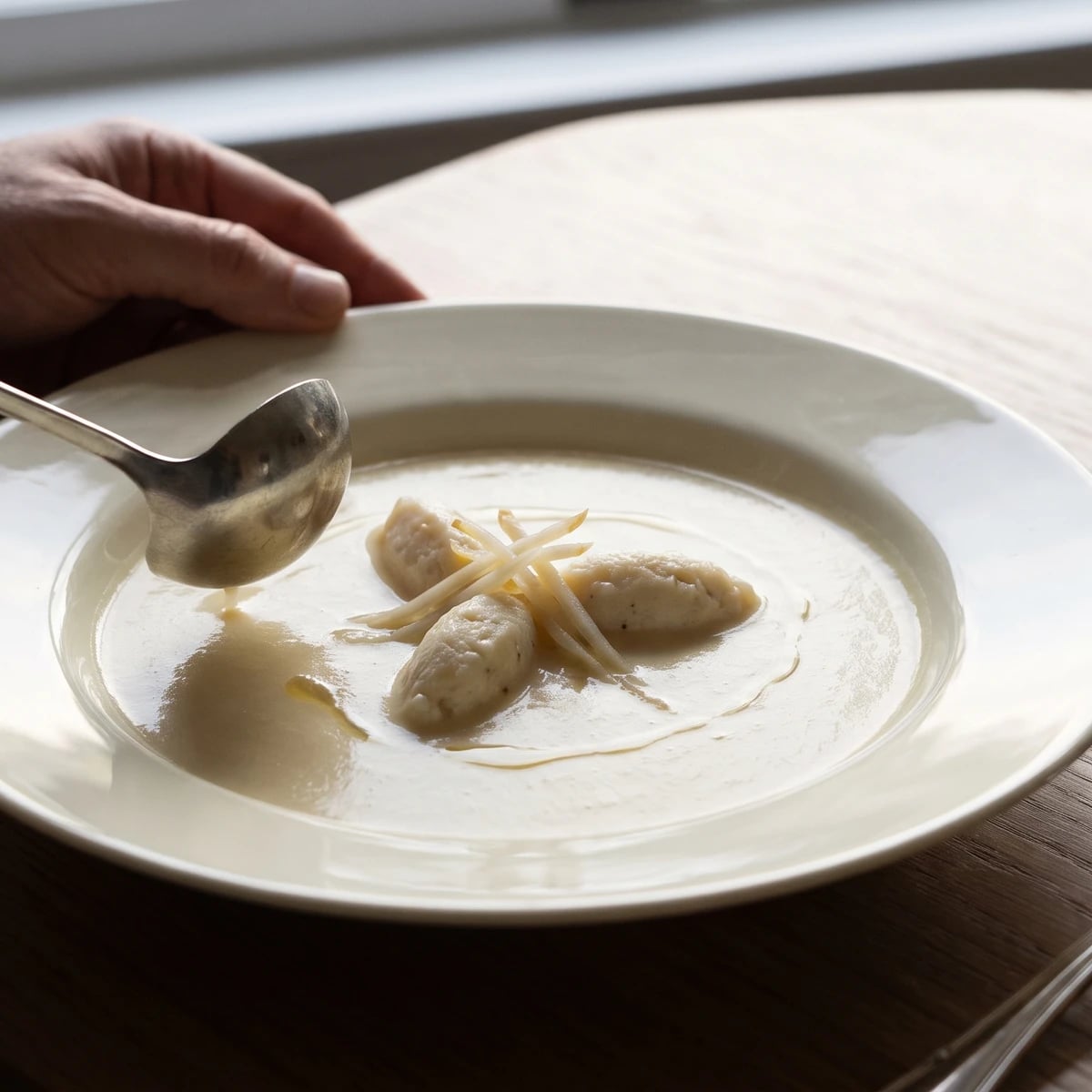
Velouté Carmélite
Created by Chef Juliette
Butter-stewed sole and whiting vanish into a pale fish velouté, then a yolk-and-cream liaison gives it satin, while sole julienne and tiny smelt quenelles restore texture to every spoonful.
Velouté Carmélite (a silken fish soup bound with yolks and cream) teaches the difference between thickness and refinement. The fish is not left as meat in broth. It is stewed softly in butter and lemon, worked into fish velouté, then passed through a sieve until the soup feels like satin. One true thing before you touch a pan: once the liaison enters, the Carmélite must never boil.
The original kitchen assumed a saucier at the pot, fish velouté and consommé never far from the fire, and a broad tammy with hands available to work the soup through it. At home, a blender does the pounding and a fine-mesh sieve does the tammy’s work. This batch carries the source proportions into about two quarts, enough for eight first-course bowls. The mortar and extra hands were brigade scaffolding; the gentle butter stew, fine sieving, liaison, sole julienne, and smelt quenelles are the dish, so they stay. One cook, one stove, one evening.
When it is right, the Carmélite is pale ivory and quietly glossy, tasting first of clean fish, then butter, with lemon present only as brightness. Temper the liaison slowly and keep the heat gentle. If it begins to grain, ça se rattrape, and the rescue is waiting in the method.
Ingredients
prepared fish velouté
Quantity
6 cups (1.42 L / approximately 1.5 kg)
skinless sole fillets
Quantity
8 oz (227 g)
cut into 1-inch (2.5 cm) pieces
skinless whiting fillets
Quantity
8 oz (227 g)
cut into 1-inch (2.5 cm) pieces
| Ingredient | Quantity |
|---|---|
| prepared fish velouté | 6 cups (1.42 L / approximately 1.5 kg) |
| skinless sole filletscut into 1-inch (2.5 cm) pieces | 8 oz (227 g) |
| skinless whiting filletscut into 1-inch (2.5 cm) pieces | 8 oz (227 g) |
Where cooking meets culture.
Culinary guides, cultural storytelling, and the editorial depth that makes cooking meaningful.
Discover Culinary Explorer