Culinary Explorer
A cooking platform built around craft, culture, and the stories behind what we eat.
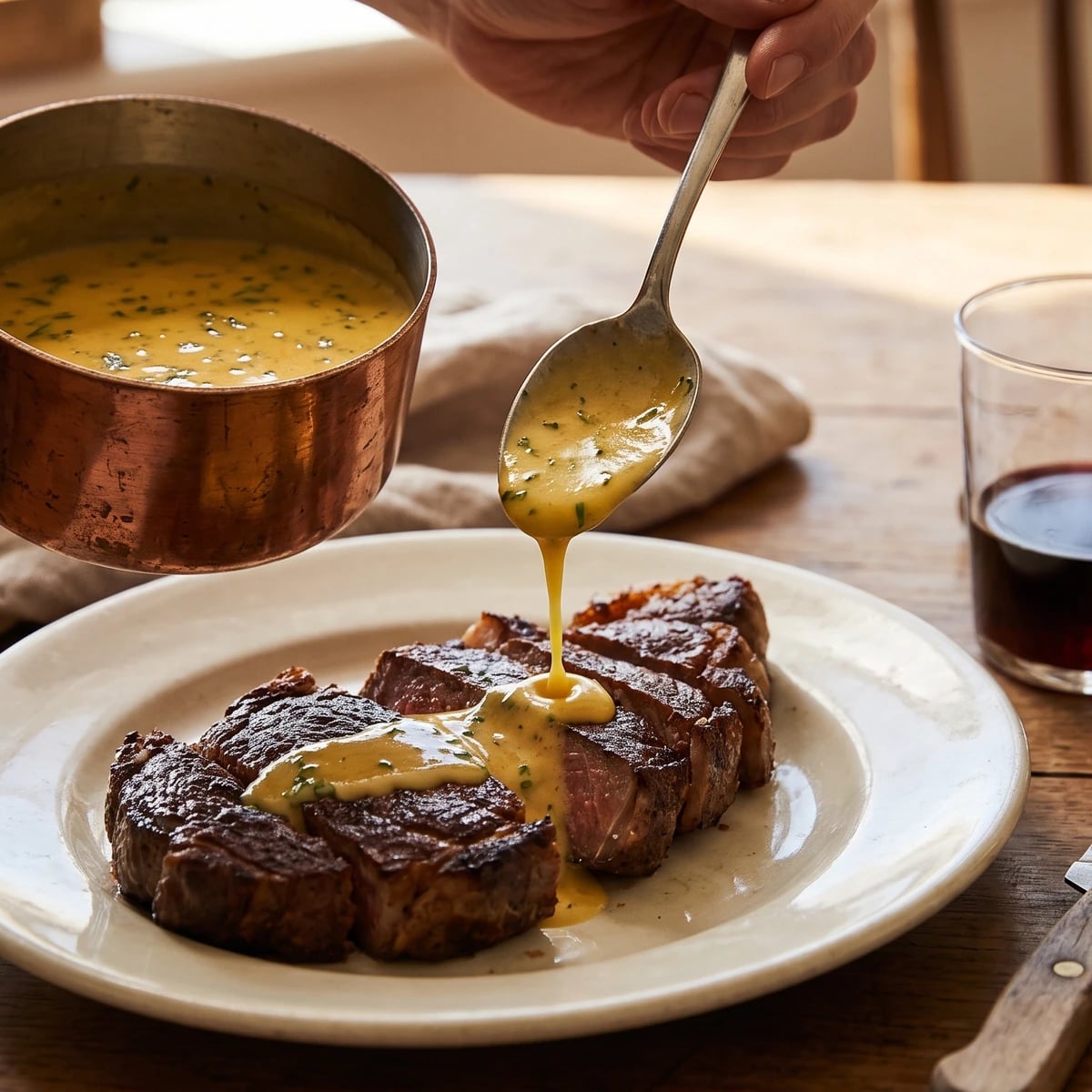
Foyot or Valois Sauce (Béarnaise with Meat Glaze)
Created by Chef Juliette
Sauce Foyot takes a stable, tepid Béarnaise and deepens it with pale meat glaze, spoonful by spoonful. The result is glossy, savory, and strong enough for properly grilled butcher’s meat.
Sauce Foyot, dite aussi sauce Valois (Béarnaise enriched with meat glaze), teaches the discipline of finishing an emulsion without bullying it. The one true thing to know before touching a pan is that the pale meat glaze must meet a stable Béarnaise Sauce (No. 62) at the same tepid temperature. Too hot, it shocks the yolks; too cold, it firms the butter.
The book assumed a saucier on staff and a stockpot never off the fire, so dissolved pale meat glaze was simply waiting. A home kitchen needs neither brigade nor gallon measure: use half a finished home batch of Béarnaise Sauce (No. 62) and half the book’s glaze, preserving its ratio exactly. The separate service setup is scaffolding and can go; the gradual addition is the dish and stays. One cook, one stove, one evening.
When it lands, butter-yellow turns warm ochre, tarragon stays bright, and the sauce falls in a glossy ribbon that can meet a grilled steak without disappearing beneath it. Add the glaze a teaspoon at a time, whisk each addition smooth, and never put the finished sauce over direct heat. That slow meeting is the one step that decides Foyot.
Ingredients
Béarnaise Sauce (No. 62)
Quantity
½ batch, about ⅔ cup (160 ml / 160 g)
freshly made and tepid
dissolved pale meat glaze
Quantity
1½ tablespoons (22.5 ml / 23 g)
tepid and fluid
warm water (optional)
Quantity
2 teaspoons (10 ml / 10 g)
for rescuing or loosening the emulsion
| Ingredient | Quantity |
|---|---|
| Béarnaise Sauce (No. 62)freshly made and tepid | ½ batch, about ⅔ cup (160 ml / 160 g) |
| dissolved pale meat glazetepid and fluid | 1½ tablespoons (22.5 ml / 23 g) |
| warm water (optional)for rescuing or loosening the emulsion | 2 teaspoons (10 ml / 10 g) |
Where cooking meets culture.
Culinary guides, cultural storytelling, and the editorial depth that makes cooking meaningful.
Discover Culinary Explorer